CBSE Class 12 Chemistry 2025 Supplementary Paper with Solutions
CBSEChemistry2025 Previous Year Paper
Paper code: 56/S/3 · 2025Practise with the full English version of the 2025 CBSE Class 12 Chemistry supplementary paper, Set 3 (56/S/3). Use the worked solutions after your attempt to check not just your final answers, but also your choice of method, use of conditions and written reasoning.
This set is one of the year's papers. See every set from 2025, grouped by series.
What’s in the 2025 paper
This year-wise resource contains the full supplementary paper, rather than a set of questions grouped by chapter. It preserves the original English question layout, options and diagrams. The paper has 33 questions for 70 marks, with three hours of writing time and a separate 15-minute reading period. Calculators are not allowed. The file pairs the question paper with worked solutions, including both branches of printed internal choices.
The paper is useful for seeing how a concept changes with the format of the question. Electrochemistry, for instance, appears through a question about a conductivity cell, an explanation involving dilution and a calculation of cell emf. Each asks you to do something different with related material: recognise a feature of an instrument, explain a trend or calculate a quantity under stated conditions.

Chemistry Supplementary 2025 | Class 12 | Previous Year Paper | Code 56/S/3
In the StudentCurio app
A complete 2025 CBSE Class 12 Chemistry supplementary examination paper with worked solutions. It covers questions across the syllabus, helping students practise the board-exam format and review solution methods.
Five sections, five kinds of response
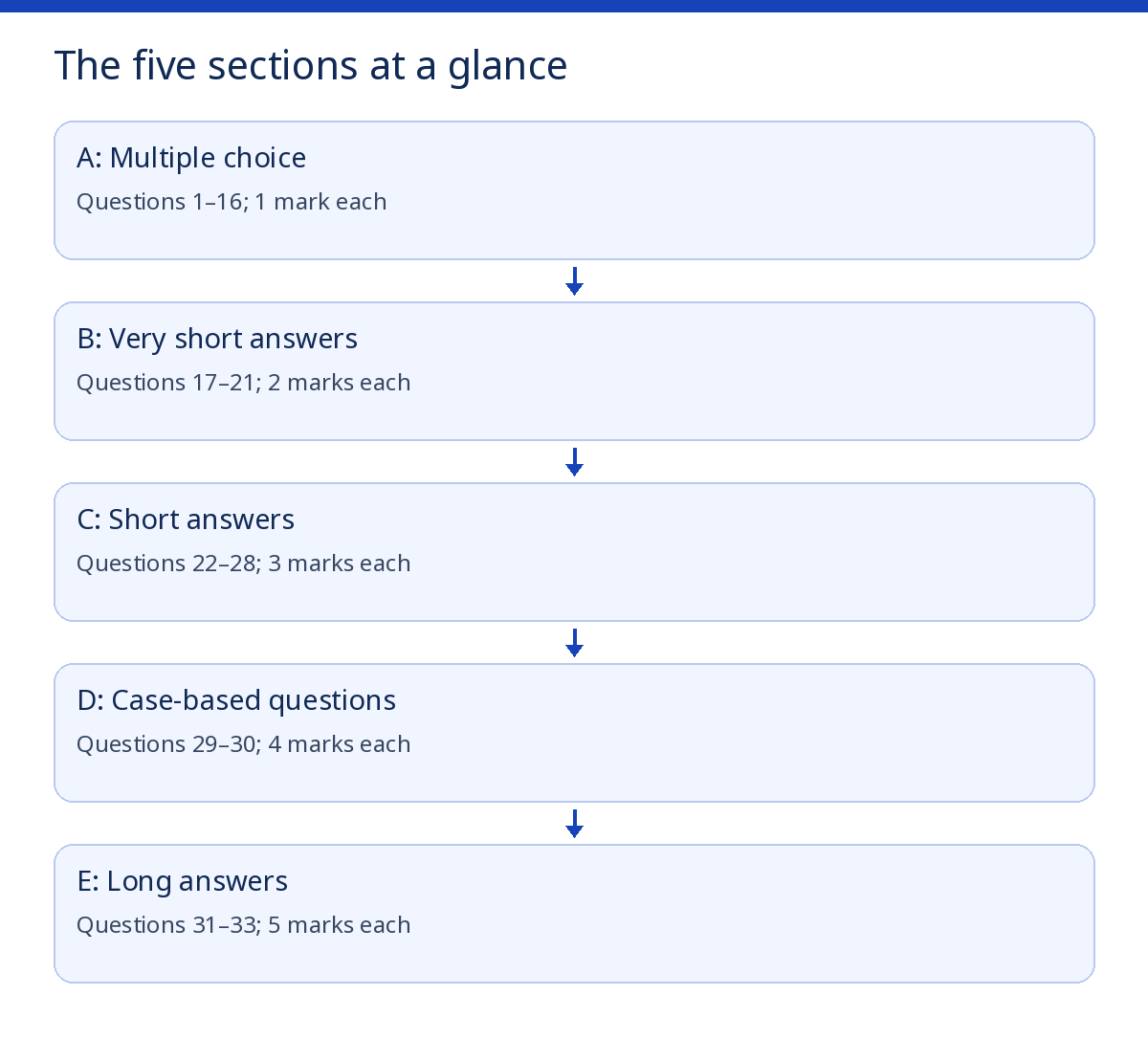
Section A contains 16 one-mark multiple-choice questions, including four assertion–reason items. Section B has five two-mark very short answers, and Section C has seven three-mark short answers. Section D contains two four-mark case-based questions. Section E has three five-mark long answers, which can divide their marks among subparts.
There is no overall choice, but some questions in Sections B through E offer an internal choice. During a timed attempt, read the scope of each OR before writing: it may replace one subpart rather than the entire question. Use the marks and command words together. A definition calls for a precise statement; an instruction to justify or give reasons calls for the chemical link between what is given and what you conclude. For assertion–reason items, check each statement separately before deciding whether the reason explains the assertion.
When a physical chemistry rule applies
The paper covers gas solubility, first-order half-life, electrochemical cells and colligative properties. In each case, identify the condition that makes a rule relevant. In the form of Henry’s law used here, , where is the gas’s partial pressure and is its mole fraction in solution. For a comparison at the same temperature and partial pressure, a smaller corresponds to a larger dissolved mole fraction.
The half-life relation is specific to a first-order reaction. If the half-life is expressed in seconds, the rate constant from this relation is in inverse seconds. In electrochemistry, distinguish conductivity from molar conductivity: the dilution question asks about the latter. For the cell-emf calculation, distinguish the given standard emf from the emf at the stated concentrations. In the boiling-point elevation problem, compare the solution’s boiling point with that of the pure solvent at the same external pressure.
Organic chemistry: track the structure and the conditions
The organic questions move between explaining properties, predicting reactions, proposing conversions and distinguishing compounds by a chemical test. Phenol acidity, carbonyl addition and amine chemistry are among the topics represented. When a prompt asks for a reason, naming an effect is only the start: explain what that effect changes in the molecule or intermediate and how that change accounts for the comparison.
For a reaction sequence, mark the clue supplied by each reagent or observation before committing to a structure. Then check that the proposed structure fits the other steps too. For a distinguishing test, write what you would observe for each compound rather than stopping at the reagent’s name. The worked notes flag ambiguity in the printed Lucas-reagent item; use that note to understand why the wording and reaction conditions matter rather than treating the item as a universal classification rule.
Case-based questions: separate evidence from theory
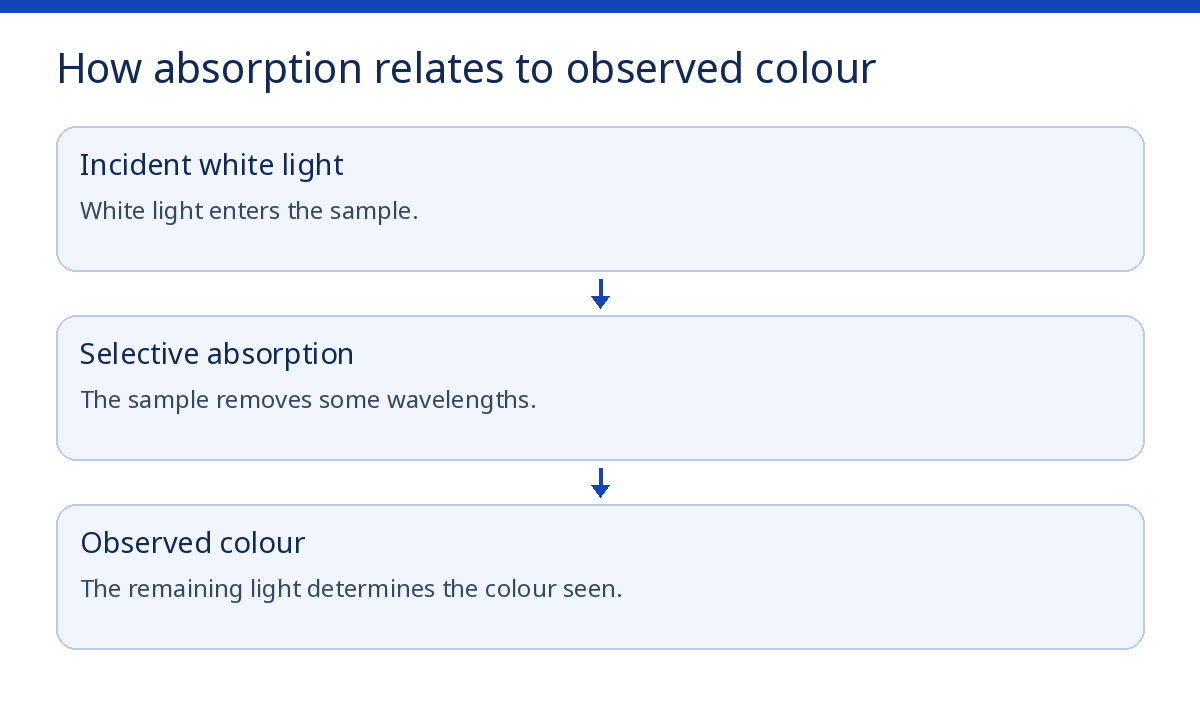
The coordination-compound case gives a table with separate columns for the wavelength absorbed, the colour absorbed and the colour observed. Keep those columns distinct: the observed colour is associated with the light that remains, not the light removed from the incident beam. A task about wavelength can be approached by locating the relevant entries, while a task about crystal-field splitting requires a concept that goes beyond reading the table.
The second case uses a nutrition passage to frame questions on biomolecules. Its subparts ask about carbohydrate functions, monosaccharides and related syllabus knowledge. Read the specific subpart before returning to the passage: a table or paragraph can supply context without supplying the definition or explanation the question requests.
Review the method before checking the answer
Use the reading period to scan the five sections and locate internal choices, then attempt the paper without opening the worked solutions. For calculations, leave your setup and units visible. For explanations, write the reason even when the conclusion seems obvious. This gives you something more useful to compare than a set of final answers.
The worked pages separate the formula used, concept used and explanation in steps. Compare your work in that order to identify whether you chose the wrong rule, missed a condition or made an error applying a correct method. Check the unused OR branch afterwards as a separate practice task. For this guide, the numerical kinetics example in Q28 and any results derived from its inconsistent printed data are omitted, as is the bracketed nickel datum in Q25(b). Neither is needed to review the paper’s other kinetics or coordination chemistry topics.
Spotted an error? Report a correction. Practise this in the app: notes, formula sheets and mind maps.















































































































































Loading comments…