CBSE Class 12 Chemistry: 2024 Supplementary Paper
CBSEChemistry2024 Previous Year Paper
Paper code: 56/S/2 · 2024Practise with the full 2024 CBSE Class 12 Chemistry supplementary theory paper (Set 2, code 56/S/2). Use the worked solutions to check not just what you got wrong, but where your reasoning or calculation went off track.
This set is one of the year's papers. See every set from 2024, grouped by series.
What this year-wise paper contains
This file pairs the English question paper with worked solutions. It is organised by exam year rather than by chapter, so you can practise switching between organic, inorganic and physical chemistry in the order the paper presents them. The questions include calculations, reaction writing, explanations of chemical behaviour and case-based interpretation.
The paper carries 70 marks and allows three hours of writing time. The title page also specifies a separate 15-minute reading period, during which candidates do not write answers. Calculators are not allowed. The file preserves the question layout, options and diagrams, and provides links between questions and solutions. For a timed attempt, stay in the question-paper portion so that the solution links do not interrupt your reasoning.

Chemistry Supplementary 2024 | Class 12 | Previous Year Paper | Code 56/S/2
In the StudentCurio app
A solved CBSE Class 12 Chemistry supplementary examination paper for 2024, with questions and worked solutions spanning organic, inorganic and physical chemistry. Helps students practise the board-exam format and review solution methods.
How the five sections change what you write
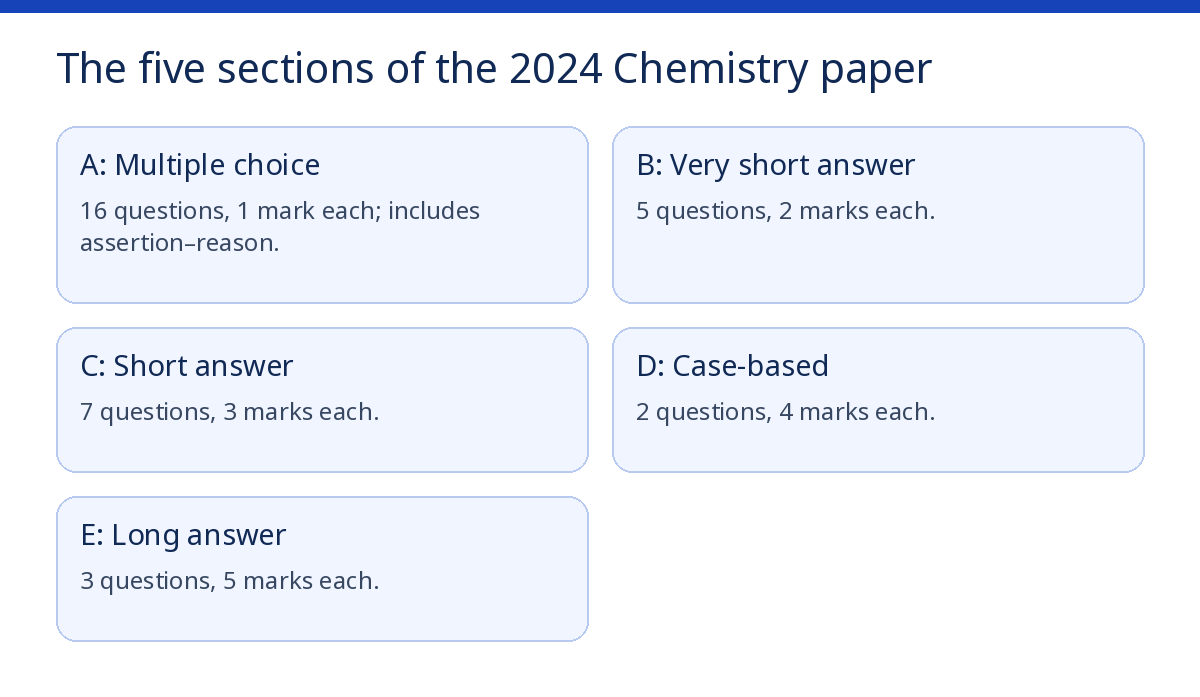
Section A contains 16 one-mark multiple-choice questions, including four assertion–reason items. Section B has five two-mark very short answers, and Section C has seven three-mark short answers. Section D contains two four-mark case-based questions, while Section E has three five-mark long-answer questions. There are 33 questions in all.
There is no overall choice. Internal choices appear in some questions outside Section A, so follow the direction printed in each question rather than skipping an entire numbered item. Where the paper says “any three” or “any five,” count the required responses before moving on. In long answers, keep the subpart labels visible: one question can ask for several different things, such as an explanation, an equation and a calculation. A correct equation does not replace an explanation when the prompt asks for both.
Physical chemistry: identify the quantity first
The physical chemistry questions draw on kinetics, solutions and electrochemistry. In kinetics, the paper asks you to interpret how rate depends on concentration and to work with a stated first-order process. In a decomposition calculation, distinguish the amount that has reacted from the amount that remains. The first-order expression uses the concentration remaining at time and applies when the process follows first-order kinetics with a constant over the interval considered.
The solutions questions connect vapour pressure and boiling-point changes to different pieces of information about the solute. In electrochemistry, identify whether the prompt asks for resistance, resistivity, conductivity or molar conductivity before substituting values. They are distinct quantities, and the units are a practical way to check that you have reached the one requested.
When a chemical rule applies
In the organic questions, the reaction conditions are part of the information you must use. Reagents, solvent and subsequent treatment can all matter, so read the whole reaction line before drawing a product. When comparing amine basicity, check the phase specified: a gas-phase comparison does not include the solvation effects that can influence an aqueous comparison. Likewise, a chemical test calls for an observable distinction between the two given compounds, not simply the name of a familiar reaction.
For coordination chemistry, separate the metal’s oxidation state and electron count from the effect of the ligands. The paper uses these ideas to ask about splitting, magnetism and colour. A comparison that holds the metal ion and oxidation state fixed lets you focus on the ligands; it does not establish a universal stability ranking for unrelated complexes.
Case-based questions: use the passage and the command
One case concerns non-ideal solutions and azeotropes; the other concerns nucleic acids. In the solutions case, connect deviations from ideal behaviour to differences in intermolecular interactions. At an azeotropic composition, the liquid and vapour have the same composition, so fractional distillation cannot separate the mixture into its pure components. That limitation is not a claim that all non-ideal mixtures form azeotropes.
In the biomolecules case, distinguish a question about function from one about composition. A description of what DNA does will not answer a question about the products of hydrolysis, and a comparison of DNA and RNA requires a shared basis for comparison. Check the subpart before deciding which details from the passage are relevant.
Quick self-check before opening the solutions
For an assertion–reason item, ask three questions: Is the assertion true? Is the reason true? If both are true, does the reason actually explain the assertion? This last check matters because the paper provides separate choices for two true statements with and without an explanatory link.
For a numerical answer, could you explain why the stated assumptions allow your method, and can you track the units from the given data to the result? For a reaction or conversion, could someone follow the sequence from the starting compound through the reagents and conditions you wrote? Check these points on your own script before looking at the worked steps.
Review the reasoning, not just the final line
The solutions separate the formula or principle, the concept and the worked steps. Compare those parts with your attempt to locate the first difference: a misread condition needs a different correction from an arithmetic slip. Once you have reviewed your timed attempt, use the worked solutions for the unattempted internal choices as separate practice rather than counting both choices in the original attempt.
The guide leaves out the disputed stability ranking in Q1 and the competing naming options in Q9; the file flags limitations in both items. Neither is a reliable single-answer checkpoint. Use the explanations to review the underlying concepts without treating either item as an unambiguous measure of what you know.
Spotted an error? Report a correction. Practise this in the app: notes, formula sheets and mind maps.















































































































































Loading comments…