CBSE Class 12 Chemistry 2024 Supplementary Paper: Set 3
CBSEChemistry2024 Previous Year Paper
Paper code: 56/S/3 · 2024Use the full 2024 CBSE Class 12 Chemistry supplementary paper (56/S/3) for a timed theory attempt. Then use the worked solutions to check whether you chose the right rule, recognised its conditions and showed enough reasoning.
This set is one of the year's papers. See every set from 2024, grouped by series.
Know the format before you start
This year-wise resource contains the English version of Set 3, with the original question layout, options and diagrams. The theory paper has 33 questions for 70 marks and allows three hours of writing time. The printed instructions also specify a separate 15-minute reading period during which candidates do not write answers. Calculators are not allowed.
Section A has 16 one-mark questions, including assertion–reason items. Section B has five two-mark very short answers, and Section C has seven three-mark short answers. Section D has two four-mark case-based questions, followed by three five-mark long answers in Section E. All numbered questions are compulsory, but some questions outside Section A offer internal choices. Check whether the choice replaces an entire branch or only a subpart.

Chemistry Supplementary 2024 | Class 12 | Previous Year Paper | Code 56/S/3
In the StudentCurio app
Complete solved CBSE Class 12 Chemistry supplementary examination paper for 2024, covering questions across organic, inorganic and physical chemistry. Helps students practise board-exam questions and review worked answers.
Physical chemistry: choose the model before calculating
The paper tests chemical kinetics, solutions and electrochemistry. In kinetics, a comparison of rates at different concentrations asks how rate depends on concentration. A timed decomposition problem instead asks how concentration changes over time. Use the integrated first-order law only when first-order behaviour is given or established, and distinguish the fraction remaining from the fraction already decomposed.
In electrochemistry, keep resistance, resistivity, conductivity and molar conductivity distinct. Using a cell constant in inverse centimetres gives conductivity in siemens per centimetre when resistance is in ohms; the concentration convention must then match the units used for molar conductivity. For a boiling-point elevation problem involving an electrolyte, check the stated assumption about ionisation before choosing a particle-count factor. The calculation depends on that assumption.
Organic chemistry: let the structure guide the explanation
The organic questions move between naming compounds, distinguishing them by chemical tests, explaining properties and writing reactions or conversions. These tasks require different evidence. For naming, identify the parent chain before assigning locants. For a distinguishing test, name the test and give contrasting observations for the two compounds. For a conversion, show the intermediate structures when more than one step is needed, and place the relevant reagent or condition over each arrow.
The paper also asks you to reason about carbonyl reactivity, carboxylic acid strength and amine basicity. Compare the structural feature that changes rather than relying on a memorised order. For an amine comparison, check the phase named in the question: a gas-phase trend cannot simply be carried over to water, where solvation also matters.
Inorganic chemistry: separate geometry, magnetism and colour
Coordination chemistry appears in both objective and written questions. The paper covers ligand naming, geometry, geometrical isomerism, electron arrangement and colour. Start by identifying the metal’s oxidation state and electron count. Then use the geometry and ligand information relevant to the property being asked about. Unpaired electrons matter for the spin-only magnetic moment, whereas the energy separation between sets of orbitals matters when discussing electronic excitation.
Keep the assumptions visible. An electron arrangement specified for octahedral splitting greater than the pairing energy is not a rule for every complex with the same electron count. Elsewhere, the paper asks for explanations of transition-metal behaviour, including oxidation states and catalysis, and compares contraction across the lanthanoids and actinoids.
Read each case passage with its subparts in mind
The two case-based questions draw on biomolecules and solutions. The nucleic-acids case moves between molecular components, the distinction between DNA and RNA, and structural relationships such as how units are joined. Read the noun in each prompt carefully: a question about a nucleotide is asking about a different level of structure from a question about a strand.
The solutions case combines explanations of non-ideal behaviour with a calculation. Separate the evidence about intermolecular interactions from the numerical data attached to the chosen subpart. The passage links an azeotrope’s equal liquid and vapour compositions to the limit of fractional distillation. In the numerical branch, first identify what was measured: a change in vapour pressure and a change in boiling point call for different relations.
Quick self-check for assertion–reason items
Before looking at the options, decide whether the assertion is true as written, then judge the reason independently. If both are true, ask whether the reason actually accounts for the assertion. Two statements can be correct and concern the same topic without one explaining the other. Section A gives you a chance to practise this distinction across kinetics, inorganic chemistry and biomolecules.
On review, write down which judgement you missed: the assertion, the reason or the link between them. That tells you whether to revisit a fact or practise explaining a cause.
Review the method, not just the final answer
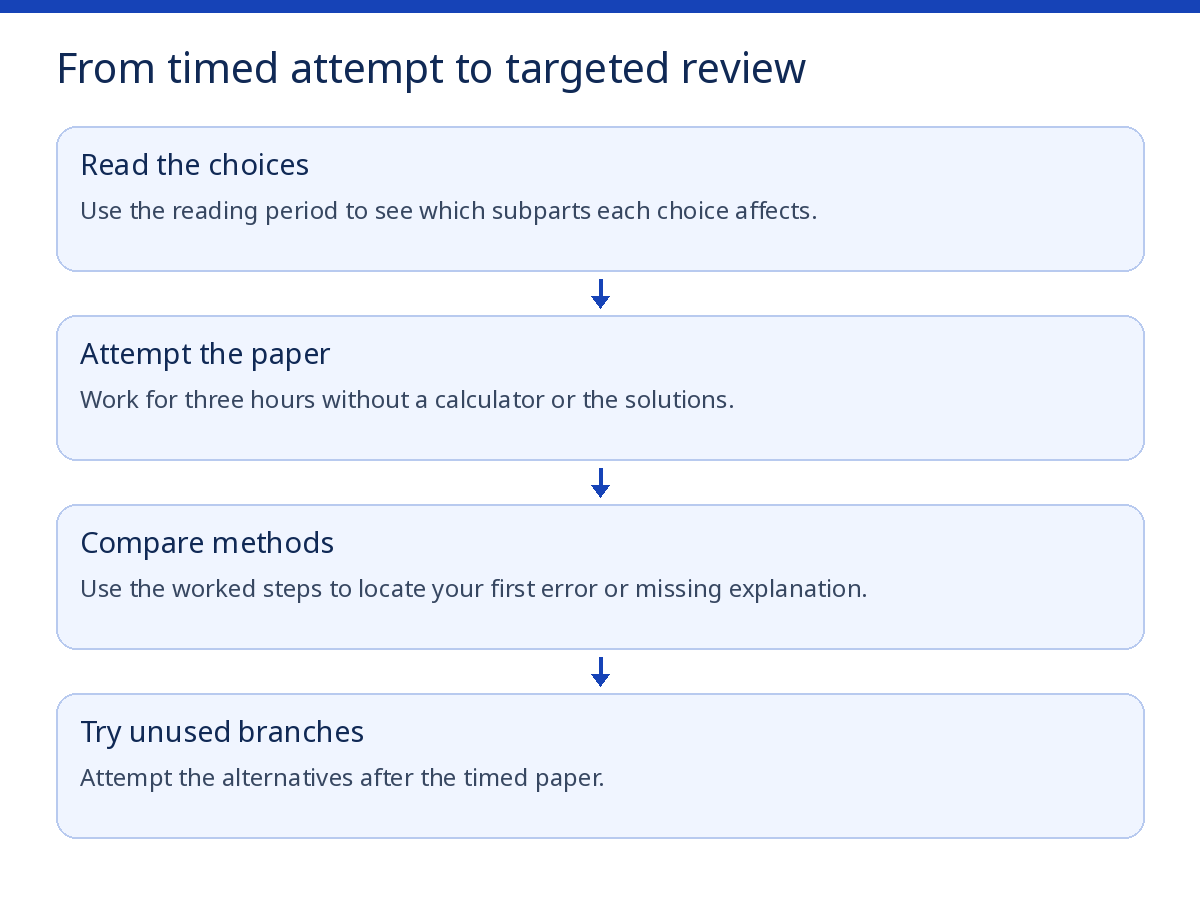
Make your first attempt without opening the worked solutions, following the printed internal choices. Afterward, use the question-number links to compare your approach with the resource’s formula, concept and step-by-step explanation. In a numerical response, find the first place where your setup, units or reasoning diverged. In a written response, check whether you explained the observation rather than merely restating it. Try the unused OR branches separately so they serve as extra practice without changing the conditions of your first attempt.
Two items are left out of this guide’s review: the electrode-potential item, where the supplied question and solution text disagree about the printed nickel sign, and the complex-stability item, where the worked solution notes that the conditions for an unconditional ranking are not specified.
Spotted an error? Report a correction. Practise this in the app: notes, formula sheets and mind maps.















































































































































Loading comments…