CBSE Class 12 Chemistry Supplementary Paper 2024
CBSEChemistry2024 Previous Year Paper
Paper code: 56(B)/S · 2024Use this full, year-wise CBSE Class 12 Chemistry supplementary paper to practise five board-exam question formats. The guide explains how to attempt the adapted 2024 paper, review the worked solutions and handle questions whose wording needs care.
This set is one of the year's papers. See every set from 2024, grouped by series.
What this 2024 supplementary paper contains
This English-language resource contains the full Chemistry theory paper identified by question paper code 56(B)/S, Set 5. The reproduced CBSE title page identifies it as the paper for visually impaired candidates only; the resource cover describes the file as an adapted paper. Treat it as practice with this specific supplementary set, not as a chapter-wise worksheet or a guide to what another CBSE set will ask.
The question paper comes before the worked solutions. The cover links to individual question numbers and states that the solutions cover every question and subpart, including both branches of printed OR choices. The solution pages separate the formula or rule, the underlying concept and the explanation. You can therefore check how an answer was reached rather than just whether it matches.

Chemistry Supplementary 2024 | Class 12 | Previous Year Paper | Code 56(B)/S
In the StudentCurio app
Complete CBSE Class 12 Chemistry supplementary examination paper with worked solutions, covering questions across multiple Chemistry chapters and question formats. Helps students practise board-exam questions and review their solutions.
How the 70 marks are distributed
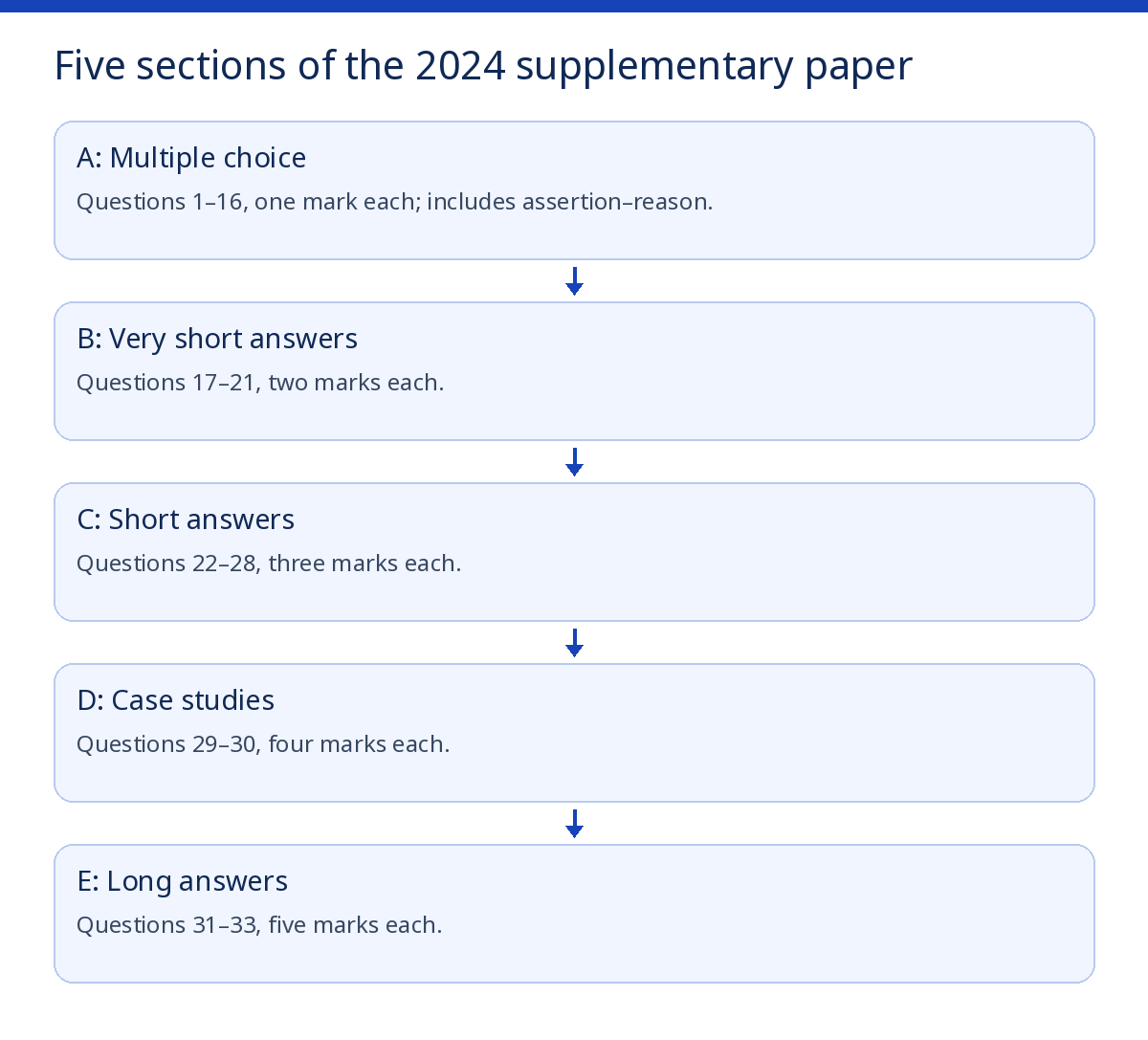
The paper has 33 questions across five sections. The writing time is three hours, with a separate 15-minute reading period on the title page. Calculators are not allowed.
- Section A: Q1–Q16 are one-mark multiple-choice questions. Q13–Q16 use the assertion–reason format.
- Section B: Q17–Q21 are two-mark very short answers.
- Section C: Q22–Q28 are three-mark short answers.
- Section D: Q29–Q30 are four-mark case studies.
- Section E: Q31–Q33 are five-mark long answers.
There is no overall choice: you cannot drop an entire question because you prefer another. Instead, follow each local instruction. An OR gives alternative branches, while an instruction such as “attempt any five” tells you how many listed parts to answer. Use the reading period to mark these decisions before beginning the timed attempt.
Physical chemistry: identify the quantity before calculating
The physical chemistry questions move between explanations, numerical work and a cell-based case study. In Solutions, the paper tests Henry’s law, deviations from Raoult’s law, the van’t Hoff factor and freezing-point depression. A useful distinction is that a Henry’s law comparison holds temperature fixed for the specified gas and solvent, while a freezing-point calculation uses molality, based on the mass of the solvent rather than the mass of the whole solution. When using ion counts to interpret a van’t Hoff factor, check that complete dissociation is the assumption.
Electrochemistry asks you to distinguish conductivity from molar conductivity and to interpret electrode potentials and cell notation. The case study brings in the Nernst equation, where concentrations matter. Chemical Kinetics shifts the focus from whether a reaction is spontaneous to how fast it proceeds, using rate laws, mechanisms and the temperature dependence of the rate constant.
Organic chemistry: distinguish a reagent from its role
Organic questions ask for reagents, products, named reactions and explanations of trends. The paper includes phenol reactions, transformations of aldehydes and ketones, amine preparation and basicity, and comparisons of carboxylic acid strength. It also asks you to distinguish substitution mechanisms and define stereochemical terms. These tasks call for different kinds of answers: naming a reagent does not explain a reactivity order, and recalling a reaction name does not by itself identify the starting functional group or the transformation.
Before reviewing a conversion, mark the functional group and read the full reagent sequence. A treatment followed by a separate workup is not the same as a single reaction step. For a basicity comparison, note the medium specified: in water, electron donation is not the only consideration because hydration of the conjugate acid also matters.
Inorganic chemistry and the case studies
Coordination chemistry appears through ligand terminology, the chelate effect, nomenclature, orbital occupancy and the ions a complex salt produces in solution. Keep the species inside the coordination brackets separate from the counterions outside them. That distinction helps you decide what remains coordinated and what is released as an ion on ordinary dissolution. The paper also asks for reasons behind properties of transition elements and comparisons involving the lanthanoids and actinoids, so rehearse the link between a stated property and its explanation.
The two case studies draw on amino acids and electrochemistry. Read each subpart as a separate task: the passage supplies context, but a definition, a comparison and an equation require different responses. Check whether the question asks you to draw on the passage alone or to apply a concept to the system described.
When a comparison needs a condition
A worked solution can flag a limitation in the question without settling every possible reading. The iodoform item uses an alcohol name without specifying the position of the hydroxyl group. The nitrobenzene reduction item uses comparative wording even though more than one listed method can work under suitable conditions. The complex-stability item does not supply the conditions or formation data needed for an absolute ranking, and the nitrophenol assertion–reason explanation depends on an intended reading of the hydrogen-bonding statement.
This guide leaves out the answer selections for those four items. During review, separate the underlying chemistry from the wording of the question. In particular, use the chelate effect as a relevant comparison principle, not as proof that denticity alone ranks unrelated complexes.
Quick self-check after the timed attempt
Keep the solutions closed until you finish. Then use the question-number links to revisit an uncertain answer. Read the concept first and ask whether it lets you repair your reasoning before you look at the steps. For assertion–reason items, check the truth of each statement separately, then ask whether the reason actually explains the assertion. For numerical items, identify the quantity you were asked for and check whether your final unit belongs to that quantity.
Once the timed review is complete, try an OR branch you did not choose. Compare what the two branches ask you to do, such as explain a mechanism or apply a temperature-dependent relationship. That gives you a second use for the paper without changing what counted in your timed attempt.
Spotted an error? Report a correction. Practise this in the app: notes, formula sheets and mind maps.















































































































































Loading comments…