CBSE Class 12 Chemistry 2023 Supplementary Solved Paper
CBSEChemistry2023 Previous Year Paper
Paper code: 56/C/3 · 2023Practise with the full 2023 CBSE Class 12 Chemistry supplementary theory paper, Set 3 (56/C/3). The year-wise PDF pairs the original English question layout with worked solutions, so you can attempt the paper first and then review how you chose and applied each concept.
This set is one of the year's papers. See every set from 2023, grouped by series.
Read the five-section format before you start
This is a 70-mark theory paper with 35 questions and three hours of writing time. The printed instructions also specify a separate 15-minute reading period and prohibit calculators. Use the reading period to locate internal choices and notice what each subpart asks you to do: name, define, explain, calculate or write an equation.
Section A has eighteen one-mark multiple-choice questions, including assertion–reason items. Section B has seven two-mark very short answers, and Section C has five three-mark short answers. Section D contains two four-mark case-based questions, while Section E contains three five-mark long answers. There is no overall choice: follow the choices printed within individual questions or subparts rather than treating a whole question as optional. In a timed attempt, answer only the required alternatives; save the unused ones for later practice.

Chemistry Supplementary 2023 | Class 12 | Previous Year Paper | Code 56/C/3
In the StudentCurio app
Complete solved CBSE Class 12 Chemistry supplementary examination paper, with questions and worked answers across physical, organic and inorganic chemistry. Helps students practise the board-paper format and review solution methods.
Physical chemistry: decide which model fits
The physical chemistry questions cover kinetics, electrochemistry and solutions. In kinetics, the paper moves between concentration effects, elementary steps, half-life and the Arrhenius equation. Keep reaction order and molecularity separate: order comes from the exponents in a rate law, whereas molecularity counts the reacting entities in a single elementary step. The coefficients of an overall equation do not, by themselves, give the reaction order. For a temperature comparison, the activation energy calculation in this paper explicitly assumes that activation energy remains constant over the stated range.
Electrochemistry shifts between cell emf, conductivity, batteries and electrolysis. These prompts call for different starting points: cell notation helps identify the half-reactions, dilution questions concern molar conductivity, and deposition questions connect the amount of product to the amount of charge transferred. When reviewing an emf calculation, check the sign convention and the direction of the written reaction before checking the arithmetic.
When the vapour-pressure rule applies
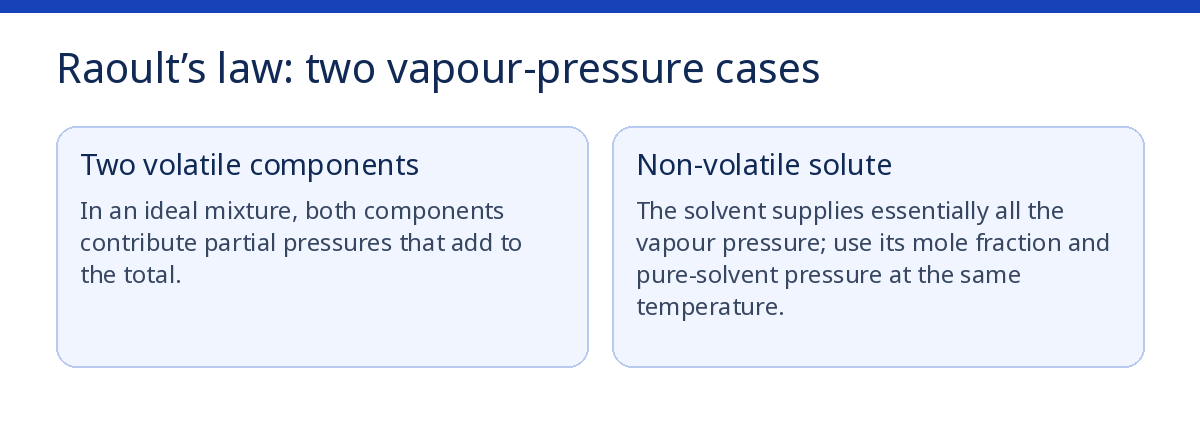
The solutions case is useful for distinguishing two applications of Raoult’s law. For an ideal solution with two volatile components, each contributes a partial vapour pressure at equilibrium, and the total is the sum of those contributions. With a non-volatile solute, the solute contributes negligibly to the vapour pressure; Raoult’s law relates the solvent’s vapour pressure above the solution to its mole fraction and to the vapour pressure of the pure solvent at the same temperature.
For deviations from ideality, the relevant comparison is between the attractions of unlike molecules and those of like molecules. Stronger unlike attractions tend to lower vapour pressure relative to the ideal prediction; weaker ones tend to raise it. The paper separately tests freezing-point depression. There, check that you are using molality, which is based on the mass of the solvent, not molarity or the mass of the entire solution.
Organic chemistry: let the structure and conditions guide you
The organic questions use functional-group tests, reagent-based transformations and explanations of reactivity. The paper includes haloalkanes and haloarenes, phenols and ethers, carbonyl compounds and amines. For a question that asks you to distinguish compounds, identify the structural feature the test depends on. For a transformation, look at the substrate, reagent and stated conditions together; naming a reaction does not replace writing the equation when the question asks for it.
The paper also tests whether you notice conditions that limit a comparison. For instance, an amine basicity comparison specified in the gas phase should not be justified by hydration in water. In a multistep identification question, check that each proposed structure agrees with both the reaction that forms it and the evidence given for its next reaction. Editorial note: the reaction sequence in Question 35(b) is not discussed here because the printed wording assigns C to two steps while asking for a D it does not separately identify.
Inorganic chemistry: separate charge, structure and magnetism
The coordination chemistry questions ask about oxidation state, naming, isomerism and predictions using valence bond theory. Start by distinguishing ligands inside the coordination sphere from counter-ions outside it. The charge of the complex and the charges of its ligands are used to infer the metal’s oxidation state; the number of donor atoms attached to the metal is a different quantity. For a magnetic prediction, check the presence or absence of unpaired electrons instead of treating the shape alone as an explanation.
The questions on transition and inner-transition elements ask for reasons as well as recall. When revising oxidation states or the classification of an element, connect the claim to the relevant electronic configuration. If a question asks for an ionic equation instead, check that both atoms and total charge balance.
Quick self-check before opening the worked solutions
In the carbohydrate case, can you distinguish a question about the bond joining sugar units from one about the products of hydrolysis or the difference between two structures? In an assertion–reason item, can you judge the truth of each statement before deciding whether the reason explains the assertion? These checks help you notice when you know the topic but have answered a different question from the one asked.
After your attempt, use the PDF’s question-number links to open the relevant worked explanations. The solution pages separate the formula, the concept and the explanation in steps. Use that separation to find the first point where your reasoning diverged: perhaps you chose the wrong principle, missed a condition or set up a calculation correctly but mishandled a sign or unit. Reattempt that subpart without the solution in view, then use the unattempted internal choices to see whether you can apply the method independently.
Spotted an error? Report a correction. Practise this in the app: notes, formula sheets and mind maps.















































































































































Loading comments…