CBSE Class 12 Chemistry 2023 Supplementary Paper
CBSEChemistry2023 Previous Year Paper
Paper code: 56/C/2 · 2023Practise with the full 2023 CBSE Class 12 Chemistry supplementary theory paper (56/C/2), then use the worked solutions to review your reasoning. The English-version file brings together the original question layout and a question-number index for checking individual attempts.
This set is one of the year's papers. See every set from 2023, grouped by series.
What the 2023 paper contains
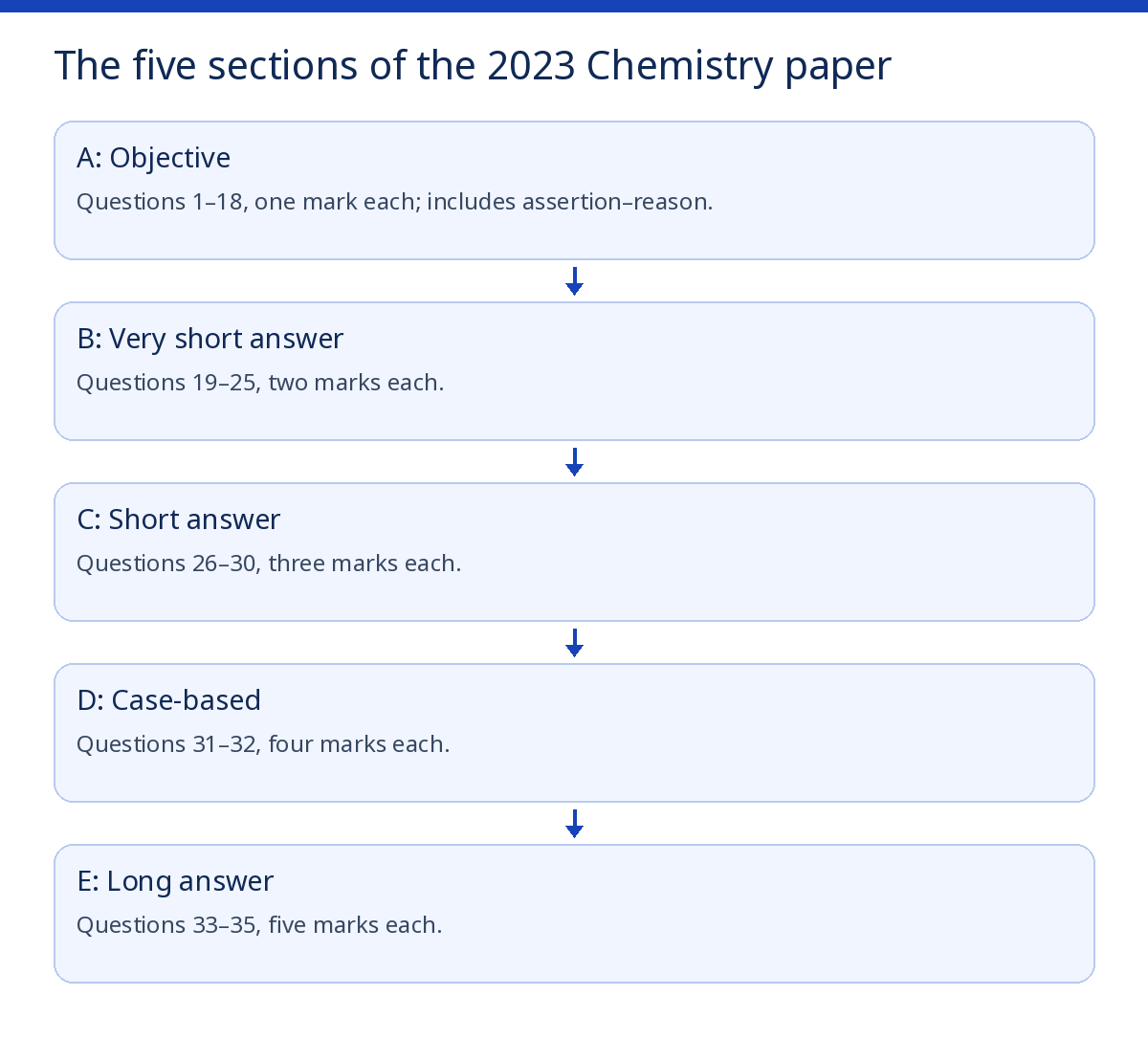
This year-wise resource is the 2023 supplementary examination, Set 2, not a chapter-wise worksheet. The paper allows 3 hours and carries 70 marks across 35 numbered questions. Section A has 18 one-mark questions, including assertion–reason items. Section B has seven two-mark very short answers, Section C has five three-mark short answers, Section D has two four-mark case-based questions, and Section E has three five-mark long answers.
There is no overall choice: you cannot drop a numbered question because you prefer another topic. Where the paper gives an OR, attempt one alternative in a timed sitting and save the other for revision. Also read the directions within each question: one short-answer item asks you to answer any three of its four prompts.

Chemistry Supplementary 2023 | Class 12 | Previous Year Paper | Code 56/C/2
In the StudentCurio app
Complete CBSE Class 12 Chemistry supplementary examination paper for 2023, code 56/C/2, with worked solutions. Covers questions from multiple Chemistry chapters and helps students practise the full board-paper format.
Use the reading period to plan your attempt
The printed instructions give candidates 15 minutes to read the paper without writing answers and do not allow calculators. To rehearse those conditions, keep the solutions closed and use the reading period to locate internal choices, spot multi-part questions and notice which numerical items supply constants or logarithms. Decide between alternatives after reading every subpart, rather than choosing on the strength of a familiar first line.
The sections ask you to show knowledge in different ways. In an assertion–reason item, judge each statement separately before deciding whether the reason explains the assertion. In a short written response, distinguish a request for a definition from a request for a reason or a chemical equation. In a long answer, label your subparts so you can check later which parts of the prompt you addressed.
Before calculating: identify the governing conditions
The physical chemistry questions move between chemical kinetics, electrochemistry and solutions. In kinetics, distinguish an experimentally determined rate law from a proposed mechanism. The rate law tells you how rate depends on concentration under the conditions described; molecularity refers to the reactant entities in a single elementary step, not to the overall reaction. A temperature-change calculation in this paper explicitly assumes that activation energy stays constant over the stated interval. Keep that assumption attached to the calculation when reviewing your work.
In electrochemistry, the paper moves between conductivity on dilution, cell potential, equilibrium and electrolysis. Before choosing a relation, identify what you are finding: a voltage, an equilibrium quantity or an amount of electricity. For cell emf, check whether the stated conditions are standard before using a standard potential as the cell potential. For boiling-point elevation, distinguish molality, which uses the mass of solvent, from concentration expressed per litre of solution.
Separate charge, geometry and electron arrangement
The inorganic questions draw on coordination compounds and the d- and f-block elements. The coordination questions range from naming a complex and finding an oxidation state to reasoning about isomerism, shape and magnetic behaviour. These tasks use different information, even when they start from the same kind of formula. For charge accounting, distinguish the species inside the coordination brackets from counterions outside them. For geometrical isomerism, ask whether the arrangement of ligands gives distinct relative positions in the stated geometry.
The valence bond theory item also asks about spin and magnetism. Keep the reasoning in order: establish the metal ion’s electron count before deciding how electrons are paired, then connect unpaired electrons to magnetic behaviour. This makes your explanation easier to check than a list of unsupported predictions.
Read organic reactions from substrate to conditions
The organic questions include haloalkanes, alcohols, phenols, ethers, carbonyl compounds and amines. They ask you to recognise reactions, write equations, compare reactivity or acidity, and distinguish compounds by a chemical test. Start by marking the functional group and the stated reagent and conditions. A reaction name is a useful memory cue, but the structure and conditions tell you whether that reaction applies to the substrate in front of you.
For an elimination or substitution prompt, notice whether it asks you to predict a product or explain a difference in rate. Those are different jobs. For a distinguishing test, practise stating the observation that would separate the compounds, rather than relying on a test name alone. In a sequence of reactions, check that each proposed intermediate fits both the step that forms it and the next stated reaction.
Quick self-check for the two case passages
The first case concerns Raoult’s law and solution behaviour. As you read, ask: which components are volatile, and is the question about one component’s partial vapour pressure or the total pressure above the solution? For an ideal mixture of volatile liquids, each component contributes a partial pressure. If the solute is non-volatile, it does not contribute appreciably to the vapour pressure under the conditions considered. This distinction matters before you choose a relation.
The second case concerns carbohydrates. Ask whether the subpart is testing the number of sugar units, the bond joining them, behaviour on hydrolysis or reducing behaviour. These are different ways of describing carbohydrates. Use the passage to orient yourself, then check whether the question needs a term, a comparison or an explanation.
Review the reasoning before checking the answer
The file’s question-number links let you return to individual worked solutions after your attempt. Use the labels Formula used, Concept used and Explanation in steps to find where your reasoning first diverged. Was the governing principle wrong, did you miss a condition, or did an otherwise sound approach fail in the calculation or written explanation? Rework that step before attempting an unused OR branch.
Source note: The reaction sequence in Question 33(b) has inconsistent compound labels in the supplied wording. This guide omits that worked example rather than inferring a correction. Use the other branch for timed practice and flag the ambiguous branch separately when reviewing the paper.
Spotted an error? Report a correction. Practise this in the app: notes, formula sheets and mind maps.















































































































































Loading comments…