CBSE Class 12 Chemistry 2022 Supplementary Paper
CBSEChemistry2022 Previous Year Paper
Paper code: 56/6/1 · 2022Use this solved CBSE Class 12 Chemistry supplementary paper to practise a full 2022 Term II theory exam. Attempt the original questions first, then use the worked solutions to check your reasoning, units and use of chemical evidence.
This set is one of the year's papers. See every set from 2022, grouped by series.
How this 2022 Term II paper is organised
This year-wise resource contains the English version of the 2022 supplementary theory paper, Set 1, with question paper code 56/6/1. The original paper allows two hours for 35 marks, with a separate 15-minute reading period in which no answers are written. It does not allow calculators or log tables. Use these instructions to recreate the conditions of this particular paper rather than assuming that every CBSE Chemistry paper follows the same format.
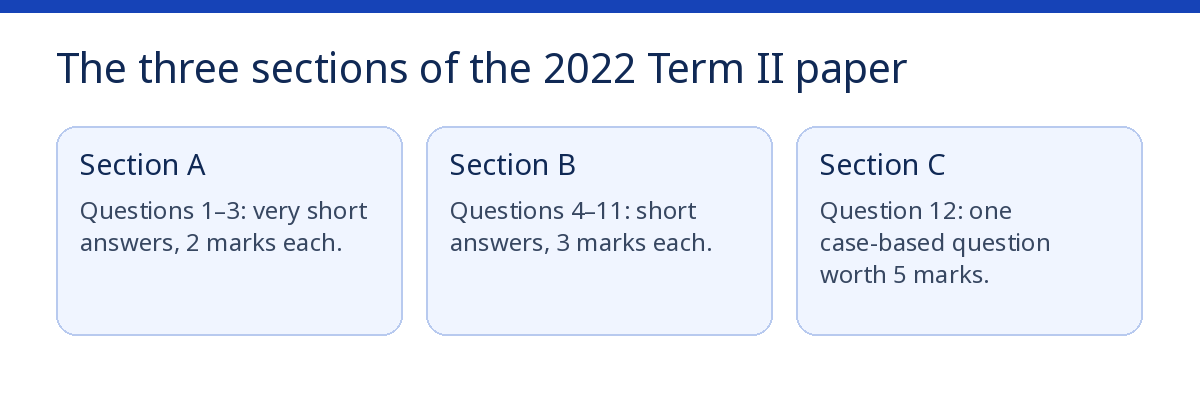
The 12 questions are split into three sections. Section A has three very short-answer questions worth two marks each. Section B has eight short-answer questions worth three marks each. Section C has one five-mark case-based question. All numbered questions are compulsory, but some offer a choice of subparts or print an OR alternative. During the reading period, distinguish those choices from compulsory subparts so you know exactly what to attempt.

Chemistry Supplementary 2022 | Class 12 | Previous Year Paper | Code 56/6/1
In the StudentCurio app
A solved CBSE Class 12 Chemistry supplementary examination paper in the 2022 Term II format, covering questions across topics including electrochemistry, chemical kinetics, organic chemistry, and d- and f-block elements. It helps students practise board-exam questions and review worked solutions.
Electrochemistry: keep the quantities distinct
The electrochemistry questions move between measuring an electrolyte’s resistance, representing a galvanic cell and calculating molar conductivity. These are different tasks: one concerns how a measurement is made, another asks you to represent a redox process, and the calculation requires you to connect quantities with different units. For cell notation, identify the oxidation and reduction processes before arranging the electrodes and species, then check that the notation matches the direction of the stated reaction.
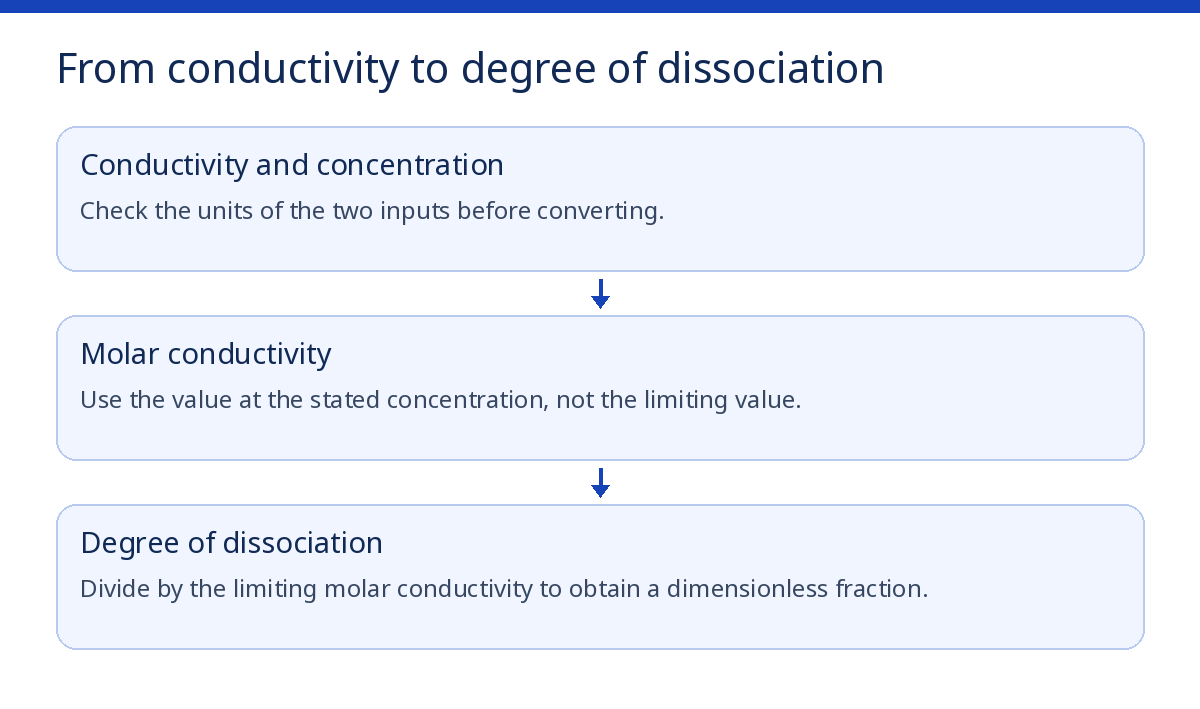
When the conductivity conversion applies: Use when conductivity is in and concentration is in . The result is in . Keep molar conductivity at the stated concentration distinct from its limiting value at infinite dilution. For the weak electrolyte in this paper, the ratio of these two molar conductivities is used to estimate the degree of dissociation. The ratio is dimensionless; write it as a percentage only after converting it.
Chemical kinetics: read the axes before the slope
The kinetics questions test how reaction order is inferred, first from half-life behaviour and then through a choice between interpreting a concentration–time plot and calculating a time for partial decomposition. When using a graph, read both axes before deciding which integrated rate law fits. A straight line is not enough by itself: a concentration plot and a logarithmic concentration plot represent different relationships. Once you have chosen the model, use it to justify the slope and check the units of the rate constant against the time unit used.
Two distinctions worth checking: Reaction order comes from the exponents in the rate law, whereas molecularity counts the reacting particles in one elementary step. In a decomposition calculation, the fraction decomposed is not the fraction remaining. If your rate equation uses the reactant concentration at time , express it as the fraction still present before substituting.
Inorganic chemistry: start with the ion, not the atom
The d- and f-block questions connect electronic configuration with oxidation states, atomic size, colour and magnetism. Before counting unpaired electrons, write the configuration for the species actually named. A neutral atom and its ion need not have the same subshell occupancy. Also distinguish a spin-only magnetic moment from an observed moment: the spin-only calculation uses the unpaired-electron count and does not include an orbital contribution.
The coordination chemistry question asks you to link the metal’s oxidation state and electron count to the ligands before describing the complex. In formula writing, separate ligands bonded to the metal from counter-ions outside the coordination brackets. A ligand’s charge enters the charge balance of the coordination entity; a counter-ion balances the charge of that entity in the compound. Checking both balances helps you catch a misplaced ion even when you recognise the compound name.
Surface chemistry: distinguish motion from aggregation
The surface chemistry choice tests either interpretation of a diagram or precise use of terms such as adsorption, lyophobic sol and multimolecular colloid. When reading the diagram, look for evidence of particle movement and distinguish it from what may happen when the particles lose charge stabilisation. Electrophoresis is the motion of charged colloidal particles relative to the dispersion medium in an electric field; coagulation is their aggregation. Movement is therefore not itself evidence that aggregation has occurred. For the definition alternative, keep the basis of each term clear: adsorption concerns a surface, while the colloid terms describe affinity for the medium or the constitution of the dispersed particles.
Organic chemistry: use structure and reaction conditions
The organic questions cover carboxylic acid strength, naming a compound with carbonyl groups, classifying amines, comparing their basicity and completing reactions. For amine classification, count the carbon groups bonded directly to nitrogen rather than judging how branched the carbon skeleton looks. For basicity comparisons, pay attention to the stated medium: in water, hydration of the protonated amine matters alongside electron donation.
The case-based question brings together aldehydes, ketones and carboxylic acids. Use the passage to locate the relevant topic, then check the structure and conditions for each subpart. For an aldol question, inspect the carbons next to the carbonyl group for an alpha hydrogen. For a chemical test, plan to state both the reagent and the contrasting observations. The compound-identification alternative in Question 12(d)(i) is incomplete in the available text transcription, so its reaction sequence and worked answer are not discussed here.
Review the reasoning behind each worked solution
After a timed attempt, use the linked question numbers to open the corresponding solutions. Compare your method with the resource’s formula, concept and step-by-step explanation, not just its final answer. For a calculation, locate the first point where your setup, conversion or units differ. For an explanatory answer, check whether you connected the relevant chemical property to the observation rather than merely naming a concept. Once you have reviewed your chosen answers, use the unattempted OR alternatives as fresh practice without counting them as part of your timed attempt.
Spotted an error? Report a correction. Practise this in the app: notes, formula sheets and mind maps.















































































































































Loading comments…