CBSE Class 12 Chemistry 2026 Board Paper With Solutions
CBSEChemistry2026 Previous Year Paper
Paper code: 56/2/2 · 2026Practise the full English CBSE Class 12 Chemistry 2026 main board paper, set 56/2/2. Use the worked solutions to review not just where your answer went wrong, but whether you chose the right model, interpreted the conditions correctly or showed enough reasoning.
This set is one of the year's papers. See every set from 2026, grouped by series.
Know the format before you start
This year-wise resource pairs the question paper with worked solutions and an index linking to questions by number. The paper contains 33 questions for 70 marks, with three hours allowed and no calculator. All questions are compulsory, subject to the printed internal choices. An OR lets you choose between the alternatives at that point; it does not give you permission to skip the question altogether. Section A has no internal choice.
Section A contains sixteen one-mark multiple-choice questions, including assertion–reason items. Section B has five two-mark very short answers; Section C has seven three-mark short answers. Section D has two four-mark case-based questions, and Section E has three five-mark long answers. In assertion–reason items, judge the truth of each statement separately before deciding whether the reason actually explains the assertion.

Chemistry 2026 | Class 12 | Previous Year Paper | Code 56/2/2
In the StudentCurio app
A complete CBSE Class 12 Chemistry main examination paper, set 56/2/2, with worked solutions across topics including electrochemistry, chemical kinetics, coordination compounds, solutions and organic chemistry. Helps students practise board-exam questions and review their solutions.
Kinetics: when the first-order equation applies
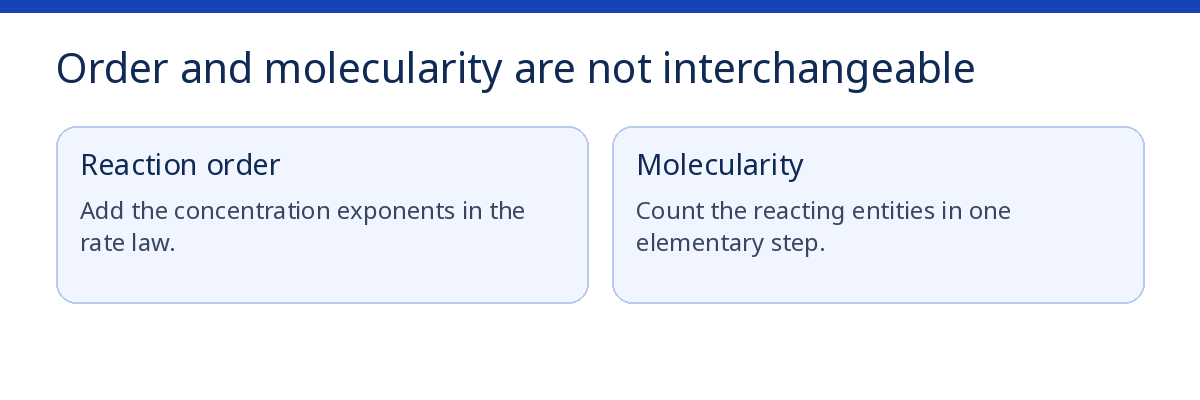
The kinetics questions move between interpreting rate laws, distinguishing order from molecularity, and using concentration changes to find a rate constant or elapsed time. Reaction order comes from the exponents in the rate law, not automatically from the coefficients in the overall equation. Molecularity counts the reacting entities in a single elementary step; an overall multistep equation does not establish that count.
For a first-order reaction, relates the initial concentration to the concentration remaining at time . Use positive concentrations in the same units so the logarithm has a dimensionless argument. If the question gives the fraction decomposed, subtract it from one to get the fraction remaining before forming the ratio. Check that the time unit matches the reciprocal time unit of .
Solutions: keep the two concentration measures apart
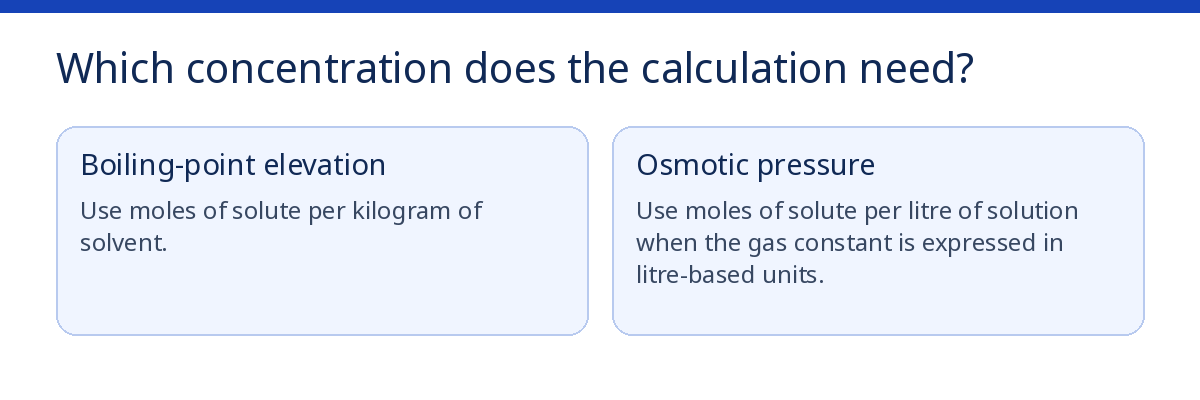
The paper tests colligative properties through a boiling-point elevation problem and a case study on osmosis. In the boiling-point problem, identify the increase relative to the pure solvent before using the boiling-point elevation constant. The concentration measure here is molality: moles of solute per kilogram of solvent, not per kilogram of solution. This distinction matters when the information is given as separate masses of solute and solvent.
For a dilute solution, the osmotic-pressure relation instead uses molar concentration, absolute temperature and a van ’t Hoff factor where appropriate. The case also uses isotonic, hypotonic and hypertonic to compare osmotic pressures. Read the last two as relative descriptions: a solution is hypotonic or hypertonic with respect to another solution.
Electrochemistry and coordination: match the model to the task
The cell-emf question gives nonstandard conditions, so practise writing the balanced cell reaction and identifying the electron-transfer number before setting up the Nernst equation. The reaction quotient must represent that same reaction. This is a different task from a conductivity measurement: resistance depends on the cell geometry as well as on the solution, whereas molar conductivity relates conductivity to molar concentration. The paper also asks for qualitative reasoning about batteries and fuel cells.
In coordination chemistry, separate what you need for naming from what you need for predicting magnetism. Naming requires identifying the ligands and using charge balance to find the metal oxidation state. For a crystal-field question, establish the metal ion’s d-electron count and use the stated relation between splitting and pairing energies before assigning electrons to orbitals. Magnetic behaviour then depends on whether electrons are unpaired.
Organic chemistry and biomolecules: explain what the evidence shows
The organic questions ask for different kinds of evidence: a reagent for a conversion, an observation for a distinguishing test, or a sequence of steps for a mechanism. When reviewing a conversion, check what happens to the carbon skeleton as well as to the functional group. For a chemical test, naming a reagent is not the same as describing the contrasting observations. The amines case study also calls for distinguishing hydrogen bonding between solute molecules from hydrogen bonding with water: the former helps explain boiling-point trends, while the latter is relevant to aqueous solubility.
The biomolecules questions range from glucose structure to proteins, starch components and DNA. Keep the level of explanation clear. A question about a linkage asks how units are joined; a structural comparison asks how those units are arranged. In glucose questions, ask which observations a proposed structural model can explain, rather than treating all reactions and physical observations as evidence for the same feature.
After the mock: find the first step that went wrong
Attempt the paper before opening the linked solutions. During the timed attempt, answer only the required branch of each internal choice; afterwards, use the unattempted branch as a separate practice question. For case-based items, check which information comes from the passage and which part of the response requires a chemical principle that you must supply.
The worked explanations separate the formula, concept and steps. Compare those layers with your own work: a correct formula can still be paired with the wrong assumptions, and a correct setup can still be undermined by inconsistent units. Reattempt the question from the point where your reasoning first diverged, without looking at the final answer.
Review exclusions: This guide leaves out Q12’s Gibbs-energy example because the supplied silver potential does not match the printed silver-oxide reaction. It also omits Q33’s flagged KCl numerical example and the apparent NaCl dissociation ratio. Use other questions to practise those concepts.
Spotted an error? Report a correction. Practise this in the app: notes, formula sheets and mind maps.















































































































































Loading comments…