CBSE Class 12 Chemistry 2026 Board Paper With Solutions
CBSEChemistry2026 Previous Year Paper
Paper code: 56/2/3 · 2026Practise the full 2026 CBSE Class 12 Chemistry main examination in English, then use the worked solutions to check how you chose formulas, explained trends and justified reactions. This year-wise resource contains paper 56/2/3.
This set is one of the year's papers. See every set from 2026, grouped by series.
Know the format before starting the three-hour paper
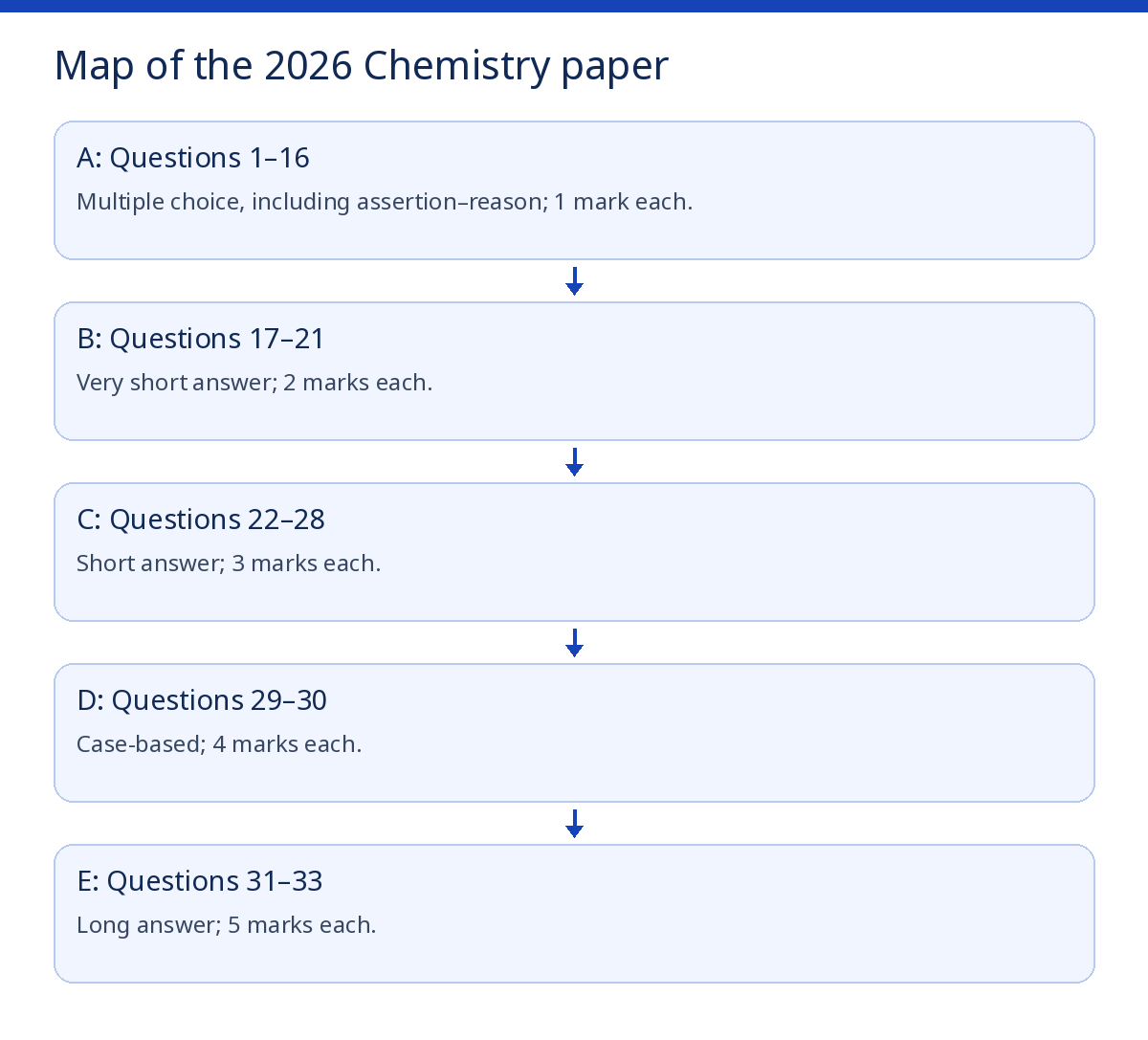
The paper carries 70 marks across 33 questions in five sections. Section A contains 16 one-mark multiple-choice questions, including assertion–reason items. Sections B and C contain two-mark very short answers and three-mark short answers, respectively. Section D has two four-mark case-based questions, and Section E has three five-mark long-answer questions.
There is no overall choice: all question numbers are compulsory, but some questions outside Section A offer an internal choice. For a timed attempt, choose one branch where an OR is printed rather than answering both. Work without a calculator, as the printed instructions require. Afterward, you can use the worked solutions for both branches to practise the material you skipped.

Chemistry 2026 | Class 12 | Previous Year Paper | Code 56/2/3
In the StudentCurio app
Complete CBSE Class 12 Chemistry main examination paper with worked solutions, covering questions across physical, inorganic and organic chemistry, including solutions, electrochemistry, kinetics, coordination compounds, biomolecules and organic reactions. Helps students practise board-exam questions and review solution methods.
Chemical kinetics: separate the rate law from the equation
The kinetics questions move from interpreting a rate law to using concentration and time data. When a rate law gives concentration exponents, use those exponents to determine the overall order. The coefficients in a balanced overall equation describe reacting proportions; they do not, by themselves, establish the rate law. Molecularity is a different idea: it counts the reacting species involved in a single elementary step.
When the first-order formula applies: For first-order kinetics, , where is the concentration remaining at elapsed time . If a question describes how much reactant has decomposed, first identify what remains. Use a time unit consistent with the rate constant. In your review, check the concentration ratio and time unit before checking the arithmetic.
Physical chemistry: track what each quantity measures
The electrochemistry questions cover cell emf, conductivity and batteries. In an emf calculation at nonstandard conditions, identify the cell reaction before writing the reaction quotient: the reaction determines both the species in the quotient and the number of electrons transferred. For conductivity work, distinguish conductivity, expressed here in , from molar conductivity, expressed in . They are not interchangeable labels for the same result.
The solutions questions offer a different check on concentration units. Freezing-point depression uses molality, which counts moles of solute per kilogram of solvent, not per kilogram of solution. The osmosis case shifts from calculation to interpretation. When reviewing it, keep the direction of solvent movement separate from the comparison of osmotic pressures across the semipermeable membrane.
Inorganic chemistry: reason from charge and electron arrangement
The inorganic questions include transition-metal electronic configurations, ionization enthalpy, and comparisons involving lanthanoids and actinoids. Coordination chemistry asks you to work with the same structural information in several ways: name a complex, identify its coordination features, or relate its electronic arrangement to magnetism.
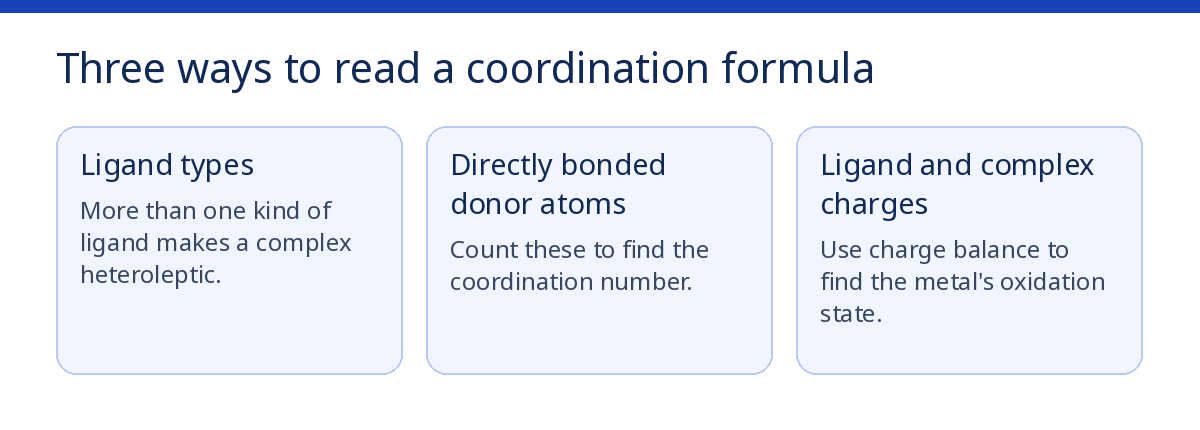
Common mix-up: ligand type versus donor count. A heteroleptic complex contains more than one type of ligand. Coordination number instead counts the donor atoms directly bonded to the central metal. For nomenclature, use ligand charges and the overall charge of the complex to establish the metal's oxidation state. For the octahedral crystal-field questions, compare the splitting energy with the pairing energy before deciding how the electrons occupy the orbitals and how many are unpaired.
Organic chemistry: follow the functional group through each step
The paper asks for more than named-reaction recall. It includes reagent selection, multistep conversions, compound identification from reaction clues, chemical tests and an explanation of acid-catalysed alkene hydration. In a conversion, mark the functional group that must change and track the carbon skeleton before choosing a reagent. In a mechanism question, the product alone does not explain how the transformation occurs; in a chemical-test question, the observation is what makes the test useful for distinguishing the compounds.
The amines case adds a structure–property comparison. Keep two settings distinct when reading it: attractions among amine molecules matter for boiling-point comparisons, whereas interactions between an amine and water matter for aqueous solubility. The two properties need not follow the same reasoning.
Biomolecules: match each explanation to the structural feature
Biomolecules appear in questions on nucleic acids, glucose, polysaccharides and proteins. For glucose, distinguish what a reaction can tell you about the open-chain form from what requires considering the cyclic form. A structural model can account for one observation without accounting for every property of the compound.
Quick self-check: which level of structure are you describing? Before reviewing the protein questions, ask whether your explanation concerns the linkage between amino acid residues, the overall form of a fibrous or globular protein, or the structural change associated with denaturation. These are different kinds of descriptions. In a short comparison, use the same basis for both sides so the distinction is clear.
Use the worked solutions to locate the first error
The file preserves the English question layout, options and diagrams and provides links by question number. The worked pages separate the formula used, concept used and explanation in steps. Compare your reasoning in that order: was the governing rule appropriate, did the conditions fit, and did the calculation or written explanation follow? For an assertion–reason item, assess the truth of each statement separately before deciding whether the reason explains the assertion.
This guide omits the numerical treatment of Q2, the worked substitution in Q20(B), the broad property claims in the Q30 passage, the numerical dissociation result in Q31(A)(a), and the numerical example in Q31(B)(a). The surrounding topics can be reviewed without relying on those details.
Spotted an error? Report a correction. Practise this in the app: notes, formula sheets and mind maps.















































































































































Loading comments…