CBSE Class 12 Chemistry 2026 Board Paper with Solutions
CBSEChemistry2026 Previous Year Paper
Paper code: 56/5/3 · 2026Practise the full English-language 2026 CBSE Class 12 Chemistry main examination, paper code 56/5/3, in its original three-hour format. Then use the worked solutions to check not just what you answered, but why a formula, reaction condition or explanation applies.
This set is one of the year's papers. See every set from 2026, grouped by series.
How the 70-mark board paper is organised
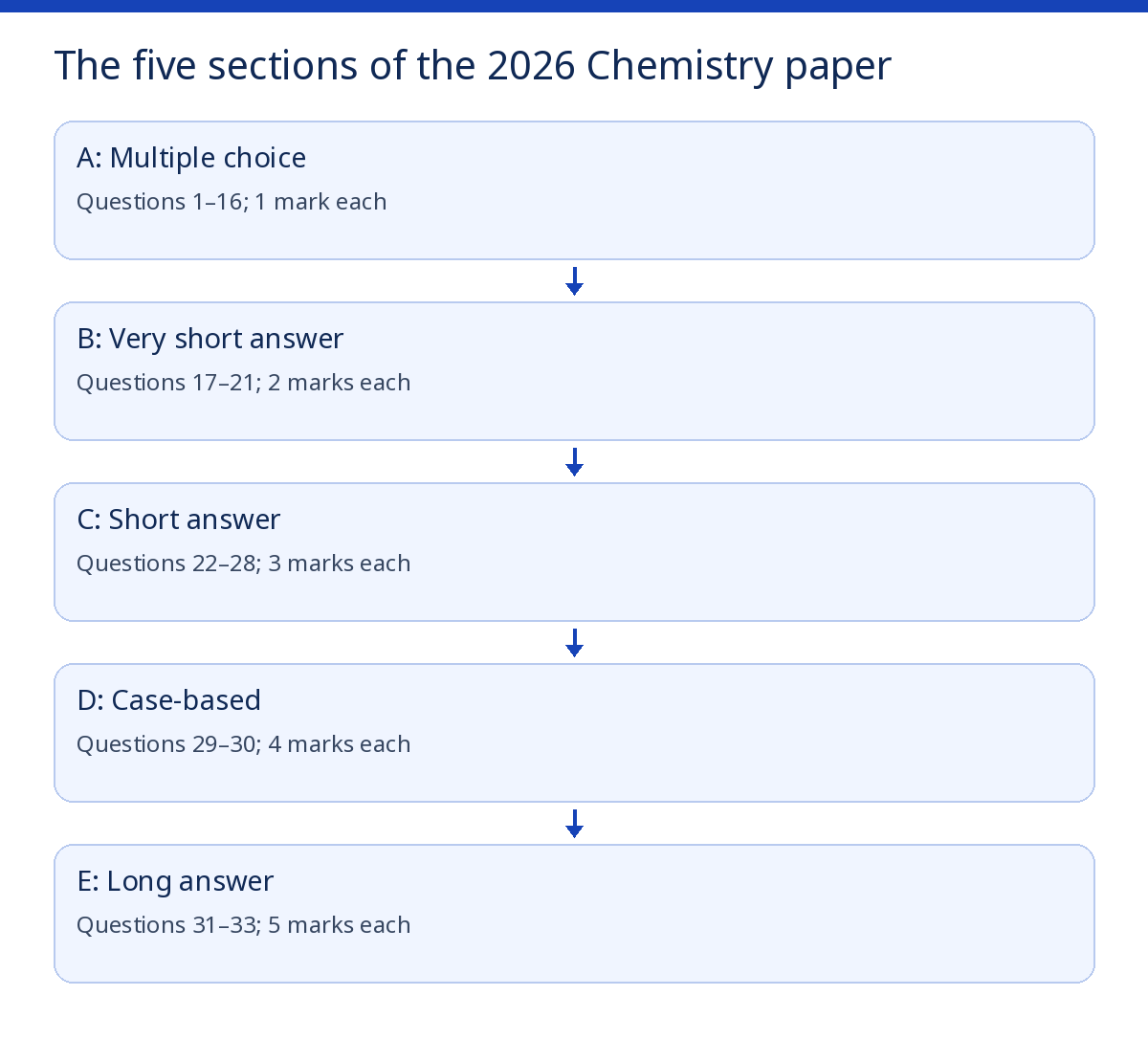
This year-wise resource contains the complete 2026 main examination paper, rather than a chapter-wise selection. Its 33 questions are divided into five sections: Section A has 16 one-mark multiple-choice questions, including four assertion–reason items; Section B has five two-mark very short answers; and Section C has seven three-mark short answers. Section D contains two four-mark case-based questions, while Section E has three five-mark long answers.
The paper offers internal choice, not overall choice. Every question number is compulsory, but where an OR is printed, you choose between the alternatives at that point. Some choices are within a subpart rather than across the whole question, so check exactly where the OR appears. The instructions also prohibit calculators.

Chemistry 2026 | Class 12 | Previous Year Paper | Code 56/5/3
In the StudentCurio app
The complete 2026 CBSE Class 12 main Chemistry examination paper (code 56/5/3) is accompanied by worked solutions covering questions across multiple chapters. It helps students practise the full board-paper format and review solution methods.
How the paper asks you to show your understanding
The same topic can demand different kinds of thinking as you move through the paper. In chemical kinetics, for example, recognising a relationship from the stated reaction order is different from interpreting the powers in a rate law or working out how a temperature change affects a reaction rate. A definition, a prediction and a calculation do not call for the same kind of response, even when they share the same chapter heading.
The organic questions likewise move between recognising reactions, planning conversions and interpreting evidence from chemical tests. In inorganic chemistry, coordination nomenclature, isomerism, oxidation states and explanations of colour sit alongside questions on the d- and f-block elements. Biomolecules appear through carbohydrate classification, protein structure and short questions on topics such as sucrose hydrolysis and essential amino acids.
When a physical chemistry formula applies
Before doing arithmetic, identify the model that the question gives you. The relation applies to first-order kinetics; the independence of half-life from initial concentration is a feature of that model, not a general property of all reactions. By contrast, when interpreting a given rate law, read the reaction orders from the concentration exponents, not from the coefficients in the chemical equation. If a reactant is in large excess, its concentration may be treated as approximately constant over the interval considered, which changes the apparent rate law.
For solutions, distinguish the concentration measures before substituting. Freezing-point depression uses molality, expressed in moles of solute per kilogram of solvent, whereas the dilute-solution osmotic pressure relation uses molarity. The paper explicitly assumes complete dissociation in its long-answer colligative-property calculations. Treat that as a condition of those questions, not as a conclusion to carry into every electrolyte problem.
Read the ether and electrolysis cases for conditions
The ether case shows why a named reaction is not enough to predict an outcome. Williamson synthesis relies on an alkoxide displacing a leaving group by an pathway. In the paper’s comparison, a primary alkyl halide is suitable for that substitution, whereas a tertiary alkyl halide favours elimination. When reviewing ether cleavage, make a separate distinction: the passage treats alkyl–aryl ethers differently from ethers with two alkyl groups, so the identity of each side of the oxygen matters.
The electrolysis case switches between predicting products and relating deposited material to charge. For a product prediction, first identify the medium, the species present and the electrode material. For a Faraday-law question, use the electron count in the electrode half-reaction to connect the chemical amount with charge. A correct calculation method does not by itself establish which product forms.
Quick self-check: is the reason an explanation?
For an assertion–reason item, decide whether each statement is true before deciding whether the reason explains the assertion. A true statement about the same topic can still fail to account for the specific observation. Before selecting a code, ask yourself whether you can say what the reason explains, rather than just recognise the two statements as familiar.
Apply the same check to a written answer on coordination chemistry: if your explanation invokes oxidation state, electron configuration or ligand binding, can you identify which step connects that idea to the property being asked about? That connecting step is what distinguishes a justification from a restatement.
Use the worked solutions after a closed-paper attempt
Do the paper in one three-hour sitting without a calculator. On the first pass, mark questions you answered by elimination or with uncertain reasoning so that a correct guess does not disappear from your review. Record which internal choices you attempted; try the unused alternatives afterwards as separate practice, not as extra questions in the timed attempt.
Use the question-number index or the Solution links to review your work. The worked pages separate the formula used, concept used and explanation in steps. Compare them with your own reasoning at the first point where it differs: perhaps you chose the wrong relationship, overlooked a reaction condition or handled the units incorrectly. Then close the explanation and rewrite that step yourself. This guide leaves out the boiling-point numerical example and does not reconstruct the Fehling’s-test solution, which is cut off in the supplied excerpt.
Spotted an error? Report a correction. Practise this in the app: notes, formula sheets and mind maps.















































































































































Loading comments…