CBSE Class 12 Chemistry 2026 Solved Paper: Set 56/5/2
CBSEChemistry2026 Previous Year Paper
Paper code: 56/5/2 · 2026Use this full, year-wise CBSE Class 12 Chemistry main examination paper to practise the three-hour board format. The English-language file pairs the original question layout with worked solutions, so you can attempt the paper first and then review the reasoning behind each response.
This set is one of the year's papers. See every set from 2026, grouped by series.
Read the paper structure before you start
The 2026 main examination paper, set 56/5/2, carries 70 marks across 33 questions. There is no overall choice, and calculators are not allowed. Where an internal OR is printed, answer one alternative during a timed attempt; the worked file covers both, so the unused branch is available for revision later.
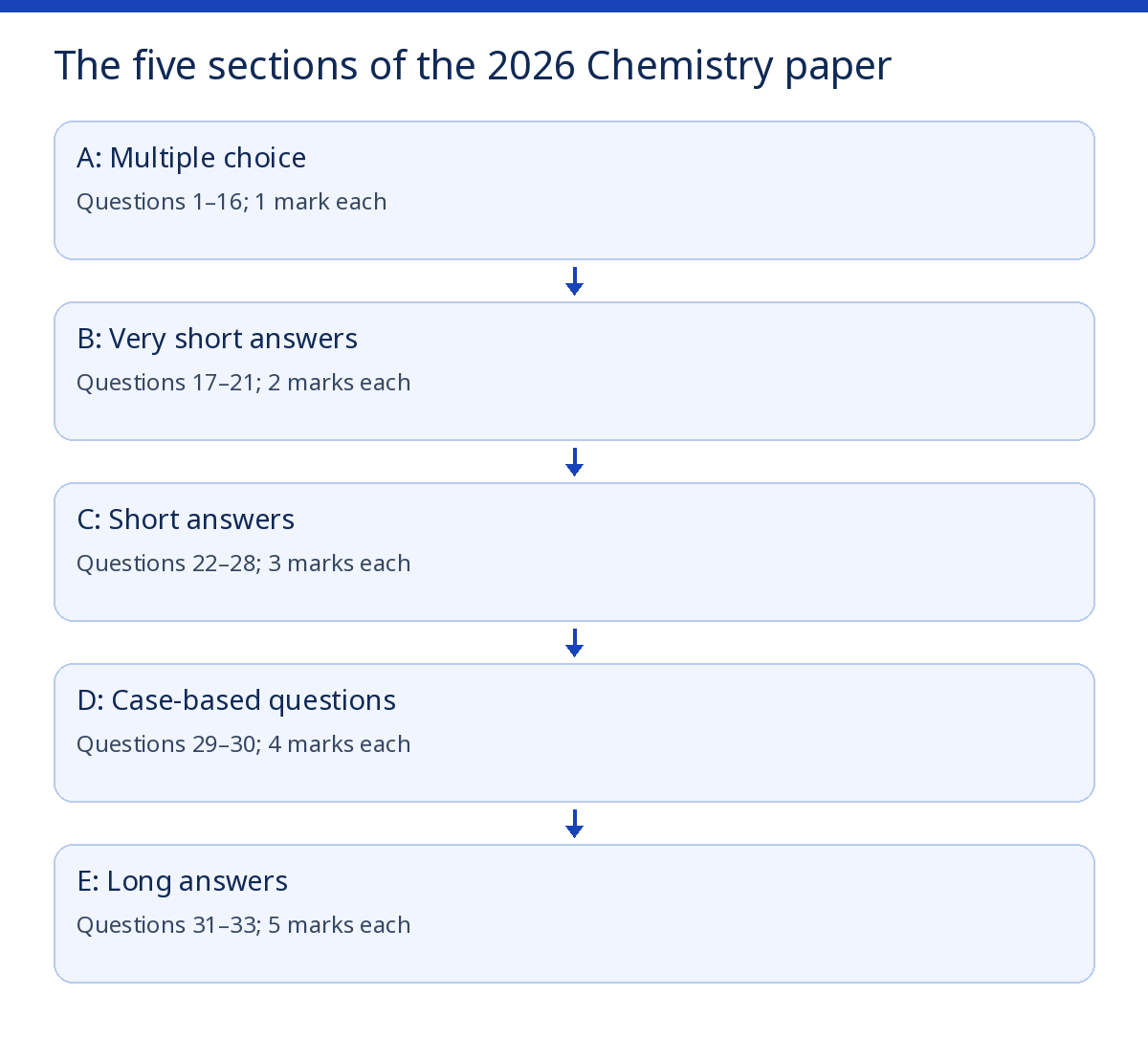
- Section A: Questions 1–16 are worth 1 mark each and include assertion–reason items.
- Section B: Questions 17–21 are very short answers worth 2 marks each.
- Section C: Questions 22–28 are short answers worth 3 marks each.
- Section D: Questions 29–30 are case-based and worth 4 marks each.
- Section E: Questions 31–33 are long answers worth 5 marks each.
Internal choices appear in selected questions outside Section A. Read the marks beside each subpart: a five-mark question can ask for several distinct responses rather than one extended explanation.

Chemistry 2026 | Class 12 | Previous Year Paper | Code 56/5/2
In the StudentCurio app
A solved CBSE Class 12 Chemistry main examination paper with questions and worked answers spanning organic, inorganic and physical chemistry. Helps students practise the board-paper format and review solution methods across the syllabus.
When the physical chemistry formula applies
The paper moves between chemical kinetics, solutions and electrochemistry. In kinetics, identify the condition that makes a relation valid before substituting numbers. The half-life relation applies to a first-order reaction. If the half-life is in seconds, the corresponding rate constant is in inverse seconds. The temperature question instead uses the Arrhenius relationship and explicitly assumes that the activation energy does not change over the stated interval.
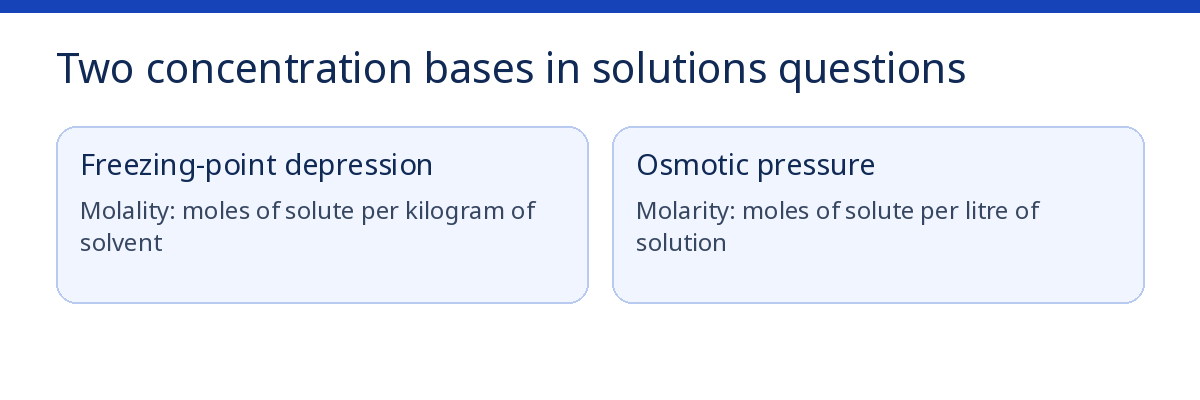
The rate-law question also distinguishes overall order from the apparent order when one reactant is in large excess. In the latter case, that reactant’s concentration is treated as effectively constant during the reaction. In solutions, look for a different kind of assumption: the freezing-point and osmotic-pressure alternatives expressly specify complete dissociation. Keep their concentration bases separate. Freezing-point depression uses molality, based on solvent mass, whereas the dilute-solution osmotic-pressure expression uses molarity, based on solution volume.
Read organic reactions through structure and conditions
Organic questions cover amines, halo compounds, alcohols, ethers and carbonyl compounds. The tasks vary: recognise a named reaction, plan a conversion, distinguish classes of compounds or justify a product. For a conversion, compare the starting and target structures before naming a reagent. Decide whether the required change concerns the functional group, the carbon skeleton or both. That gives you a way to check whether the proposed steps actually lead to the target.
The ether case illustrates why a synthesis name is not enough. Williamson synthesis proceeds by nucleophilic substitution with a suitable alkyl halide; the passage contrasts a primary substrate with a tertiary one, for which elimination competes strongly and is favoured. For ether cleavage, first distinguish an alkyl–oxygen bond from an aryl–oxygen bond. The smaller-group shortcut in the passage is not a universal rule: the passage treats a tertiary alkyl group separately.
Keep coordination chemistry distinctions clear
The inorganic questions test nomenclature, ligand denticity, isomerism, oxidation state, colour and magnetic behaviour. Start by separating what lies inside the coordination brackets from the counterions outside. This matters for naming a complex and for interpreting a question that uses a precipitation observation to distinguish coordinated chloride from chloride outside the coordination sphere.
A ligand with alternative donor sites is not necessarily polydentate. Denticity counts how many donor atoms from the same ligand bind to a metal centre at once; an ambidentate ligand can bind through either of two sites, one at a time. For transition-metal comparisons, work from the electronic configuration of the specified ion rather than the neutral atom when reasoning about unpaired electrons. Treat an oxidation-state trend as a separate explanation, not as a substitute for that electron count.
Quick self-check: what does each statement establish?
Assertion–reason items ask you to make two judgments: whether each statement is true and, if both are true, whether the reason actually explains the assertion. Write those judgments separately before matching them to the printed codes. A statement can be chemically relevant without explaining the specific claim.
Try the same precision with biomolecules. Can you tell whether a description concerns the sequence of amino acids, the folding of one chain or the association of several chains? For carbohydrates, ask whether a label describes configuration or the direction of optical rotation. These distinctions help you identify exactly what a prompt asks you to classify or explain.
Use the worked file to find your first wrong step
Attempt the question pages without opening the solutions, using the printed three-hour limit if you want to simulate the exam. Then open the worked response by question number. Compare your approach with the solution’s Formula used, Concept used and Explanation in steps labels. Locate the first point where your reasoning diverged: selecting a relation, interpreting a structural feature, carrying units through a calculation or leaving out a requested justification.
Use the case-based section to practise separating background information from what a subpart asks. The electrochemistry case connects charge passed with the amount of substance deposited through Faraday’s laws; the ether case asks you to apply reaction conditions and structural distinctions. This guide omits the anode comparison in Q29(c) because its printed potential labels are ambiguous. After reviewing the other subparts, try the unused OR branches separately so they serve as fresh practice rather than a second answer in your mock attempt.
Spotted an error? Report a correction. Practise this in the app: notes, formula sheets and mind maps.















































































































































Loading comments…