CBSE Class 12 Chemistry 2026 Previous Year Paper Guide
CBSEChemistry2026 Previous Year Paper
Paper code: 56/2/1 · 2026Practise with the full 2026 CBSE Class 12 Chemistry main examination paper, code 56/2/1. This year-wise file pairs the English question paper with worked solutions so you can review the reasoning behind calculations, explanations and reactions after a timed attempt.
This set is one of the year's papers. See every set from 2026, grouped by series.
Know the format before you start
This is a three-hour, 70-mark board paper with 33 questions across five sections. Section A has 16 one-mark multiple-choice questions, including assertion–reason items. Section B has five two-mark very short answers, Section C has seven three-mark short answers, Section D has two four-mark case-based questions, and Section E has three five-mark long answers.
There is no overall choice: all numbered questions are compulsory, but some questions outside Section A offer an internal choice. In a timed attempt, answer only the required branch wherever an OR is printed. The worked solutions cover both branches, so you can try the alternative later as a separate exercise. Keep a calculator out of the timed attempt, as the paper instructions prohibit its use. For multipart questions, use the printed mark splits to check that you have answered every part of the branch you chose.

Chemistry 2026 | Class 12 | Previous Year Paper | Code 56/2/1
In the StudentCurio app
A complete 2026 CBSE Class 12 Chemistry main examination paper with worked answers, spanning topics including chemical kinetics, electrochemistry, solutions, coordination compounds, biomolecules and organic chemistry. It helps students practise the board-paper format and review solutions across the syllabus.
Physical chemistry: choose the relationship before calculating
The kinetics questions cover rate laws, activation energy, rate-constant units and first-order calculations. Keep reaction order separate from molecularity: find overall order by adding the concentration exponents in the rate law, whereas molecularity counts the reacting species in one elementary step. A balanced equation for an overall reaction does not establish either quantity on its own.
For a first-order calculation, distinguish the amount remaining from the amount that has reacted before setting up the concentration ratio. Keep the time unit consistent with the rate constant. The units of the rate constant depend on reaction order, so inverse seconds are not a default for every kinetics problem.
The solutions questions include boiling-point elevation and an osmosis case. Separate the temperature rise from the final boiling point, and remember that molality uses the mass of the solvent in kilograms. In the osmosis case, hypertonic and hypotonic describe one solution relative to another. Electrochemistry covers cell notation, emf under nonstandard conditions, conductivity, batteries and fuel cells. Identify the cell reaction before writing its reaction quotient. In conductivity questions, check which quantity is requested: conductivity in siemens per centimetre and molar conductivity in siemens square centimetres per mole are not interchangeable.
Coordination chemistry: keep three counts separate
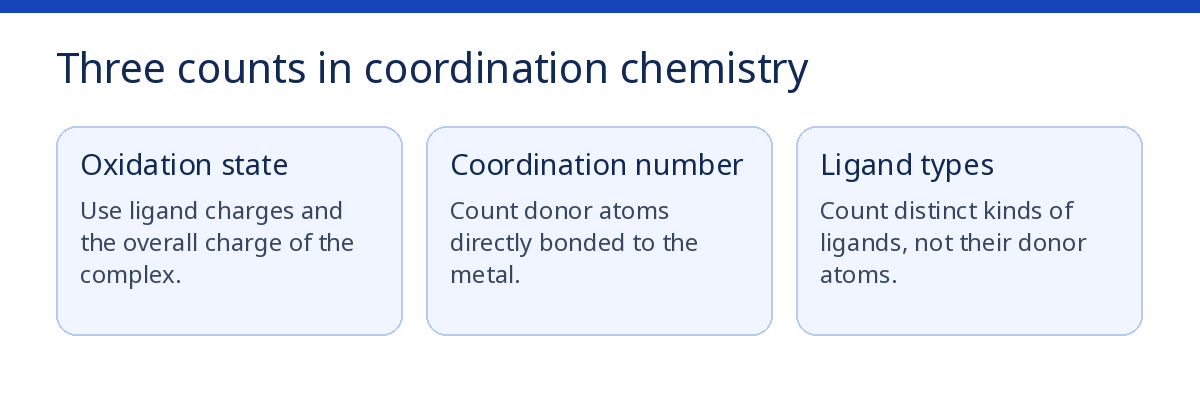
Coordination questions test naming, ligand types, coordination number, isomerism and crystal field reasoning. Keep three quantities distinct: the metal’s oxidation state comes from charge balance, the coordination number counts donor atoms directly attached to the metal, and the number of ligand types tells you whether the complex has one kind of ligand or more. A ligand can contribute more than one donor atom without adding another ligand type.
For questions on magnetic behaviour, start with the metal ion’s electron count, not the neutral atom’s. Then use the relevant splitting and pairing conditions to decide how the electrons occupy the orbitals before judging whether any are unpaired. The paper also tests transition-element properties and lanthanoid separation. Those prompts call for an explanation of the particular property, not just identification of the element or group.
Organic chemistry and biomolecules: match evidence to the task
The organic questions ask for structures, products, named reactions, chemical tests, conversions and a mechanism. These are different tasks. In a conversion, account for how each step moves the starting compound towards the target. In a distinguishing test, state what you would observe for each compound rather than just naming a reagent. Where a mechanism is requested, show the sequence of changes rather than stopping at the overall transformation.
For comparisons of physical properties, identify what is being compared before choosing an explanation. In the amines case, hydrogen bonding between amine molecules is a different consideration from their interactions with water. Keep those interactions separate when deciding whether the question is about boiling point or aqueous solubility. Biomolecules questions cover glucose, proteins and nucleic acid components. For glucose, organise revision around what a reaction or observation tells you about a structural model, rather than memorising each observation as an unrelated fact.
Quick self-check: can you justify your first step?
Before opening a solution, look at one response from each of three formats. For an assertion–reason item, ask whether you assessed the two statements separately before deciding if the reason explains the assertion. For a numerical response, point to the information that makes your chosen relationship applicable and label the units before substituting. For a case-based response, identify which detail from the passage matters and which chemistry concept connects it to the question.
If you cannot justify the first step, revisit the underlying distinction before checking the final result. This helps separate a mistaken setup from an arithmetic slip or an incomplete explanation.
Use the worked pages to find your first error
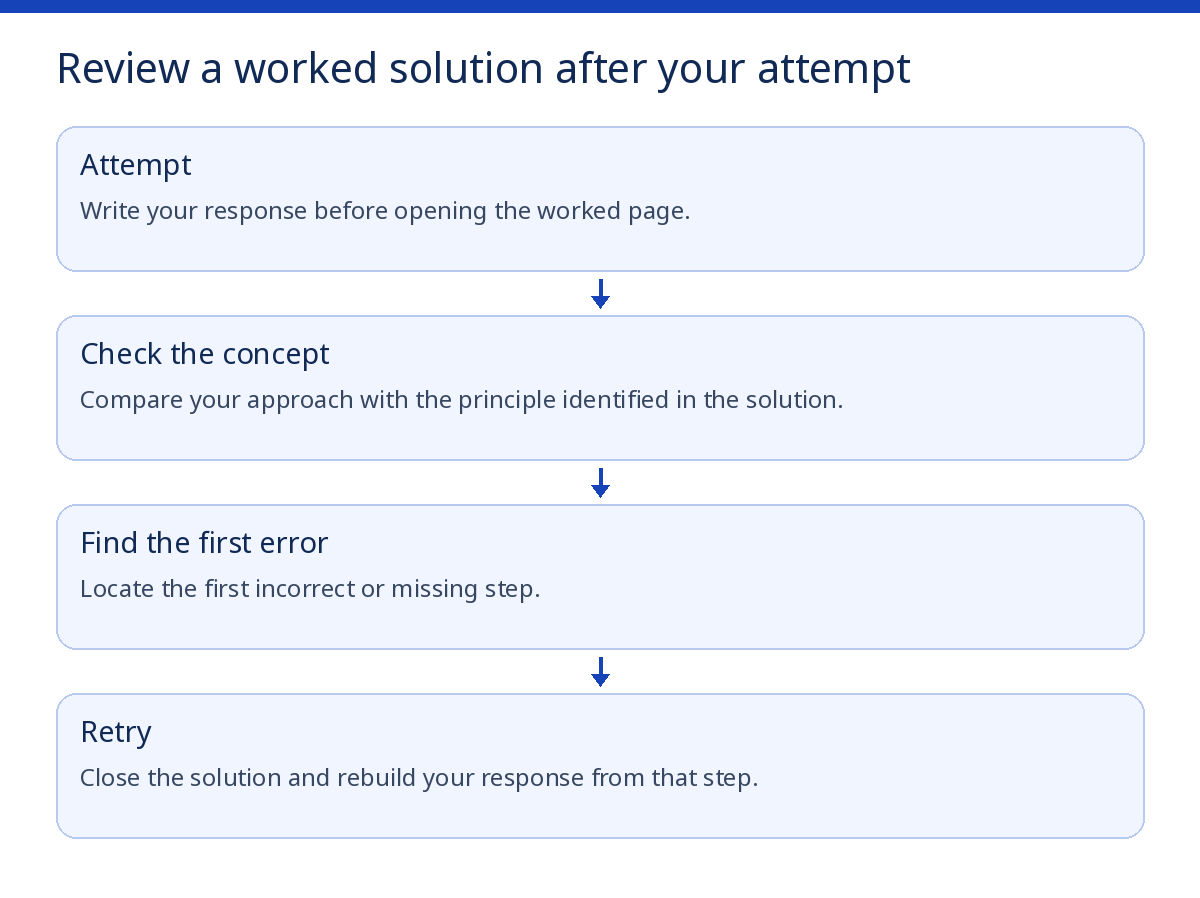
The file’s question-number links take you to the worked solutions. The solution pages distinguish the formula used, the concept used and the explanation in steps. Start by comparing the concept with the one you chose, then read only far enough to find where your reasoning first diverged. Close the solution and rewrite that step in your own words or notation before retrying the rest of the response.
This guide leaves out selected details from Q1, Q13, Q17(B), Q26(a), Q30 and Q32 because the printed data, assumptions, notation or scope require qualification. Use the independently supported concepts discussed above for revision rather than treating those details as general rules.
Spotted an error? Report a correction. Practise this in the app: notes, formula sheets and mind maps.















































































































































Loading comments…