CBSE Class 12 Chemistry 2026 Board Paper With Solutions
CBSEChemistry2026 Previous Year Paper
Paper code: 56/4/1 · 2026Use the English version of the 2026 CBSE Class 12 Chemistry main examination, paper code 56/4/1, for a full three-hour practice attempt. Then use the worked solutions to check whether you chose the right principle, carried it through correctly and answered what each subpart asked.
This set is one of the year's papers. See every set from 2026, grouped by series.
What the 70-mark paper looks like
This year-wise resource contains the full question paper and worked solutions. The 33 questions are divided into five sections. Section A has 16 one-mark multiple-choice questions, including assertion–reason items. Section B has five two-mark very short answers, and Section C has seven three-mark short answers. Section D has two four-mark case-based questions, and Section E has three five-mark long answers.
There is no overall choice. Where an internal OR is printed, choose one alternative for that part of your timed attempt. Some choices occur outside Section A, and a choice within a subpart does not make the rest of the question optional. The paper does not allow a calculator. Keep your rough calculations so you can later distinguish an arithmetic slip from a mistake in choosing the method.

Chemistry 2026 | Class 12 | Previous Year Paper | Code 56/4/1
In the StudentCurio app
A solved CBSE Class 12 Chemistry main examination paper with worked answers across topics including coordination compounds, electrochemistry, chemical kinetics, biomolecules and organic chemistry. Useful for practising the board-paper format and reviewing solution methods.
How the same topic changes across sections
Use the paper to see how a familiar topic can demand a different kind of answer. Coordination chemistry appears in multiple-choice questions, a naming task and a longer question that asks you to interpret evidence and describe a complex. Recognising a term is not the same as using the information given to justify a structural or magnetic description. Also keep the models straight: crystal field splitting and valence bond descriptions are not interchangeable just because both concern the same class of compounds.
Electrochemistry makes a similar shift. Some questions ask what changes when a condition changes; others ask you to explain an observation, perform a calculation or write electrode reactions. Before writing, underline the action word. A request to explain needs a chemical reason, while a request to write reactions calls for equations, not just a description of the process.
Check the conditions before choosing a formula
The solutions questions include Henry’s law and colligative properties. Distinguish a question about a gas dissolving in a liquid from one about how dissolved particles affect a solvent property. For colligative properties, the count of dissolved particles matters: dissociation increases it, while association decreases it. Use the assumption stated in the question. A problem that specifies complete dissociation or complete dimerisation is giving you a condition for that calculation, not a rule for every solution of that solute.
In electrochemistry, distinguish the standard cell potential from the cell potential under the stated conditions. At equilibrium the cell potential is zero, which does not in general make the standard cell potential zero. For a conductivity calculation, also distinguish conductivity from molar conductivity and its limiting value, written . Check the units before substituting rather than treating these quantities as interchangeable.
Keep reaction order and molecularity separate
The kinetics items move between a rate calculation, questions about concentration dependence and interpretation of a mechanism. Reaction order comes from the concentration exponents in the rate law; molecularity counts the reacting entities in an elementary step. The coefficients of an overall equation for a multistep reaction do not, by themselves, tell you the order. When a question gives a mechanism, read the labels on the individual steps before deciding which of the two ideas the subpart is asking about.
For a numerical item, write the form of the rate law before inserting the numbers, then check that the units of the rate constant fit that law. For assertion–reason practice, test each statement on its own before asking whether the reason explains the assertion. This guide omits the answer choice for the kinetics assertion about the slowest step because its interpretation depends on a simplifying assumption.
Read chemical evidence in the case-based questions
The two cases focus on alcohols and phenols and carbohydrates. In the first, the reaction conditions and the structure of the starting compound help you decide which idea is relevant. A mechanism needs a sequence of chemical steps; an acidity comparison needs a reason tied to the substituents. In the carbohydrate case, distinguish evidence used to assign features of the open-chain structure of glucose from evidence that motivates a cyclic representation. The passage gives context, but the subpart tells you which evidence or representation to use.
Quick self-check: If a question asks what an observation tells you about a molecule, can you name the structural feature the observation supports and explain the link? If it asks for a structure instead, check that you have actually drawn the requested form rather than merely naming it.
Use the worked solutions to revise your reasoning
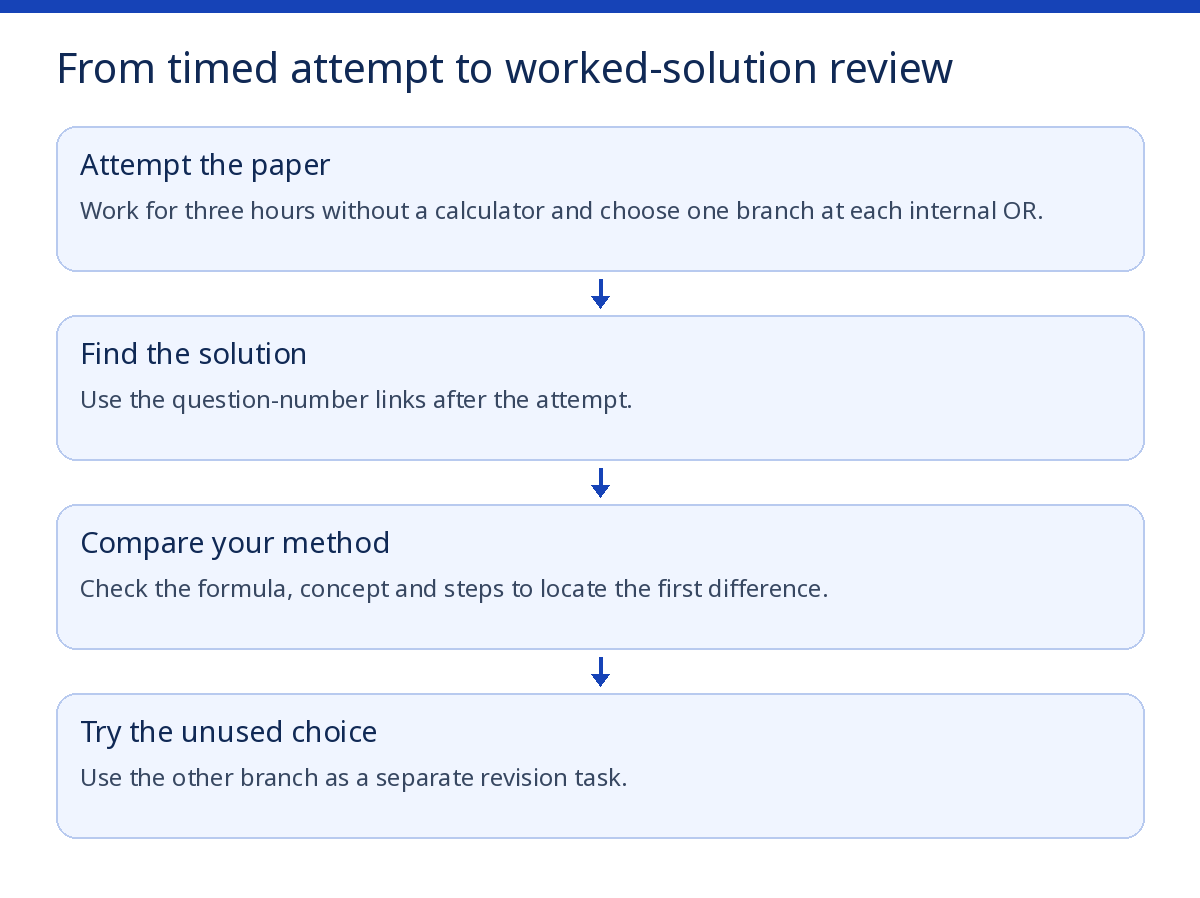
Attempt the paper from the question pages first. When reviewing, use the numbered links to find each worked solution. The solution layout separates the formula used, the concept used and the explanation in steps. Compare them in that order: did you choose an applicable relationship, did you know why it applied, and did you carry it through correctly? For a qualitative answer, pay particular attention to the link between the concept and the observation the question asks you to explain.
Mark the first point where your reasoning diverged rather than just copying the final line. If your method was sound but your answer omitted a required equation or structure, note that separately from a concept error. After the timed attempt, try an OR alternative you skipped. This lets you use the other branch for revision without confusing it with what the exam required you to attempt.
Spotted an error? Report a correction. Practise this in the app: notes, formula sheets and mind maps.















































































































































Loading comments…