CBSE Class 12 Chemistry 2026 Paper With Worked Solutions
CBSEChemistry2026 Previous Year Paper
Paper code: 56/3/1 · 2026Practise the full 2026 CBSE Class 12 Chemistry main examination in its original English layout, then use the worked solutions to check your choice of concept, your reasoning and how you present each answer.
This set is one of the year's papers. See every set from 2026, grouped by series.
Know the format before you start
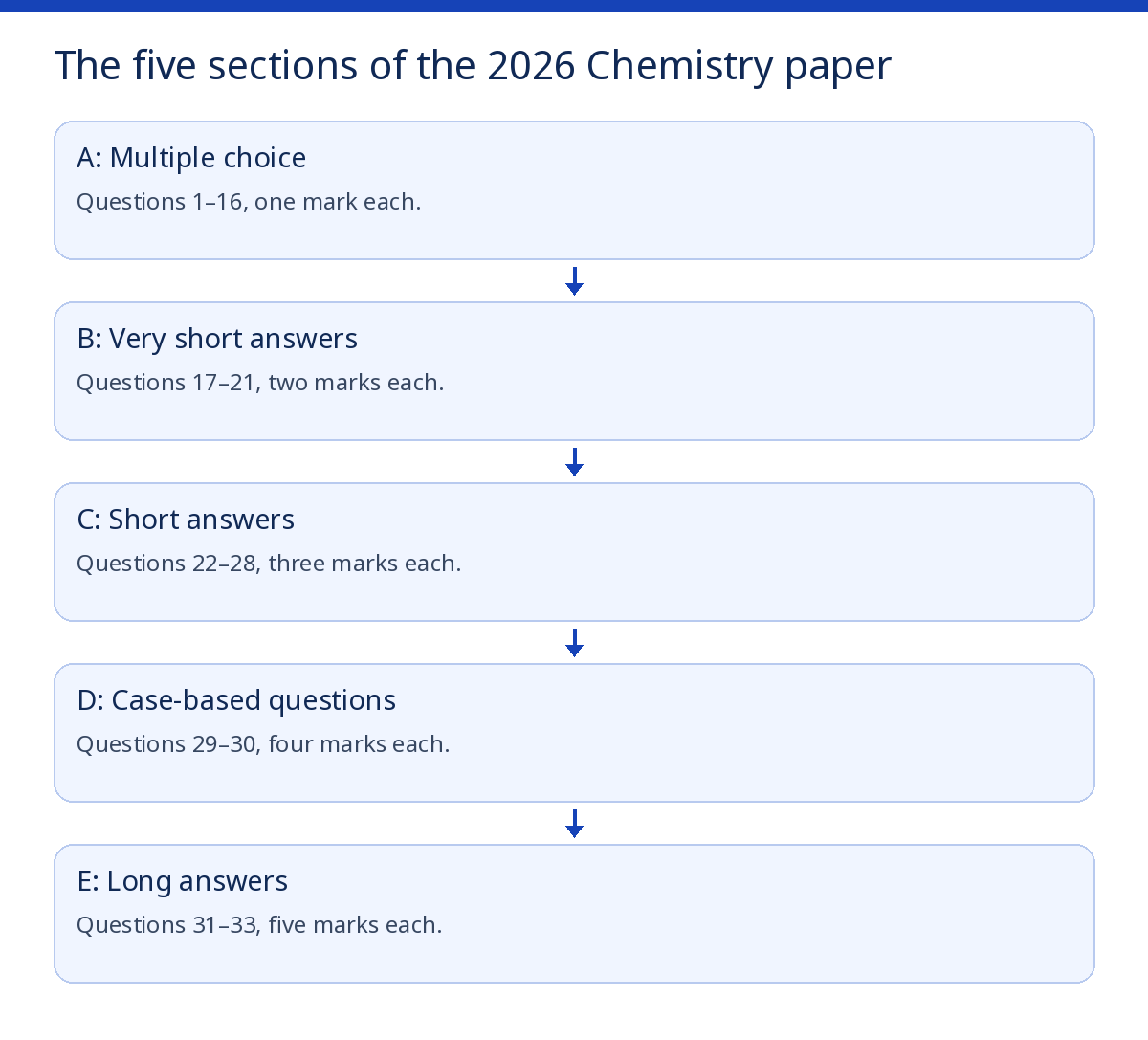
This year-wise resource contains the full CBSE Class 12 Chemistry main examination paper for 2026, identified by paper code 56/3/1. The paper allows three hours, carries 70 marks and does not permit a calculator. It has 33 questions across five sections:
- Section A: Questions 1–16 are multiple-choice items worth one mark each, including assertion–reason questions.
- Section B: Questions 17–21 are very short answers worth two marks each.
- Section C: Questions 22–28 are short answers worth three marks each.
- Section D: Questions 29–30 are case-based questions worth four marks each.
- Section E: Questions 31–33 are long answers worth five marks each.
There is no overall choice. Some questions outside Section A offer an internal OR. In a timed attempt, answer only the required branch where a choice appears. Save the unused branch for a later practice session.

Chemistry 2026 | Class 12 | Previous Year Paper | Code 56/3/1
In the StudentCurio app
Complete CBSE Class 12 Chemistry 2026 main examination paper with worked solutions, covering physical, inorganic and organic chemistry. It helps students practise the full board-paper format and review solution methods.
Physical chemistry: identify the quantity first
The paper moves between solution composition, freezing-point depression, reaction rates, radioactive decay and electrochemistry. Before choosing an equation, write down what the question actually asks you to find. Molality uses the mass of the solvent in kilograms, whereas mole fraction uses the total amount of all components in moles. In kinetics, a species’ rate of formation or disappearance is not necessarily the same numerical quantity as the reaction rate, which is normalized by the relevant stoichiometric coefficient.
The conductivity questions also ask you to interpret behaviour, not just substitute numbers. At high dilution, a weak electrolyte’s degree of dissociation changes substantially, so its molar conductivity does not follow the same extrapolation pattern as a strong electrolyte’s. Kohlrausch’s law provides another route: at infinite dilution, the limiting molar conductivity is the sum of the limiting contributions of the constituent ions, counted according to their stoichiometry.
Inorganic chemistry: keep charge, bonding and medium separate
Coordination chemistry appears in questions on oxidation state, Werner’s theory, nomenclature, ligands and the magnetic behaviour of complexes. When reviewing these items, keep oxidation state and coordination number separate. A neutral ligand does not contribute to the charge balance, but its donor atoms still count towards the coordination number. For questions that compare complexes, do not stop at the metal’s oxidation state: the ligands matter when reasoning about electron pairing and magnetism.
The transition-element questions also use observations such as colour and ask for redox equations in a specified medium. When checking an ionic equation, verify that both atoms and total charge balance. Keep the stated medium visible in your working rather than treating acidic and alkaline conditions as interchangeable.
Organic chemistry: read the reagent and the conditions together
The organic questions ask you to compare substitution behaviour, distinguish functional groups, plan conversions and identify compounds from several test results. Begin by locating the functional group or bond that can react, then read the reagent and conditions together. In the identification problem, make each proposed structure account for both positive and negative observations. A positive test can narrow the possibilities without uniquely identifying the compound.
A mechanism has a scope. The usual acid-catalysed dehydration model for secondary or tertiary alcohols involves a carbocation intermediate. Do not automatically transfer that mechanism to primary alcohols, which can dehydrate by a concerted pathway. When a solution invokes a familiar mechanism, check which structural feature makes it appropriate.
Case-based questions: match each answer to what is asked
The two cases draw on biomolecules and alcohols, phenols and ethers. The biomolecules case moves between structural comparisons and classification, while the organic case asks for reagents, a reaction and a choice of explanations or products. Use the passage to identify the relevant concept, then answer the specific subpart rather than summarising the whole case.
Pay attention to the form of the response. A structural comparison needs a clear point of contrast; a reagent prompt needs the name or formula of the reagent; a reaction prompt calls for a chemical equation. Where the case offers an internal choice, read its placement carefully so you know which subpart it replaces.
Use the worked solutions to find your first wrong step
Complete the paper before opening its question-number links if you want a timed board-paper attempt. For review, the worked pages separate Formula Used, Concept Used and Explanation in Steps. Compare your approach with those layers in order. If your equation was unsuitable, check the concept or condition that should have guided the choice. If the setup was sound, look next at unit conversion, signs, arithmetic or how you stated the conclusion.
For an assertion–reason item, judge the two statements independently before deciding whether the reason actually explains the assertion. For longer answers, use the printed subpart marks to check whether you addressed each requested task. Then try the OR branch you left unused without looking at its solution.
One item to set aside during review
The worked file flags Question 10, the dilute sodium chloride electrolysis item, as ambiguous in its single-answer format. This guide leaves out its answer choices and worked conclusion. If you tally your practice marks, record that item separately rather than treating it as an ordinary right-or-wrong response. The rest of the paper still lets you review the tested concepts and practise moving between short, case-based and extended answers under timed conditions.
Spotted an error? Report a correction. Practise this in the app: notes, formula sheets and mind maps.















































































































































Loading comments…