CBSE Class 12 Chemistry 2025 Board Paper with Solutions
CBSEChemistry2025 Previous Year Paper
Paper code: 56/5/2 · 2025Practise the full English version of the 2025 CBSE Class 12 Chemistry main examination paper, code 56/5/2. Use the worked solutions to check not only your final answers but also your choice of formula, interpretation of evidence and written reasoning.
This set is one of the year's papers. See every set from 2025, grouped by series.
How the 70-mark theory paper is organised
This year-wise resource pairs the original question paper with worked solutions. The paper has 33 questions across five sections and allows three hours of writing time. Its title page also specifies a separate 15-minute reading period during which candidates do not write answers. Calculators are not allowed.
- Section A: Questions 1–16 are one-mark multiple-choice questions, including assertion–reason items.
- Section B: Questions 17–21 are two-mark very short answers.
- Section C: Questions 22–28 are three-mark short answers.
- Section D: Questions 29–30 are four-mark case-based questions.
- Section E: Questions 31–33 are five-mark long answers.
There is no overall choice. Some questions in Sections B through E offer an internal choice, so check whether the printed OR applies to an entire question or only to a particular subpart.

Chemistry 2025 | Class 12 | Previous Year Paper | Code 56/5/2
In the StudentCurio app
Complete CBSE Class 12 Chemistry main examination paper for 2025, with worked solutions and questions spanning the syllabus. Useful for board-exam practice and reviewing step-by-step answers.
Solutions and kinetics: read the data before choosing a rule
The questions on solutions move between vapour pressure, boiling and freezing points, and osmosis. Start by identifying the assumption in the prompt. An ideal liquid mixture is treated using the mole fractions and vapour pressures of its components. A boiling-point elevation calculation instead uses molality, based on kilograms of solvent, and accounts for the number of dissolved particles. If complete dissociation is specified, use it as an assumption for that calculation rather than a general claim about every electrolyte solution.
The kinetics questions present reaction order in several forms: a concentration–time graph, units of a rate constant and a table of initial rates. Read the graph axes before interpreting its shape. In an initial-rate table, compare trials in which one reactant concentration changes while the other stays fixed. That comparison isolates the effect of one reactant on the measured rate.
Common mistake: treating two conductivity measures as one
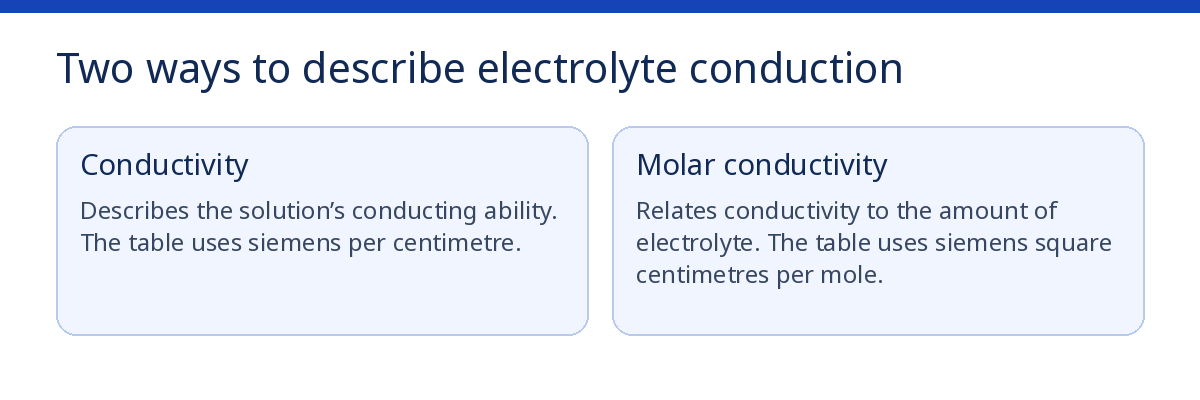
The potassium chloride table gives conductivity in and molar conductivity in at a fixed temperature. Conductivity describes the conducting ability of the solution itself. Molar conductivity relates conductivity to the amount of dissolved electrolyte. Before explaining the effect of dilution, identify which column you are discussing: fewer ions per unit volume and the conducting contribution per mole are different considerations.
The long-answer section also tests galvanic cells and, in an alternative question, Kohlrausch’s law. When reviewing the cell question, distinguish the listed standard reduction potentials from the potential under the specified concentrations. Decide which half-reaction runs as oxidation before writing the cell representation. That keeps the electron balance, cell notation and potential calculation tied to the same reaction direction.
Coordination chemistry: match the evidence to the model
The paper uses more than one way to reason about coordination compounds. A short-answer question explicitly asks for Valence Bond Theory to explain geometry and magnetic character. In that context, an answer needs to link its account of bonding and electron pairing to those properties, rather than simply naming a shape. Another prompt asks for isomer drawings, where the relative positions of ligands matter.
The Werner case study takes a different approach: it gives experimental evidence from precipitation and asks what that evidence implies about the complex. When reading a coordination formula, distinguish ligands written inside the brackets from counterions written outside. The case study also asks learners to distinguish a complex from a double salt. Elsewhere, the paper covers transition-metal properties and lanthanoid and actinoid contraction.
Organic chemistry: make the conditions part of your answer
Organic questions ask for products, mechanisms, distinguishing tests and reasons for observed behaviour. Those are different tasks. A mechanism needs to show how the transformation proceeds under the stated conditions; a distinguishing test needs an observable difference between the substances. For conversions, write the reagent and conditions with the relevant arrow so a reader can see how each step is meant to occur.
The paper also moves between haloalkane reactions, carbonyl chemistry and amines. Do not treat every reaction of a haloalkane with a base as the same transformation: read the solvent and conditions before deciding whether the question concerns substitution or elimination. For the amine basicity comparison, keep the stated aqueous phase in view. The biomolecules questions add carbohydrate structure, protein classification and vitamin deficiency to the paper’s coverage.
Use the worked solutions to locate the first missed step
Keep the solutions closed on your first attempt. Use the reading period to locate internal choices and notice command words such as define, justify and draw. Attempt only one branch at each choice under timed conditions. Afterward, use the cover’s question-number index to find the worked explanation for a response you want to check. The solutions separate the formula used, the concept used and the explanation in steps.
Compare your reasoning in that order. If a numerical answer differs, check whether you selected the right relationship before checking arithmetic. If your conclusion agrees but your explanation is weak, find the missing link between the data and the claim. Then try the unused internal-choice branch separately for revision. This guide does not interpret the configuration-inversion item or the sucrose wording.
Spotted an error? Report a correction. Practise this in the app: notes, formula sheets and mind maps.















































































































































Loading comments…