CBSE Class 12 Chemistry 2025: Solved Main Board Exam Paper
CBSEChemistry2025 Previous Year Paper
Paper code: 56/2/2 · 2025Practise the full English-language 2025 CBSE Class 12 Chemistry main examination paper, set 56/2/2. Then use the worked solutions to check not just what you wrote, but why a formula, reaction pathway or explanation applies.
This set is one of the year's papers. See every set from 2025, grouped by series.
What comes with the 2025 paper
This year-wise previous year paper pairs the original question paper with worked solutions. The English question layout, options and diagrams are preserved, so you can practise reading the questions as they were presented rather than as a list of chapter exercises. The paper gives 3 hours and carries 70 marks. It covers physical, organic and inorganic chemistry, with biomolecules among the topics visible in the worked explanations.
The cover provides navigation by question number. The solution pages separate the formula or rule used, the underlying concept and the explanation in steps. That distinction is useful: a numerical response may need a formula, whereas a question about bonding or reactivity needs a chemical reason. The file includes explanations for subparts and both printed OR alternatives, so you can revisit the alternative you did not choose during a timed attempt.

Chemistry 2025 | Class 12 | Previous Year Paper | Code 56/2/2
In the StudentCurio app
Solved questions from the 2025 CBSE Class 12 Chemistry main examination, with worked explanations across organic, inorganic and physical chemistry. Useful for practising board-exam questions and reviewing solutions across chapters.
When the half-life formula applies
The kinetics explanations distinguish reaction order from molecularity. Order comes from the powers of concentration in the rate law. Molecularity counts the reacting entities that participate in a single elementary step. An elementary step must involve at least one reacting entity, so molecularity cannot be zero. A reaction can nevertheless have zero order: within the regime where the zero-order rate law applies, its rate is independent of the reactant concentration.
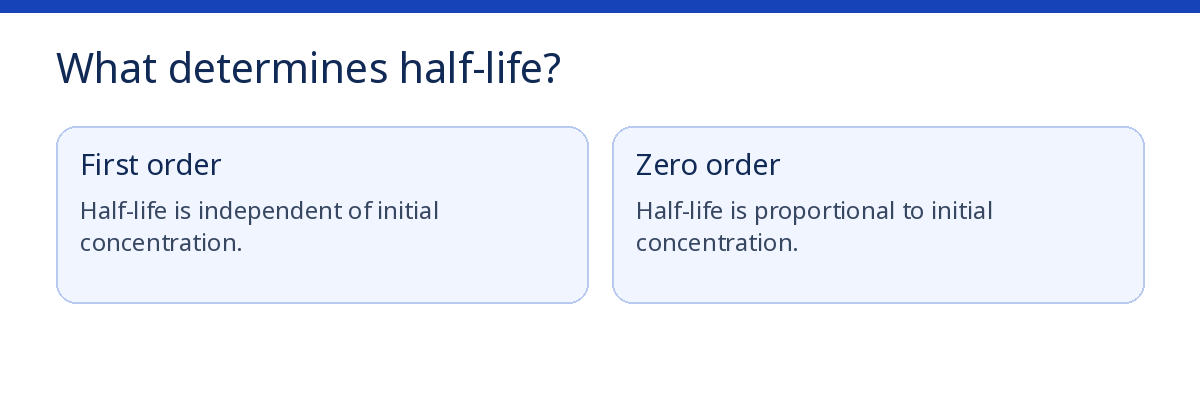
Use that distinction when reviewing half-life. For first-order kinetics, , so the half-life does not depend on the initial concentration at a fixed rate constant. For zero-order kinetics, , so the initial concentration does matter. Before comparing two half-lives, identify the order and decide which quantities are being held fixed. If your final comparison differs from the worked explanation, check the choice of rate law before checking the arithmetic.
Organic chemistry: explain why the pathway fits
The organic explanations show why substrate structure matters in nucleophilic substitution. An comparison turns on how readily the substrate can form a carbocation under the stated conditions. An comparison instead asks how easily the nucleophile can approach the reacting carbon from the back. When comparing similar substrates, a structural change that favours carbocation formation can also make backside attack harder. That is why one reactivity ranking cannot serve both mechanisms.
The same reasoning helps with named reactions. The standard Gabriel phthalimide synthesis relies on an alkyl step; ordinary aryl halides do not undergo that required displacement. When reviewing named reactions of phenols, look at the group introduced rather than memorising the name in isolation. The explanations distinguish carboxylation, which introduces a carboxyl group, from formylation, which introduces a formyl group. Those are different transformations even though both add a carbon-containing group.
Coordination chemistry: separate donor atom from spin
The coordination compound explanations illustrate two different ways to read a complex. For linkage isomerism, ask which atom is directly bonded to the metal. An ambidentate ligand can coordinate through either of two different donor atoms. The ligand’s composition need not change for the metal–ligand connection to change, so simply recognising the ligand’s name is not enough.
For a question about magnetism, the key feature is whether the complex has unpaired electrons. Follow the explanation from the metal ion’s electron count through the effect of the ligands on pairing rather than treating the metal’s identity as decisive. In this part of the paper, a useful review habit is to underline what the prompt is testing: the donor atom in a connectivity question, or the electron arrangement in a magnetic comparison.
A useful distinction: backbone bonds and base pairing
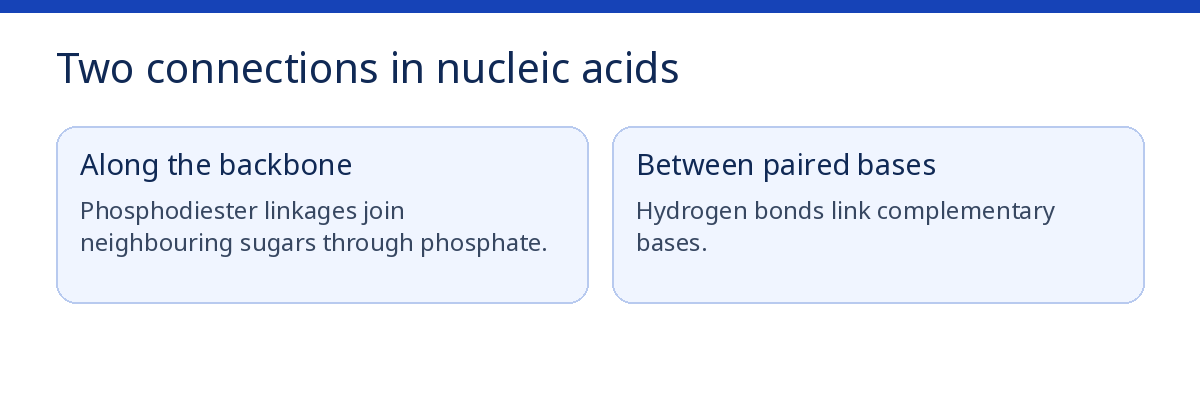
The biomolecules explanations separate the bonds that connect nucleotides along a strand from the interactions between paired bases. Phosphodiester linkages connect neighbouring sugars through phosphate, forming the sugar–phosphate backbone. Hydrogen bonds between complementary bases have a different role. When a prompt asks for the linkage between successive nucleotides, focus on connections along the strand, not on base pairing.
The vitamin and protein items call for a different distinction: identify the property being tested before choosing a biological explanation. For vitamins, solubility can help explain whether a vitamin is retained in tissues, while a deficiency question asks about the consequences of inadequate intake or availability. For proteins, denaturation concerns disruption of the native higher-order structure; it does not require cleavage of the peptide bonds that hold the amino acid sequence together.
After a timed attempt: find the first wrong step
Work from the question pages first, using the printed time limit if you want to simulate the board paper. Attempt one alternative where the question offers an OR choice, and leave the other for untimed review. For assertion–reason items, judge each statement independently before checking whether the reason explains the assertion. Two true statements do not automatically form a valid explanation.
When you open a worked solution, identify the first point where your reasoning diverged. In a redox calculation, for instance, check the oxidation-state change and the electron balance before converting a mole amount of electrons into charge. Then retry the question from the original page without looking at the explanation. This guide leaves out the copper–acid item’s answer discussion, which depends on a nonoxidizing-acid interpretation, and the milk-curdling example, which the solution treats as a textbook comparison.
Spotted an error? Report a correction. Practise this in the app: notes, formula sheets and mind maps.















































































































































Loading comments…