CBSE Class 12 Chemistry 2025 Board Paper with Solutions
CBSEChemistry2025 Previous Year Paper
Paper code: 56/6/2 · 2025Practise with the full English-language 2025 CBSE Class 12 Chemistry main examination paper, Set 2 (Q.P. Code 56/6/2). The year-wise file pairs the original questions with worked solutions so you can review how you chose a method, used the data and explained your reasoning.
This set is one of the year's papers. See every set from 2025, grouped by series.
Know the five-section paper before you start
This is a 70-mark theory paper with 33 questions and a writing time of three hours. The printed instructions allot a separate 15-minute reading period during which candidates do not write answers. There is no overall choice: questions are compulsory, but some in Sections B to E offer internal choices. Section A has no internal choice, and calculators are not allowed.
- Section A: 16 one-mark multiple-choice questions, including assertion–reason items.
- Section B: Five two-mark very short-answer questions.
- Section C: Seven three-mark short-answer questions.
- Section D: Two four-mark case-based questions.
- Section E: Three five-mark long-answer questions.
Use the reading period to find where each OR choice starts and ends and to notice changes in what the paper asks you to produce: a selection, a reason, an equation, a calculation or an interpretation.

Chemistry 2025 | Class 12 | Previous Year Paper | Code 56/6/2
In the StudentCurio app
Complete CBSE Class 12 Chemistry main examination paper for 2025 (Q.P. Code 56/6/2), with worked solutions covering questions across the syllabus. Helps students practise the board-paper format and review solution methods.
Physical chemistry: start with what the data tell you
The physical chemistry questions use several kinds of evidence. Solutions questions draw on vapour pressure and freezing-point data; kinetics questions use a graph and a table of initial rates; electrochemistry asks about cell potential, electrolysis and conductivity. The deciding step is often identifying what the data represent before choosing a formula.
For a kinetics table, compare trials in which one reactant concentration changes while the other stays fixed. This isolates the effect of the first reactant on the measured rate. For a graph, read both axis labels before interpreting its slope: a straight line alone does not tell you which concentration expression was plotted. In a cell-potential calculation, write the reaction in the stated direction before setting up the reaction quotient. Reversing the direction changes the quotient and the sign of the cell potential.
Coordination chemistry: keep counting tasks separate
The paper moves from short questions on coordination number and geometrical isomerism to naming, ligand definitions, electronic arrangements and magnetic behaviour. It also asks about oxidation-state trends and reactions of transition-element compounds. A complex can therefore test several different skills even when the same formula appears in each part.
Common mix-up: ligand count is not coordination number. Count donor atoms directly bonded to the metal for coordination number, but use ligand charges and the overall charge of the complex to determine the metal’s oxidation state. For a magnetic-behaviour explanation, identify the metal ion’s electron count and apply the relevant ligand-field information before deciding whether electrons are unpaired. Keep those steps separate when reviewing your work so you can tell whether the error was in charge bookkeeping or electron arrangement.
Organic chemistry and biomolecules: match the answer to the task
The organic questions range from reagent and product recognition to conversions from aniline, comparisons of substitution mechanisms, and identification of compounds from reaction clues. If a prompt asks for a chemical equation only, make the starting material, reagent or conditions, and product clear. If it asks for a reason, identifying the product or reaction type alone does not explain why it occurs.
In an identification problem, use positive and negative test results together: a candidate structure must fit the full set of clues, not just one familiar reaction. The biomolecules questions use a different kind of evidence. They connect the observed reactions of glucose to structural features and use a protein passage to ask about linkages, properties and levels of structure. Distinguish evidence for a functional group from a general description of the molecule.
Quick self-check: does the reason explain the assertion?
For the assertion–reason items, make two separate judgements. First decide whether each statement is true on its own. Then, if both are true, ask whether the reason accounts for the assertion rather than merely stating another fact about the same topic. Try expressing the link in one sentence using “because.” If the sentence only restates the assertion or shifts to a different claim, recheck the explanatory link before selecting a code.
Apply the same check to written questions that ask you to give reasons. A good explanation connects the chemical principle to the particular comparison or observation in the prompt, rather than just naming the principle.
Attempt first, then review the worked solutions
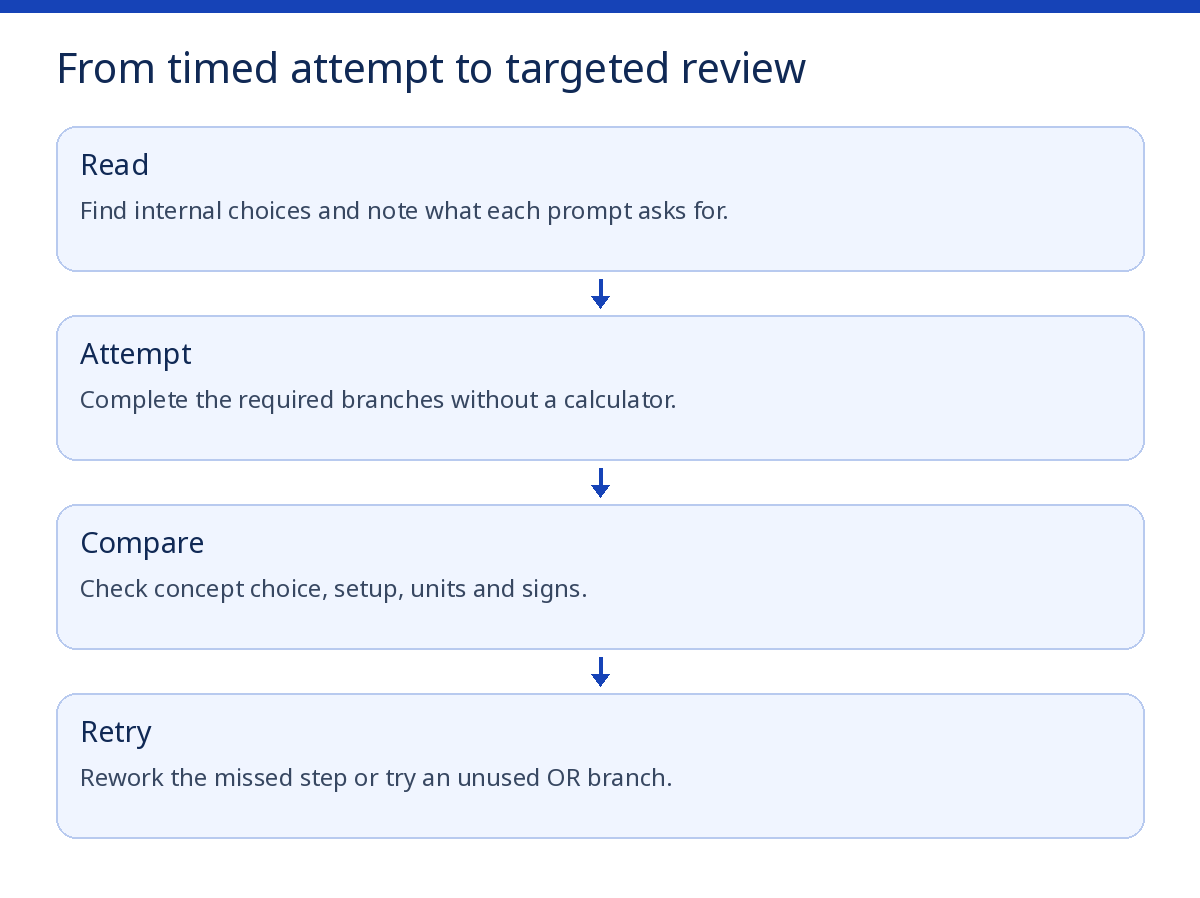
For a timed attempt, stay in the question-paper portion and answer only the required branch of each internal choice. Open the worked solutions afterwards. Their formula, concept and step-by-step explanation let you locate where your reasoning parted company with the worked method. If your setup was sound but your result differed, check units, signs and arithmetic before replacing the method. If your setup was wrong, identify which condition or clue you missed before trying the question again. Use the unused OR branches for additional practice after the timed attempt.
Three isolated details are left out of this guide: Q1’s worked option label does not match the printed option text, Q8 is flagged in the resource as ambiguous in single-choice form, and the disputed standard-potential sign and alternative numerical results for Q32(b)(ii) are omitted.
Spotted an error? Report a correction. Practise this in the app: notes, formula sheets and mind maps.















































































































































Loading comments…