CBSE Class 12 Chemistry 2025 Solved Paper: Set 56/2/3
CBSEChemistry2025 Previous Year Paper
Paper code: 56/2/3 · 2025Practise the full English-language CBSE Class 12 Chemistry 2025 main examination paper, set 56/2/3. Then use the worked solutions to check not just your final answers, but also the rules and conditions you used to reach them.
This set is one of the year's papers. See every set from 2025, grouped by series.
What this year-wise paper contains
This file gathers the complete 2025 CBSE Class 12 Chemistry main examination paper and its worked solutions. The printed time is 3 hours, and the maximum is 70 marks. It is a full paper organised by year, not a chapter-wise worksheet. The original English question layout, options and diagrams are preserved, so you can practise reading the paper as presented rather than working from a rearranged list of topics.
The question-number index lets you go directly to an explanation when reviewing. The solutions cover the questions, their subparts and both printed alternatives where the paper gives an OR choice. Having both explanations available is useful after an attempt: you can review the route you chose and then try the alternative independently.

Chemistry 2025 | Class 12 | Previous Year Paper | Code 56/2/3
In the StudentCurio app
Complete solved CBSE Class 12 Chemistry main examination paper set 56/2/3, with questions and worked solutions spanning physical, inorganic and organic chemistry. Helps students practise the board-paper format and review exam-level concepts and solution methods.
Physical chemistry: identify the rule before calculating
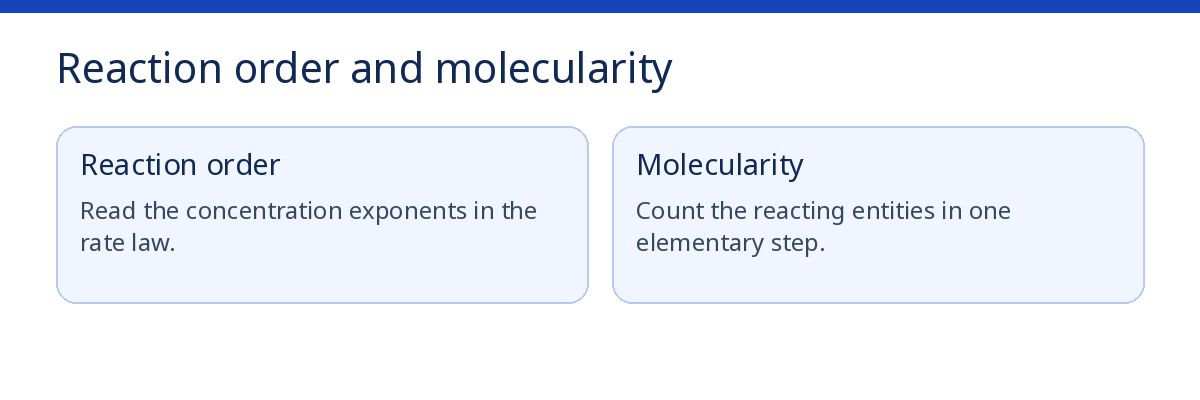
The kinetics material makes an important distinction between reaction order and molecularity. Order comes from the concentration exponents in the rate law. Molecularity counts the reacting entities in a single elementary step. Before applying either idea, ask whether the question is describing a measured rate law or the participants in one elementary event. The distinction matters because those are different kinds of information, even when they appear in the same chapter.
Electrochemistry asks for a different kind of reasoning. In a redox half-reaction, tracking the oxidation-state change helps determine the number of electrons transferred. In a question about whether a reaction can occur spontaneously under standard conditions, compare the relevant half-reactions with their directions in mind. A tabulated reduction potential describes a reduction; it is not automatically the potential for the reverse oxidation.
When the half-life formula applies
For a first-order reaction, , so at a fixed rate constant the half-life does not depend on the starting concentration. For a zero-order reaction with rate law throughout the interval considered, . In that case, the rate is independent of concentration within the applicable regime, but the half-life still depends on the initial concentration.
Keep those two statements separate when reviewing kinetics: a constant rate does not mean a constant time to consume half of any starting amount. If you find yourself choosing a formula merely because the question mentions half-life, go back and identify the order first. The formula is a consequence of the rate law, not a rule that applies to every reaction.
Inorganic chemistry: read the complex before naming it
The inorganic material includes electronic configurations and several aspects of coordination chemistry: naming, linkage isomerism, geometry and magnetism. For a naming question, first distinguish the species inside the coordination brackets from the counterions outside. Use the charge of the complex and the charges of its ligands to determine the metal oxidation state. This separates the charge calculation from the task of ordering ligand names and writing the final name.
Other questions ask you to read a different feature of the same notation. A ligand that can attach through different donor atoms can give rise to linkage isomerism; look at which atom binds to the metal, not merely which ligand is present. For magnetism, focus on whether electrons remain unpaired rather than treating the metal's identity alone as enough to classify the complex.
Organic chemistry and biomolecules: notice what changes
The organic material includes alcohol oxidation, aromatic nomenclature, phenol reactions and amine preparation. A useful way to review the reaction questions is to identify the starting functional group, then check what the reagent and conditions allow. For example, the standard Gabriel preparation relies on an alkyl substitution step. Extending that reasoning to an ordinary aryl halide without checking whether it can undergo the required displacement overlooks the condition that makes the method work.
The biomolecules material includes vitamins, proteins and nucleic acids. In reviewing nucleic-acid structure, distinguish the linkages that join units along the sugar–phosphate backbone from the interactions between paired bases. These describe different parts of the structure. This guide leaves out the paper's milk-curdling comparison and does not reproduce the interpretation-dependent answer option for the dilute-acid item.
Use the worked solutions to find your first wrong step
For a rehearsal, set aside the printed three hours and keep the worked solutions closed. Follow the question paper's directions for internal choices. When checking your attempt, use the index to revisit questions where you were unsure of your reasoning as well as those where your final answer differed. The solution pages separate the formula used, the concept used and the explanation in steps, which makes it easier to see where your approach first diverged.
Before moving on, pick one uncertain response and explain what detail in the question justified your method. Was it a stated reaction order, the charge on a complex, or the type of substrate? If you can name the rule but cannot point to the detail that makes it applicable, revisit the reasoning before trying the question again without the solution.
Spotted an error? Report a correction. Practise this in the app: notes, formula sheets and mind maps.















































































































































Loading comments…