2025 CBSE Class 12 Chemistry Previous Year Paper
CBSEChemistry2025 Previous Year Paper
Paper code: 56/7/1 · 2025Practise the full 2025 CBSE Class 12 Chemistry main examination paper, code 56/7/1, and use the worked solutions after your attempt. This year-wise resource lets you rehearse the 70-mark theory paper and see where your reasoning needs work across physical, inorganic and organic chemistry.
This set is one of the year's papers. See every set from 2025, grouped by series.
Know the format before you start
This English version of the main board paper has 33 compulsory questions, with three hours of writing time and no calculator. There is no overall choice. Some questions outside Section A offer an internal choice, so check whether the printed OR applies to a whole question or just one subpart. The original instructions also specify a separate 15-minute reading period during which candidates do not write answers.
- Section A: Questions 1–16 are worth one mark each. The last four use the assertion–reason format.
- Section B: Questions 17–21 are very short answers worth two marks each.
- Section C: Questions 22–28 are short answers worth three marks each.
- Section D: Questions 29–30 are case-based and worth four marks each.
- Section E: Questions 31–33 are long answers worth five marks each.
Read the subpart marks as well as the section labels. A five-mark question can contain several short tasks rather than require a single extended explanation.

Chemistry 2025 | Class 12 | Previous Year Paper | Code 56/7/1
In the StudentCurio app
The 2025 CBSE Class 12 Chemistry main examination paper with worked solutions, covering questions across physical, inorganic and organic chemistry. Helps students practise the board-paper format and review exam problem-solving methods.
Physical chemistry: identify the quantity first
The paper tests solutions, chemical kinetics and electrochemistry through both conceptual prompts and calculations. For solutions, it separates two ideas that are easy to mix up: deviations from Raoult’s law concern vapour pressure, while freezing-point depression depends on the effective number of dissolved particles. Association matters because several solute molecules can contribute as one particle.
In kinetics, distinguish a temperature-dependence question from a calculation that follows a reaction over time. The gas-decomposition problem reports total pressure, which is not the same as the reactant’s partial pressure once products are present. In electrochemistry, identify whether the prompt asks about a working cell or electrolysis before deciding which quantities or half-reactions to use. One cell-emf question gives nonstandard concentrations, so tabulated standard potentials are inputs, not the requested result.
Inorganic chemistry: connect notation to a property
The coordination chemistry questions move between naming, isomerism, precipitation and crystal field theory. When reading a coordination formula, distinguish ligands inside the brackets from counterions outside them. That distinction matters because a coordinated ion is not the same as a free ion available for immediate precipitation in a solution test. For an isomerism prompt, check whether you are being asked about spatial arrangement or about which atom of a ligand binds to the metal.
The crystal field case asks you to reason about orbital splitting, pairing and geometry. In the transition-metal and inner-transition-metal questions, first identify the property you need to explain. The reasoning behind an electrode potential is not interchangeable with the reasoning behind an oxidation state or a magnetic property.
Organic chemistry and biomolecules: read the conditions
The organic questions cover substitution in haloalkanes and haloarenes, reactions of alcohols and phenols, amine preparation and basicity, and tests and transformations involving carbonyl compounds. Some prompts give a reagent and ask for a product; others give observed behaviour and ask for a possible structure. In a conversion chain, track the carbon skeleton and functional group after each arrow. In a structure question, reread each subpart: the same molecular formula can be used to ask for different structures with different properties.
The amines case is a reminder to read the stated medium. In aqueous solution, basicity reflects not only electron donation but also steric effects and how well the substituted ammonium ion is solvated. The biomolecules questions require a different kind of precision: distinguish protein sequence from levels of folding, and DNA strand complementarity from the products of DNA hydrolysis.
Two traps to check before you move on
- Treating equal mass percentages as equal particle concentrations. In the dilute, idealised comparison used for boiling-point elevation, both molar mass and the effective number of particles per formula unit matter. Counting ions alone does not tell you how many dissolved particles a given mass provides.
- Treating two true statements as proof of an explanation. In an assertion–reason item, judge each statement independently. If both are true, make a separate check: does the reason actually explain the assertion? The paper distinguishes that relationship from two true statements that are merely related.
Use the worked solutions for a second pass
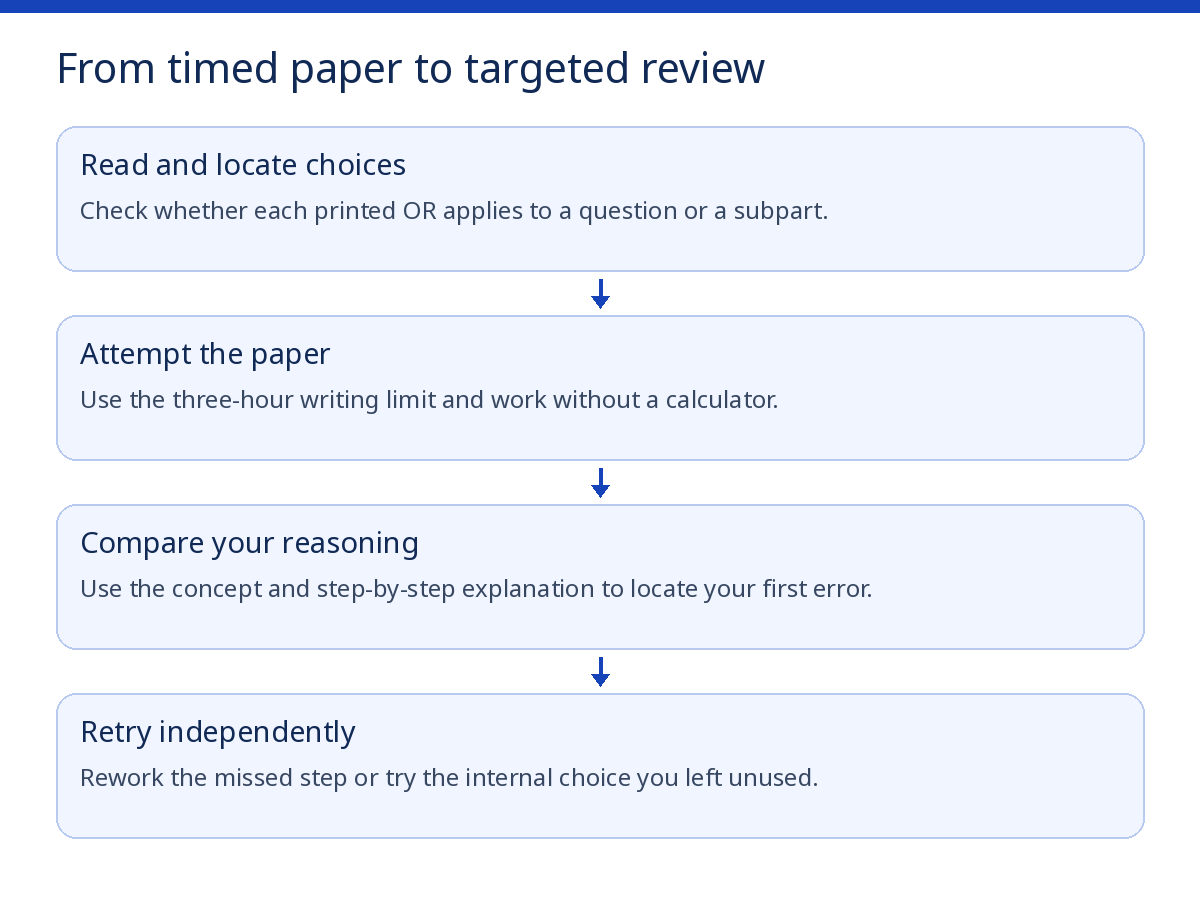
For a mock attempt, read the question pages first and use the separate reading period to locate internal choices. Work without a calculator and write down the selected branch and subpart labels. In the case-based section, use the passage to identify the relevant concept, then check what each subpart actually asks you to supply: a definition, an explanation, a comparison or a conversion.
After the timed attempt, use the file’s question-number navigation to open the worked solutions. Compare your approach with the stated concept and the explanation in steps before checking the final result. Find the first point where your reasoning diverged: did you miss a reaction condition, confuse pressure quantities, or omit the chemical reason in an explanation? Where the paper offers an internal choice, save the unattempted branch for a short follow-up exercise. That gives you another chance to apply the concept without simply remembering the answer you just read.
Spotted an error? Report a correction. Practise this in the app: notes, formula sheets and mind maps.















































































































































Loading comments…