CBSE Class 12 Chemistry 2025 Supplementary Paper
CBSEChemistry2025 Previous Year Paper
Paper code: 56/S/1 · 2025Use the full 2025 CBSE Class 12 Chemistry supplementary paper (56/S/1) to practise across five question formats. Then use the worked solutions to check the principle you chose, the conditions under which it applies and the steps you wrote.
This set is one of the year's papers. See every set from 2025, grouped by series.
What this year-wise paper contains
This file pairs the English version of the 2025 CBSE Class 12 Chemistry supplementary theory paper with worked solutions. The paper carries 70 marks and allows three hours of writing time, with a separate 15-minute reading period. Calculators are not permitted. Because the resource is organised as a complete paper for one year rather than by chapter, it lets you practise switching between calculations, chemical reasoning and recall in the order the questions appear.
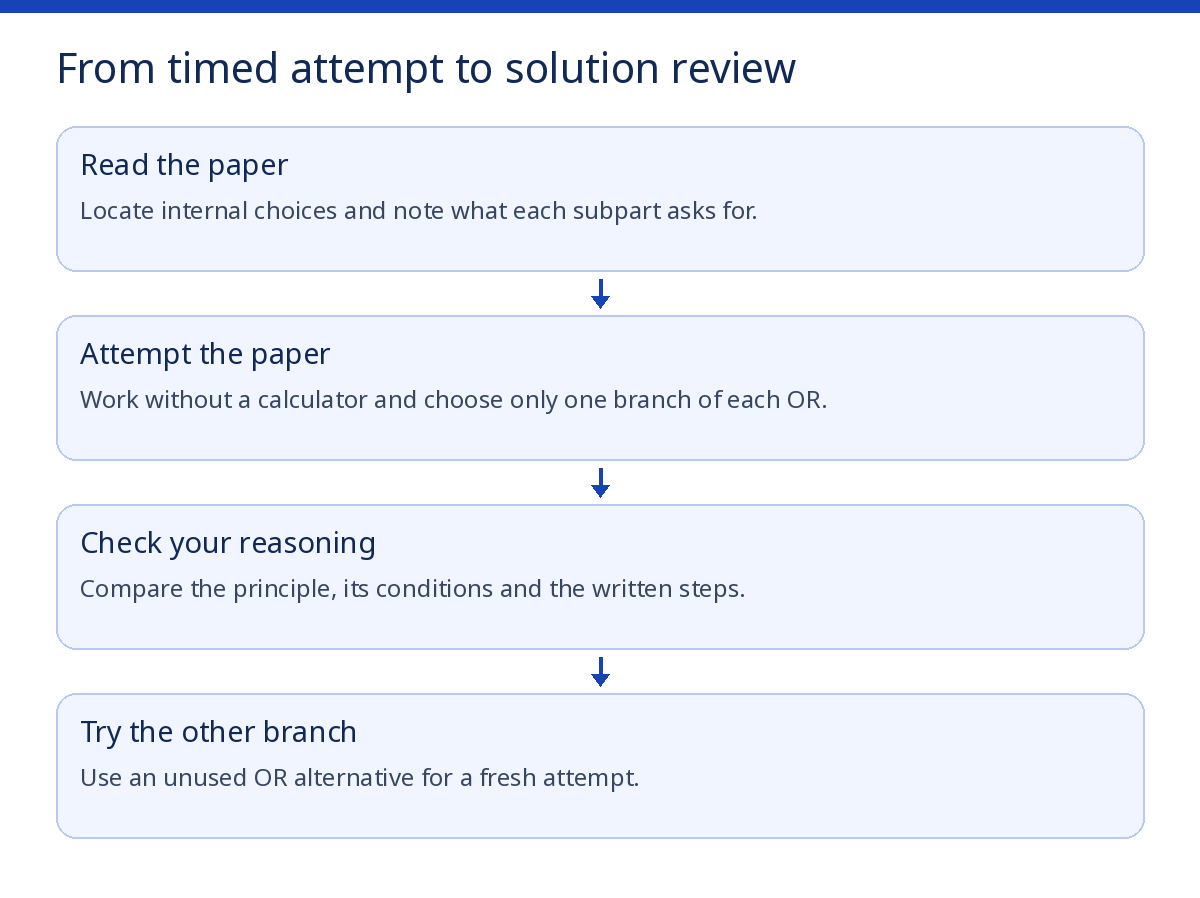
All 33 questions are compulsory, but some have internal choices. Section A has 16 one-mark multiple-choice questions, including assertion–reason items. Sections B and C have five two-mark very short answers and seven three-mark short answers, respectively. Section D has two four-mark case-based questions, and Section E has three five-mark long answers. There is no internal choice in Section A. Where an OR appears elsewhere, attempt only one alternative during a timed sitting; save the other for review.

Chemistry 2025 | Class 12 | Previous Year Paper | Code 56/S/1
In the StudentCurio app
Complete CBSE Class 12 Chemistry supplementary examination paper for 2025 with worked solutions. It includes questions across several chapters, including Solutions, Electrochemistry, Chemical Kinetics, Coordination Compounds, Biomolecules and organic chemistry, helping students practise board-exam questions and review answer methods.
When the physical chemistry formulas apply
In Solutions, distinguish the quantities you are comparing. With Henry’s law written as , the dissolved gas mole fraction is compared at the same temperature and gas partial pressure. In a liquid-mixture vapour-pressure calculation, using Raoult’s law across the composition range assumes ideal behaviour. The paper also asks about deviations from that law, so identify whether the task calls for an ideal-mixture calculation or reasoning about interactions between unlike molecules.
In Electrochemistry, the paper moves from conductivity and dilution to cell emf and electrolysis. In an emf calculation under nonstandard conditions, distinguish the standard cell potential from the potential at the stated concentrations. When setting up the reaction quotient, use the balanced cell reaction and leave out pure solids. In Chemical Kinetics, the fixed half-life relation applies to a first-order reaction. For an initial-rate table, start with trials in which one reactant concentration changes and the other is held constant; do not take the powers in the rate law from the overall equation.
Coordination compounds and transition-metal reasoning
The coordination-compound questions test naming, isomerism, hybridisation and magnetic behaviour. Start by reading the brackets: a species inside the coordination sphere is not treated like a counter-ion outside it. For a magnetic prediction, determine the metal ion’s oxidation state and electron count before deciding whether electrons remain unpaired. This gives you a chain of reasoning to check rather than a label to memorise.
The case on complex colours adds a table-reading task. Keep the wavelength absorbed separate from the colour observed: the table provides distinct columns for those quantities. The case also draws on crystal-field splitting and the competition between splitting and electron pairing. The long-answer section broadens the inorganic practice to transition-metal properties, lanthanoids and balancing redox equations. For a redox equation, check both atom balance and charge balance, not just the formula of the product.
Follow structures across organic chemistry and biomolecules
The organic questions range from recognising structures to explaining reactivity, planning conversions and selecting chemical tests. Before writing a product, mark the functional group or bond affected by the reagent. For halides, inspect the carbon directly bonded to the halogen rather than classifying the compound from a nearby double bond or aromatic ring. For a multistep conversion, put the reagent or condition beside each arrow so you can see where the carbon skeleton or functional group changes.
The Biomolecules questions ask for distinctions between starch and cellulose and between primary and secondary protein structure. Make each comparison on a shared basis: if one half describes structure, the other half should not merely name a function. The carbohydrate case also tests definitions and functions. Read the passage for context, then identify whether each subpart asks you to extract information or recall a chemistry concept.
Quick self-check: can you justify the link?
For assertion–reason items, decide whether each statement is true before asking whether the reason explains the assertion. Two true statements about the same topic need not have a causal connection. For written explanations, try a similar check: does your answer name the feature responsible for the result, or does it simply restate the result in different words?
The Lucas-reagent multiple-choice item is omitted from this guide because the resource flags its room-temperature wording as not yielding a unique choice. Do not use that item to judge your recall from a single option; use the other organic questions to practise matching structures and reaction conditions.
How to review with the worked solutions
Use the reading period to locate internal choices and note which subparts call for a graph, an equation or a reason. Finish your attempt before opening the solutions. The cover provides question-number navigation, and the worked format separates the formula, concept and explanation in steps. Compare your work in that order: did you recognise the relevant principle, check that it applied, and carry it through with the correct signs or units?
If a result differs, find the first step where your reasoning diverged and rewrite from that point without copying the ending. Then try the unused OR alternative where one is available. That second attempt shows whether you can use the underlying concept on a different prompt, rather than merely remember the solution you just read.
Spotted an error? Report a correction. Practise this in the app: notes, formula sheets and mind maps.















































































































































Loading comments…