CBSE Class 12 Chemistry 2025 Solved Paper (56/5/3)
CBSEChemistry2025 Previous Year Paper
Paper code: 56/5/3 · 2025Use this solved CBSE Class 12 Chemistry main examination paper to practise the full 2025 theory exam, then review your work against the step-by-step explanations. The English version is paper code 56/5/3, with three hours of writing time and a maximum of 70 marks.
This set is one of the year's papers. See every set from 2025, grouped by series.
What this paper contains
This year-wise resource pairs the complete question paper with worked solutions. The question pages retain the original English layout, options and diagrams, so you can practise reading a graph, interpreting a table or locating an internal choice in context. The cover’s question-number index lets you find an explanation after you have attempted the corresponding item.
The paper has 33 questions across five sections. Section A has 16 one-mark multiple-choice questions, including assertion–reason items. Sections B and C contain two-mark and three-mark written questions, respectively. Section D has two four-mark case-based questions, and Section E has three five-mark questions. There is no overall choice, although some questions in Sections B–E offer an internal choice.

Chemistry 2025 | Class 12 | Previous Year Paper | Code 56/5/3
In the StudentCurio app
Complete solved CBSE Class 12 Chemistry main examination paper (code 56/5/3) for 2025, with questions and worked answers spanning physical, inorganic and organic chemistry. It helps students practise board-style questions and review their solutions.
Physical chemistry: Match the model to the data
The solutions questions range from vapour pressure in an ideal liquid mixture to boiling-point elevation and applications of osmosis. Before calculating, identify what the question assumes. For a mixture specified to be ideal, the contribution of each component to the total vapour pressure is its mole fraction multiplied by its pure-component vapour pressure at the same temperature. For boiling-point elevation, use molality rather than molarity, and account for dissociation as specified in the question.
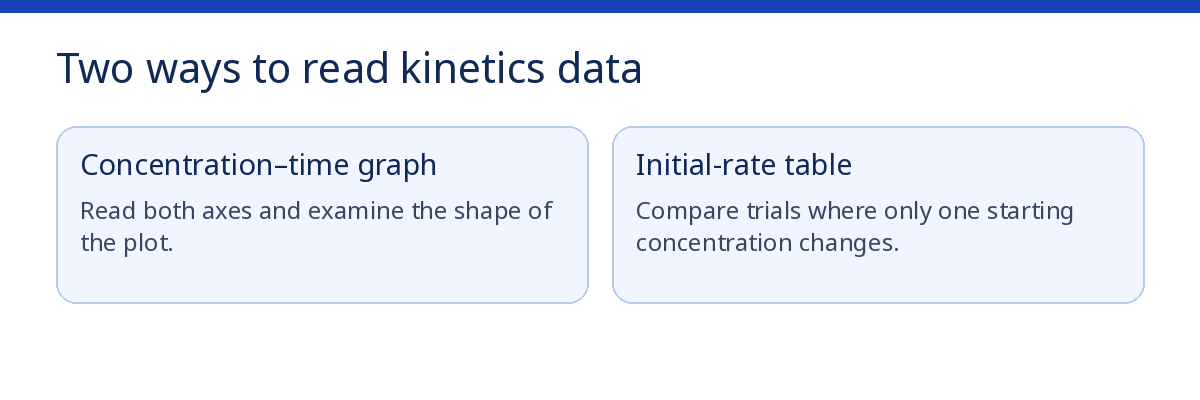
Chemical kinetics tests a different kind of interpretation. The paper includes both a concentration–time graph and a table of initial rates. For an initial-rate comparison, choose trials in which one reactant concentration changes while the other is held fixed. This lets you attribute the change in rate to the reactant you are examining.
Common mix-ups in the electrochemistry questions
Conductivity and molar conductivity are not interchangeable. The potassium chloride table places them side by side, with conductivity in and molar conductivity in . Dilution can lower conductivity while raising molar conductivity: the former describes how well the solution conducts, while the latter relates that conductivity to the amount of electrolyte per unit volume. Read the column heading before explaining a trend.
Standard potential and cell potential under the stated conditions are not necessarily equal. The galvanic-cell questions distinguish choosing the direction of half-reactions from calculating a cell potential for specified concentrations. When balancing the overall reaction, scale the half-reaction equations to cancel electrons, but do not multiply their electrode potentials by those coefficients.
Coordination compounds and periodic trends
The coordination chemistry questions ask you to move between a formula, a structural description and experimental evidence. For geometry, begin by identifying the metal’s oxidation state and the ligands before comparing complexes. A shared metal or coordination number is not enough to establish that two complexes have the same shape.
The Werner theory case uses precipitation and conductivity to probe what is inside or outside the coordination sphere. In the precipitation subpart, the amount of silver chloride is evidence about chloride available as free ions in solution, not simply a count of all chlorine atoms in the formula. Elsewhere, the paper asks for explanations involving transition-metal properties and lanthanoid contraction. In these responses, name the relevant structural or electronic feature and connect it explicitly to the observation.
Organic chemistry: Read the conditions with the structure
Organic questions move between nomenclature, chemical tests, mechanisms and conversions. The paper includes haloalkanes and haloarenes, alcohols and ethers, carbonyl compounds, carboxylic acids and amines. When reviewing a reaction question, mark the functional group that changes and read the reagent, medium and any stated temperature together. Recognising the starting compound alone is not enough to establish what happens under the given conditions.
For a chemical test, distinguish the reagent from the observation that makes the test useful. If the prompt asks for a mechanism, an overall equation does not show the requested sequence of steps. Biomolecules also feature through protein denaturation and carbohydrate stereochemistry. This guide omits the carbohydrate case’s wording about invert sugar and its ambiguously extracted stereoisomer-count expression.
Use the worked solutions after a timed attempt
To match the printed conditions, allow a separate 15-minute reading period, then attempt the paper in three hours without a calculator. During reading time, locate the internal choices and note what each subpart asks you to produce: a reason, a calculation, a structure, an equation or a mechanism. Attempt only one branch of an internal choice during the timed sitting; use the other branch for later practice.
When reviewing, use the solution layout to pinpoint where your reasoning changed course. Compare the concept used first, then the formula used where relevant, and finally the step-by-step explanation. A wrong model calls for different revision from a correct setup followed by a sign, unit or arithmetic error.
Quick self-check before a second attempt
For an assertion–reason item, can you judge the two statements separately before deciding whether the reason actually explains the assertion? For a case-based item, can you point to the observation in the passage that supports your inference? Reattempt one missed item from each format without opening its solution. Check whether your new response fixes the reasoning gap you identified, rather than merely matching the final answer.
Spotted an error? Report a correction. Practise this in the app: notes, formula sheets and mind maps.















































































































































Loading comments…