CBSE Class 12 Chemistry 2025 Solved Board Paper
CBSEChemistry2025 Previous Year Paper
Paper code: 56/6/3 · 2025Practise the full English-language 2025 CBSE Class 12 Chemistry main examination, paper code 56/6/3. Use the original questions for a timed attempt, then compare your reasoning with the worked solutions across physical, inorganic and organic chemistry.
This set is one of the year's papers. See every set from 2025, grouped by series.
Know the format before you start
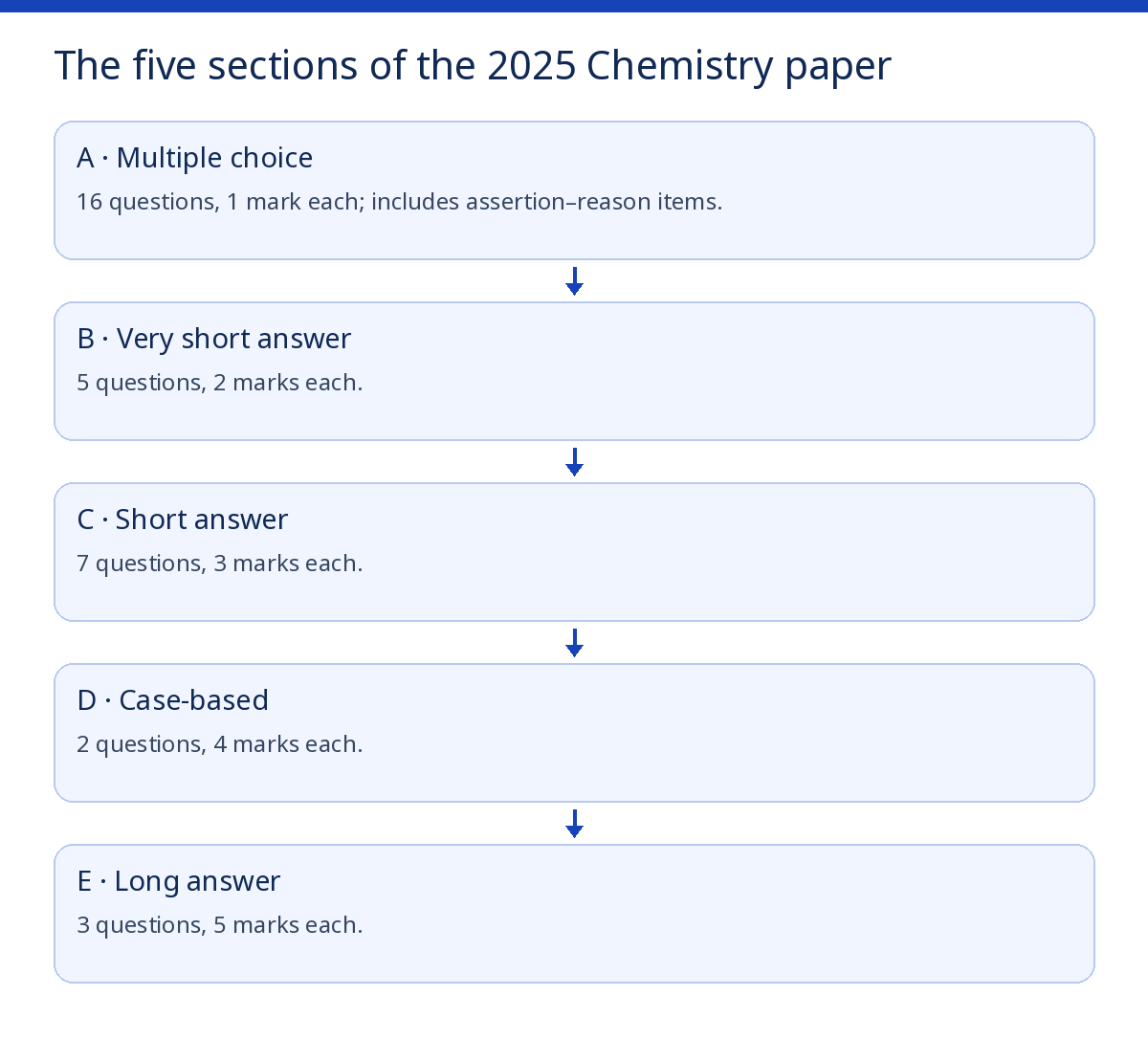
This year-wise PDF contains a complete Chemistry theory paper, not a chapter-wise question bank. The paper allows 3 hours for writing, carries 70 marks and contains 33 questions across five sections. The original instructions also specify a separate 15-minute reading period and prohibit calculators. To reproduce those conditions, read without writing during the first period, then start your three-hour timer.
- Section A: 16 multiple-choice questions worth 1 mark each, including assertion–reason items.
- Section B: Five very short-answer questions worth 2 marks each.
- Section C: Seven short-answer questions worth 3 marks each.
- Section D: Two case-based questions worth 4 marks each.
- Section E: Three long-answer questions worth 5 marks each.
There is no overall choice. Where an internal OR appears, attempt one of the printed alternatives at the point where the choice is offered. In the case-based section, that choice can apply to a subpart rather than to the entire case.

Chemistry 2025 | Class 12 | Previous Year Paper | Code 56/6/3
In the StudentCurio app
A solved CBSE Class 12 Chemistry 2025 main examination paper with questions and worked answers across organic, inorganic and physical chemistry. Useful for practising board-exam questions and reviewing solution methods.
Physical chemistry: identify what the data can tell you
The paper tests physical chemistry in several forms: a freezing-point multiple-choice item, a question on osmotic pressure and macromolecules, a kinetics graph, an initial-rate table and longer electrochemistry tasks. They call for different kinds of reasoning. A graph asks you to interpret what its axes represent; a table asks you to compare measurements; a numerical calculation asks you to select a relationship that fits the quantities supplied.
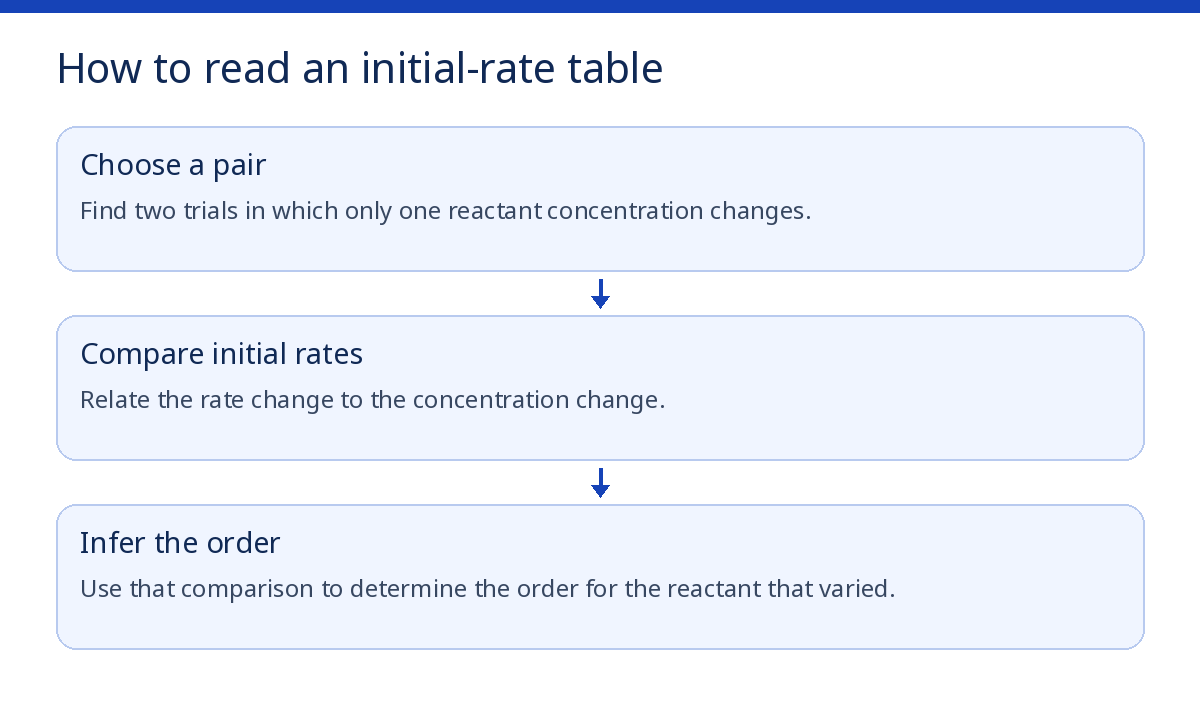
For an initial-rate comparison, look for two experiments in which one reactant concentration changes while the other is held constant. That isolates the concentration dependence for the reactant you are investigating. When reviewing a graph instead, name both plotted quantities before interpreting the slope: a slope has meaning only in relation to those axes. Use the original figure for this step rather than relying on extracted text.
In the solutions questions, separate the magnitude of a freezing-point depression from the freezing point of the solution. They are not interchangeable. Also check whether the question specifies a dissociation assumption before deciding how to account for dissolved particles.
A useful distinction: resistance and conductivity
The electrochemistry questions touch on resistance measurements, conductivity on dilution, cell potential and electrolysis. In the conductivity-cell calculation, resistance describes the measurement in a particular cell, while conductivity describes the solution at the stated conditions. The cell constant connects them and accounts for the cell geometry. Keeping those roles separate helps you choose the right operation and check the unit instead of relying on the order in which the numbers appear.
Use a different check for a galvanic-cell calculation: read the reaction in the direction printed before writing the reaction quotient, and distinguish the standard potential from the potential at the given concentrations. The magnesium half-cell item is not discussed here because the sign convention is unclear in the supplied transcription.
Inorganic chemistry: connect the formula to the explanation
The coordination chemistry questions cover naming, ligand behaviour, isomerism, and links between electronic arrangement and magnetic behaviour. When reviewing a complex, start by marking what is inside the coordination brackets and what is outside. Then work out the metal oxidation state and count the donor atoms separately. A count of ligand molecules is not necessarily a count of donor atoms if a ligand binds through more than one site.
The transition-element questions ask for explanations of properties as well as descriptions of chemical changes. Notice the difference between account for and what happens: the first calls for a reason, while the second calls for the outcome of the stated treatment. For assertion–reason questions, first assess each statement independently. If both are true, make a separate decision about whether the reason actually explains the assertion.
Organic chemistry and biomolecules: follow each clue
The organic questions move between identifying reagents, drawing products, comparing substitution pathways and interpreting chemical tests. For a conversion, track the carbon skeleton as well as the functional group. In a multistep scheme, label the transformations one arrow at a time and read the reagent and conditions attached to each arrow. Work from the printed structures: text extraction can separate an atom or bond from the structure it belongs to.
The case-based questions use alcohol and phenol chemistry in one passage and amino acids and proteins in the other. Read the subparts alongside the passage so you can distinguish a request for a definition from a request for an explanation or a comparison. In an identification question that supplies both positive and negative test results, check your proposed structure against both kinds of evidence; a match to only one clue is not enough.
After the attempt: use the solutions to find the missed step
The cover provides a question-number index, and the worked solutions separate the formula used, concept used and explanation in steps. Open the solution only after committing to an answer. When yours differs, find the first step at which the reasoning diverges. A wrong assumption calls for a different correction from an arithmetic slip, and a correct option selected by guessing still deserves a review.
In your timed attempt, answer only the required internal alternative. During review, try the other branch independently before opening its worked solution. Then revisit one question you missed and write down the cue you overlooked: an axis label, a reagent condition, a concentration assumption or the wording of a subpart. That gives you something specific to check on your next attempt without memorising an option letter.
Spotted an error? Report a correction. Practise this in the app: notes, formula sheets and mind maps.















































































































































Loading comments…