CBSE Class 12 Chemistry 2025: Solved Previous Year Paper
CBSEChemistry2025 Previous Year Paper
Paper code: 56/5/1 · 2025Practise with the full English version of the 2025 CBSE Class 12 Chemistry main examination, paper code 56/5/1. Use the worked solutions after your attempt to check not just your final answers, but also your choice of method, the conditions you used and the reasoning you wrote.
This set is one of the year's papers. See every set from 2025, grouped by series.
Know the paper before you start
This year-wise resource pairs the 2025 Chemistry theory question paper with worked solutions. It is a full board paper rather than a chapter-wise exercise set, so you move between physical, organic and inorganic chemistry as you work through it. The paper allows 3 hours for writing, carries 70 marks and specifies a separate 15-minute reading period during which candidates do not write answers. Calculators are not allowed.
The 33 questions are grouped into five sections. Section A has sixteen one-mark multiple-choice questions, including assertion–reason items. Section B has five two-mark very short answers; Section C has seven three-mark short answers. Section D has two four-mark case-based questions, and Section E has three five-mark long answers. There is no overall choice: printed alternatives are internal to some questions outside Section A.

Chemistry 2025 | Class 12 | Previous Year Paper | Code 56/5/1
In the StudentCurio app
A solved 2025 CBSE Class 12 Chemistry main examination paper covering questions across organic, inorganic and physical chemistry, including worked answers. It helps students practise board-exam questions and review their solutions.
Physical chemistry: match the method to the data
The solutions questions move between vapour pressure, boiling-point elevation and applications of osmosis. These are not interchangeable calculation types. For an ideal liquid mixture, Raoult’s law uses liquid-phase mole fractions and the vapour pressures of the pure components. For boiling-point elevation in the dilute-solution model, the concentration term is molality, based on kilograms of solvent. When a question specifies complete dissociation, that assumption determines how you account for the number of dissolved particles. Write down the assumption before substituting values.
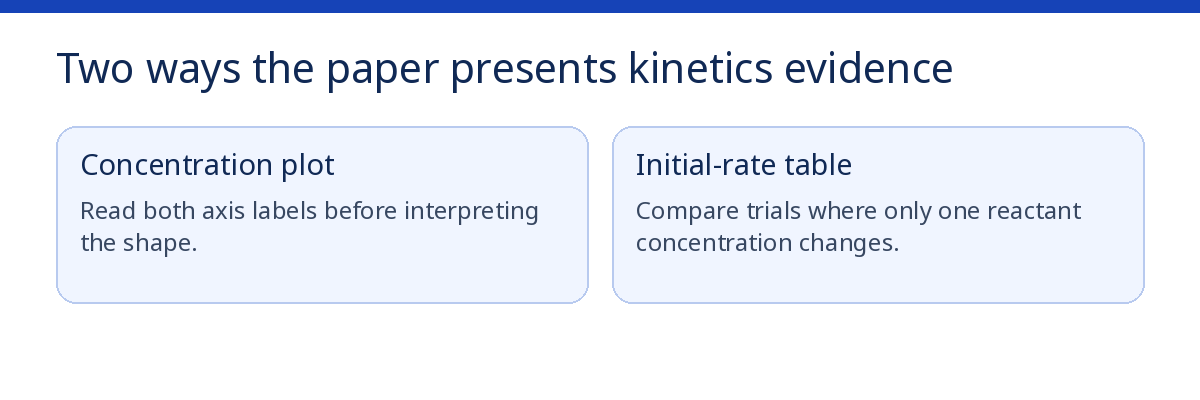
Kinetics appears in both graph and table form. Read the axis labels before interpreting a curve: a plot of concentration against time is not the same as a plot of its logarithm against time. With initial-rate data, compare trials in which one reactant concentration changes while the other stays fixed. The graph and table therefore ask you to infer reaction order from different kinds of evidence.
Two distinctions to keep clear in electrochemistry
The paper uses a dilution table, galvanic-cell questions and a task involving Kohlrausch’s law. Each calls for a different starting point:
- Conductivity versus molar conductivity: Conductivity describes the conducting ability of the solution itself; molar conductivity relates that quantity to the amount of electrolyte per unit volume. In the supplied table the units are siemens per centimetre and siemens square centimetres per mole, respectively. Read each trend from its own column rather than assuming both quantities change in the same direction.
- Standard versus non-standard cell potential: The tabulated half-cell values are standard reduction potentials. Use them as such when deciding the direction of the half-reactions. For a cell at specified non-standard concentrations, first write the balanced overall reaction. It determines the electron count and the powers in the reaction quotient used in the Nernst equation.
Organic chemistry: tell a mechanism from a test
The organic questions range from chirality and amine nomenclature to reaction mechanisms, functional-group tests and multistep conversions. What you write should follow the verb in the question. A mechanism needs intermediate steps, not just an overall equation. A distinguishing test needs a reagent and an observable difference. For a conversion, show the reagent or condition alongside each transformation so the route can be followed.
One short-answer item asks you to infer an organic structure from a molecular formula and several observations. Use the observations together: a positive test can narrow the possibilities without uniquely identifying the compound, and a negative test can rule out a candidate that otherwise looks plausible. Check your proposed structure against the complete set of clues before writing the equations.
Coordination chemistry and biomolecules in context
The coordination questions use two different models. Crystal field theory links orbital splitting and electron pairing to electronic configurations. Before assigning electrons, identify the geometry and compare the relevant splitting energy with the pairing energy. Werner’s theory, in the case-based question, distinguishes primary and secondary valencies. When reading the precipitation evidence, distinguish ions outside the coordination sphere from ligands bound to the metal.
The other case passage uses carbohydrate stereochemistry, while a short-answer question addresses proteins and differences between DNA and RNA. Treat the case passage as context and read each subpart for what it asks you to supply: a definition, a structure and a chemical reaction are different forms of evidence. The extracted stereoisomer-count expression and the final carbohydrate subpart’s terminology are not used in this guide.
Use the worked solutions to diagnose your attempt
For a timed attempt, use the reading period to locate internal choices and note where a question has several subparts. Answer only the required alternative in the mock, then try the unused branch separately if you want more practice. Keep the worked answers closed until you have finished so that you can tell what you recalled independently.
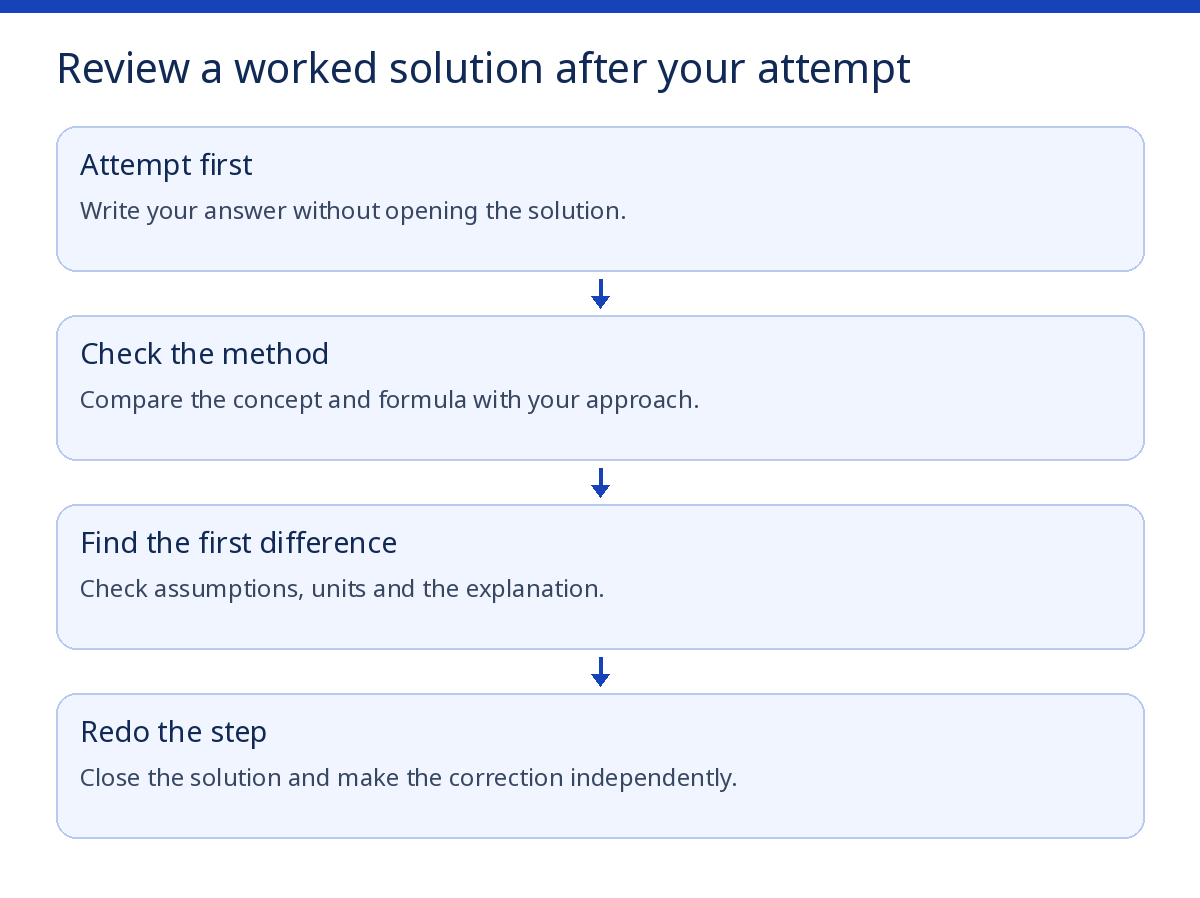
The cover’s question-number index helps you find the relevant solution. Compare your work with the file’s formula, concept and step-by-step explanation. Start at the first point where your reasoning differs: did you pick the wrong relationship, miss an assumption, misread a unit or leave out the explanation? A correct final value does not resolve a unit error, and a correct option does not show that you understood why an assertion and its reason were linked. Redo the affected step without looking at the worked answer.
Spotted an error? Report a correction. Practise this in the app: notes, formula sheets and mind maps.















































































































































Loading comments…