CBSE Class 12 Chemistry 2025 Previous Year Paper
CBSEChemistry2025 Previous Year Paper
Paper code: 56/6/1 · 2025Practise the full 2025 CBSE Class 12 Chemistry main board paper (56/6/1), a three-hour theory exam worth 70 marks. Use the accompanying worked solutions to check not just what you answered, but why your method fits the question.
This set is one of the year's papers. See every set from 2025, grouped by series.
Read the five-section paper before you start
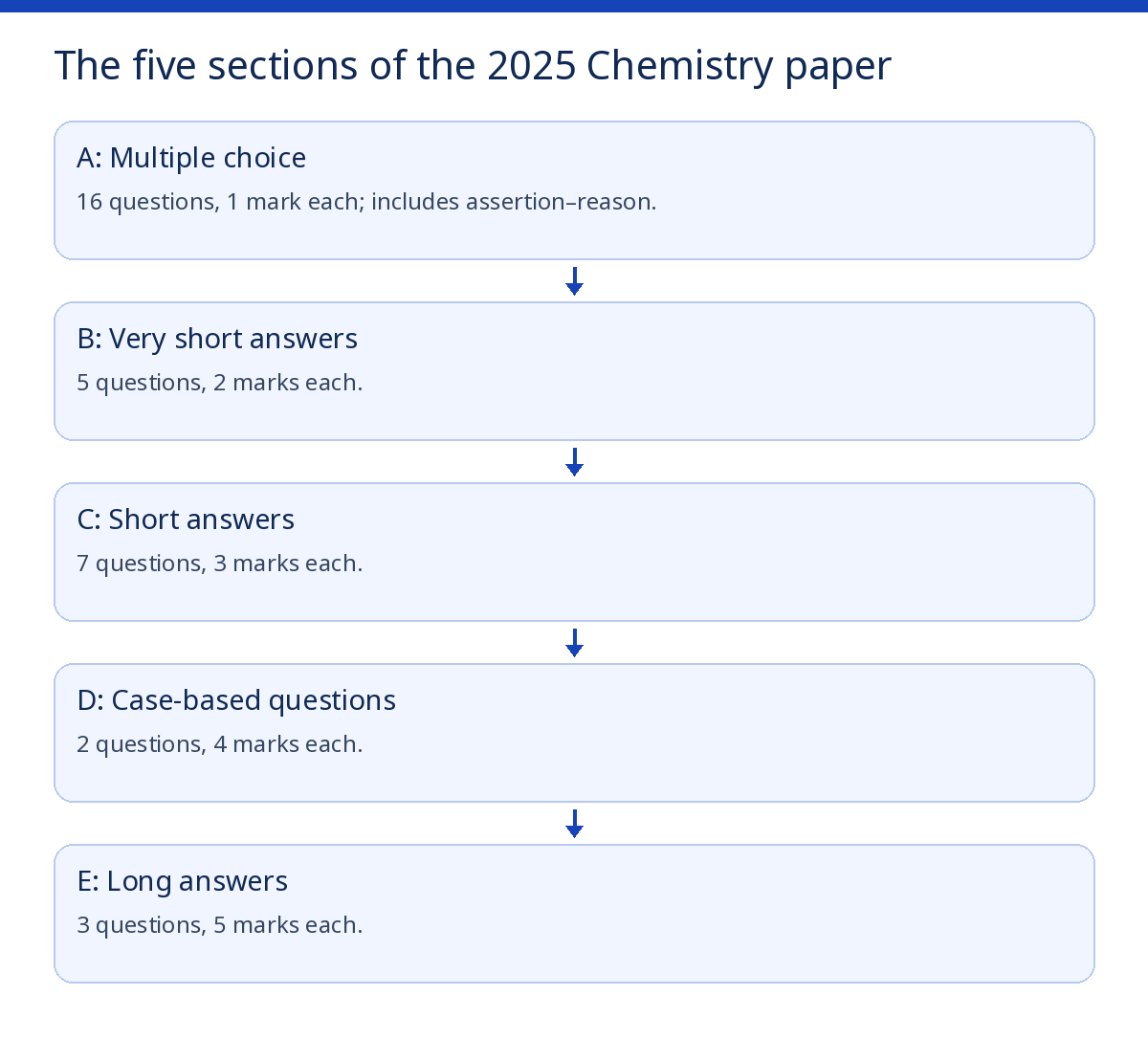
This year-wise resource contains the complete English version of the 2025 main examination paper. It has 33 questions. Section A contains 16 one-mark multiple-choice questions, including assertion–reason items. Section B has five two-mark very short answers, Section C has seven three-mark short answers, Section D has two four-mark case-based questions, and Section E has three five-mark long answers.
All questions are compulsory, but some questions outside Section A offer an internal choice. That means choosing between the printed alternatives within the same question, not skipping a question elsewhere. To reproduce the exam conditions, set aside the 15-minute reading period without writing answers, then attempt the paper in three hours without a calculator. During reading time, check which subparts belong to each alternative.

Chemistry 2025 | Class 12 | Previous Year Paper | Code 56/6/1
In the StudentCurio app
Complete CBSE Class 12 Chemistry main examination paper for 2025, with worked solutions and questions spanning organic, inorganic and physical chemistry. Helps students practise the board-paper format and review their answers.
Physical chemistry: choose the relationship before calculating
The paper tests solution properties through Henry’s law, vapour pressure and freezing-point depression. Before using a relationship, identify what the question actually gives and what it asks for. Molality is based on the mass of the solvent, whereas molarity is based on the volume of the solution. A freezing-point depression is a positive temperature difference; the solution’s freezing point is found by subtracting that difference from the pure solvent’s freezing point. For an electrolyte, check what the question assumes about dissociation before choosing a particle factor.
The kinetics questions use both a graph and a table of initial rates. For a graph, read both axes before interpreting the slope. For a rate table, compare trials where one reactant concentration changes and the other stays fixed. Electrochemistry calls for a similar distinction between quantities: resistance is a measured property of the cell setup, while conductivity describes the solution and can be obtained from resistance when the cell constant is known. The individual magnesium half-cell calculation is omitted here because the extracted potential notation is unclear.
Inorganic chemistry: separate charge, structure and behaviour
Coordination chemistry appears in questions on Werner’s theory, naming, optical activity and magnetic behaviour. Start by distinguishing the species inside the coordination brackets from the counterions outside them. To find the metal’s oxidation state, use the charge of the complex and the charges of its ligands. To find its coordination number, count the donor atoms bonded to the metal, not simply the number of ligand molecules. Those two quantities answer different questions and need not be equal.
For magnetism, trace the argument from oxidation state to the metal ion’s electron count, then to the presence or absence of unpaired electrons. For optical activity, examine the arrangement of the ligands rather than relying on the formula alone. The paper also asks about transition-element properties and the reactions of manganese and chromium species. In those questions, notice whether the prompt is asking for an explanation, a reaction, or an observation such as a colour change.
Organic chemistry: let the reagent and conditions guide you
The organic questions range from substitution mechanisms and amine reactions to phenol chemistry, carbonyl compounds and conversions from aniline. A familiar functional group is only a starting point: the substrate, reagent and conditions together determine which reaction is relevant. When comparing and , distinguish a pathway involving a carbocation intermediate from a concerted substitution. When checking a drawn product, pay attention to the position of the new bond as well as the functional group you expect to see.
The paper also uses several kinds of evidence to test structural reasoning. A question may ask you to interpret a chemical test, explain evidence for a functional group in glucose, or connect several steps in a conversion. In a chain of clues, let each clue constrain the structure before settling on it. Match the form of your response to the instruction: a request for chemical equations only is different from a request to explain why a reaction occurs.
Quick self-check: can you explain the link?
The two case-based questions use passages on alcohols and phenols, and on amino acids and proteins. Read each subpart to identify what it wants you to do with the passage: define a term, explain a property, distinguish two substances, or apply a reaction. Quoting a relevant sentence may identify the topic without explaining the chemical reason the subpart asks for.
Use the same check on assertion–reason items. First decide whether each statement is true on its own, then ask whether the reason explains the assertion. Two true statements can concern the same class of compounds without one causing the other. Before moving on, ask yourself whether you can state the link in one sentence without simply repeating either statement.
Use the worked solutions to diagnose mistakes
Keep the solution pages closed for the first attempt. Afterwards, use the question-number links and compare your work with the resource’s formula, concept and step-by-step explanation. Look for the first point of divergence rather than only the final result. In a numerical answer, that might be the choice of concentration unit or the interpretation of a graph. In a reaction answer, it might be a condition you overlooked or a bond you drew in the wrong place.
The worked solutions cover both printed alternatives where an internal choice is offered. Once you have reviewed the branch you chose in your timed attempt, try the other branch separately. That lets you check a topic you did not answer under exam conditions without confusing extra revision with the requirements of the paper.
Spotted an error? Report a correction. Practise this in the app: notes, formula sheets and mind maps.















































































































































Loading comments…