2025 CBSE Class 12 Chemistry: Solved Board Paper
CBSEChemistry2025 Previous Year Paper
Paper code: 56/7/3 · 2025Practise the full 2025 CBSE Class 12 Chemistry main examination paper (56/7/3), then use the worked solutions to check where your reasoning, calculations or written explanations need attention.
This set is one of the year's papers. See every set from 2025, grouped by series.
What this year-wise paper contains
This resource pairs the English version of the 2025 CBSE Class 12 Chemistry theory paper with worked solutions. It is organised by year, not by chapter, so you can practise switching between topics as the paper requires. The cover provides navigation by question number, and the worked pages separate the formula used, the concept used and the explanation in steps. The cover indicates that solutions are provided for subparts and both printed OR choices.
The paper allows 3 hours for writing and carries 70 marks. The original instructions also allocate 15 minutes of reading time before writing and prohibit calculator use. To recreate those conditions, read the paper with the solutions closed. Use the reading period to spot internal choices and check which prompts ask for a reason, a calculation, a structure or an equation.

Chemistry 2025 | Class 12 | Previous Year Paper | Code 56/7/3
In the StudentCurio app
A solved 2025 CBSE Class 12 Chemistry main examination paper, with worked answers spanning topics including coordination compounds, organic chemistry, electrochemistry, solutions, and the d- and f-block elements. It helps students practise board-exam questions and review solution methods.
How the five sections change what you write
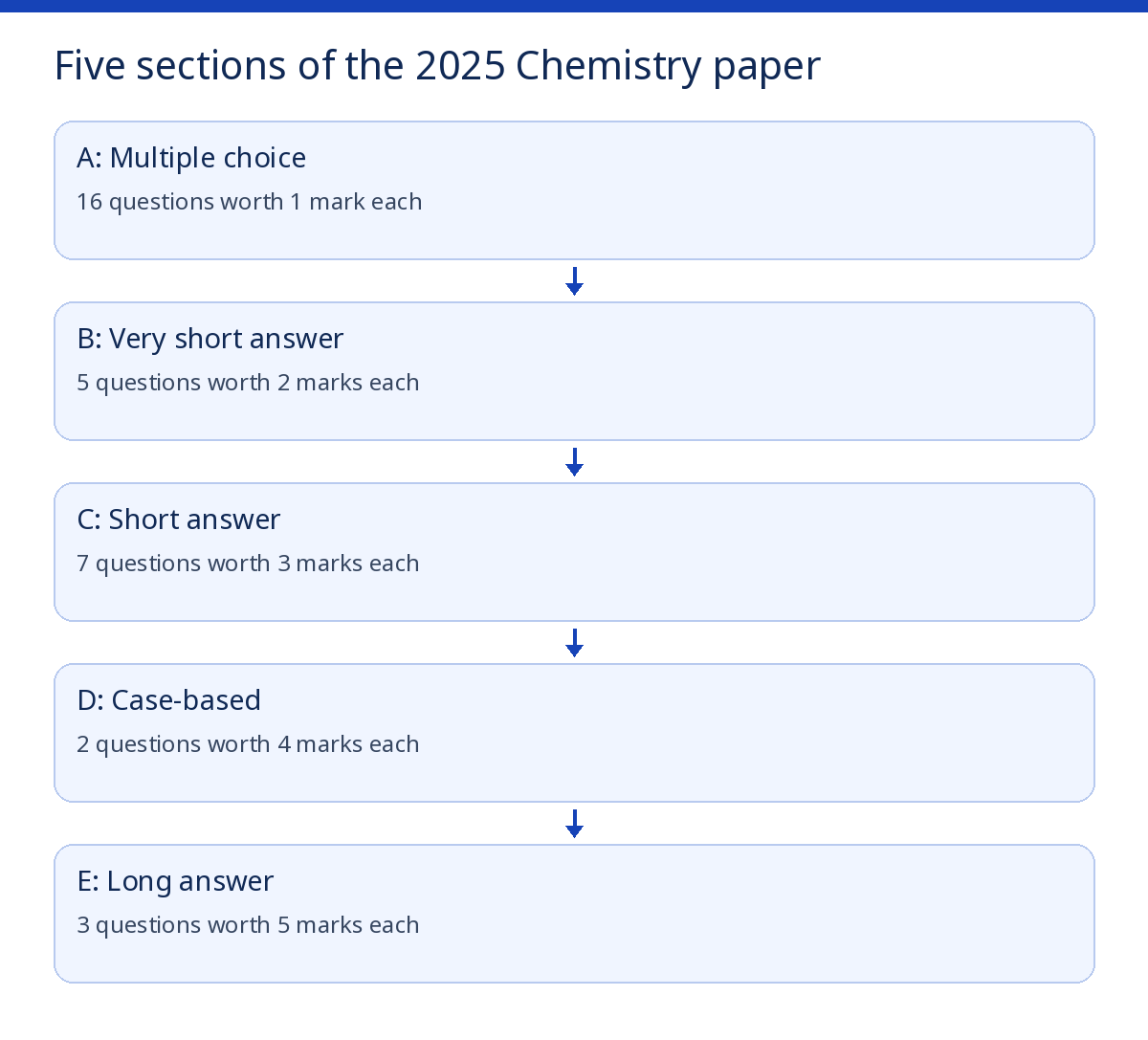
The paper has 33 compulsory questions, with no overall choice. Section A contains 16 one-mark multiple-choice questions, including assertion–reason items. Section B contains five two-mark very short answers, and Section C contains seven three-mark short answers. Section D has two four-mark case-based questions, and Section E has three five-mark long answers. Some questions in Sections B through E offer internal choices. In a mock attempt, answer only the required alternative; after the mock, the other branch gives you another way to revisit the topic.
In the assertion–reason format, deciding that both statements are true is not enough: you must also decide whether the reason explains the assertion. In the written sections, let the command word guide the response. A structure does not substitute for a reason, and a numerical result alone does not show how the data were used.
Check the setup before the arithmetic
The physical chemistry questions draw on solutions, electrochemistry and chemical kinetics. In solutions, the paper moves from particle-based reasoning about osmotic pressure to interpreting freezing-point depression when a solute associates. Those tasks use a related idea: the number of dissolved particles matters. But equal mass percentages do not automatically give equal particle concentrations. If a comparison assumes dilute behaviour and complete dissociation, recognise those as assumptions rather than properties that hold for every real solution.
The kinetics questions test both graph interpretation and the use of pressure data. On a graph, check whether the ordinate uses a natural logarithm or a common logarithm before interpreting its slope. In a constant-volume gas decomposition, distinguish the measured total pressure from the reactant’s partial pressure before applying an integrated rate law. In electrochemistry, likewise identify whether the prompt calls for cell emf, conductivity, molar conductivity or a quantity of charge. They describe different things and cannot be used interchangeably.
Read brackets, structures and reaction conditions
Coordination chemistry appears in different forms: naming compounds, drawing isomers and interpreting a crystal field theory passage. When reading a coordination formula, distinguish the ligands inside the coordination brackets from counterions outside them. For a geometry or isomerism prompt, review the arrangement you have drawn, not just the compound name. In the crystal field case, keep track of which geometry the prompt refers to and distinguish orbital splitting from the energy cost of pairing electrons.
The organic questions range from substitution and reaction sequences to amine basicity and carbonyl tests. In a multistep conversion, identify what each reagent changes before moving to the next arrow. In the amines case, keep the solvent in view: the passage connects basicity in protic polar solvents to several factors, so electron donation alone is not a complete explanation. The paper also samples biomolecules and the d- and f-block elements through questions on nucleic acids, glucose, oxidation states and lanthanoid contraction.
Quick self-check: read the case, then the subpart
Section D uses passages on crystal field theory and amines. Read the subpart with the passage in view, then identify whether you need a definition, a comparison, a chemical conversion or a reason. The passage sets the context, but copying a general statement from it may not answer the specific prompt. If an OR appears within a subpart, check exactly where the choice begins and ends before you write.
After attempting a case, ask yourself: Which detail from the passage did I use, and what chemistry did I have to supply? That distinction helps you tell whether you missed a reading cue or understood the question but lacked the concept needed to answer it.
Use the worked pages to find the first missed step
Compare your attempt with the worked explanation before looking only at the final answer. Start with the concept: did you recognise what the question was testing? Then check the setup and the first point where your method diverged. A wrong unit, a misread structure and a missing chemical reason call for different kinds of revision, even if all three cost marks. For a multiple-choice question, review items you guessed correctly as well as those you missed.
On a second pass, try the unused OR alternatives without reading their solutions first. That gives you fresh practice on the same paper without changing the choices you made in your timed attempt. This guide omits the disputed printed equation in Question 8 and does not use the wording-sensitive answer option in Question 13 as a revision rule.
Spotted an error? Report a correction. Practise this in the app: notes, formula sheets and mind maps.















































































































































Loading comments…