CBSE Class 12 Chemistry 2025 Previous Year Paper: 56/4/1
CBSEChemistry2025 Previous Year Paper
Paper code: 56/4/1 · 2025Practise the full 2025 CBSE Class 12 Chemistry main board paper in English, then use the worked solutions to review how you chose a method, interpreted evidence and explained your reasoning.
This set is one of the year's papers. See every set from 2025, grouped by series.
Paper 56/4/1 at a glance
This year-wise resource contains the 2025 CBSE Class 12 Chemistry theory paper, code 56/4/1, with worked solutions. The paper allows three hours, carries 70 marks and prohibits calculators. The printed instructions also specify a 15-minute reading period during which candidates do not write answers. If you use the file as a mock, keep that reading period separate from your writing time.
There are 33 questions across five sections. Section A has 16 one-mark multiple-choice questions, including assertion–reason items. Section B has five two-mark very short answers, and Section C has seven three-mark short answers. Section D has two four-mark case-based questions, while Section E has three five-mark long answers. There is no overall choice: use a printed OR only where an internal choice is offered. Section A has no internal choice.

Chemistry 2025 | Class 12 | Previous Year Paper | Code 56/4/1
In the StudentCurio app
Complete 2025 CBSE Class 12 Chemistry main examination paper, code 56/4/1, with worked solutions. It covers questions across multiple Chemistry chapters and helps students practise the board-exam format and review solution methods.
Match your response to the question type
The paper tests more than whether you remember a fact. In an assertion–reason item, decide whether each statement is true before asking whether the reason actually explains the assertion. Two true statements are not necessarily linked in the way the question proposes.
In the written sections, let the instruction tell you what to put on the page. A prompt to account for an observation needs a chemical explanation, not a restatement. An instruction to give a structural formula calls for connectivity, not merely a molecular formula. In Section E, a five-mark question can contain several separately marked tasks, such as completing reactions and proposing distinguishing tests. Keep the subpart labels visible so you can check that you answered every task in the branch you chose.
Before calculating: check conditions and units
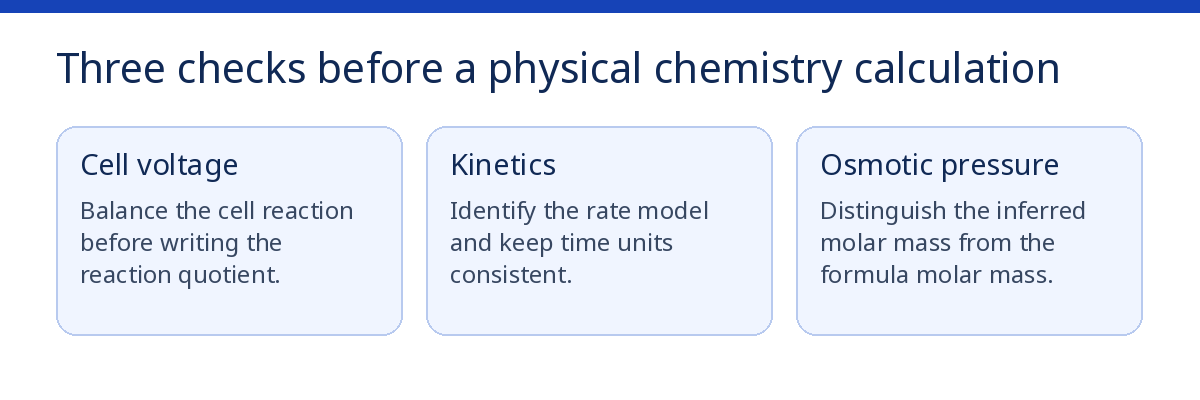
The numerical questions draw on electrochemistry, solutions and chemical kinetics. For a cell-voltage calculation at specified ion concentrations, distinguish the standard cell potential from the potential under the stated conditions. Before using the Nernst equation, balance the overall cell reaction: its coefficients determine the powers in the reaction quotient, and the balanced electron transfer determines the electron count used in the equation.
The kinetics questions shift between interpreting concentration–time data, using a stated reaction order and considering temperature effects. Do not infer the overall reaction order from the coefficients of a balanced equation. When calculating a rate constant, keep the time unit consistent with the unit you report. In the osmotic-pressure problem, distinguish the molar mass inferred from the measurement from the formula molar mass; dissociation changes the number of dissolved particles that contribute to osmotic pressure.
Inorganic chemistry: connect structure to observation
The inorganic questions move between periodic trends and the structure of individual complexes. For the questions on lanthanoid and actinoid contraction, make clear which series and which size trend you are explaining. For the coordination question that supplies a precipitation observation, distinguish ions outside the coordination sphere from groups bonded directly to the metal before drawing the complex or naming it.
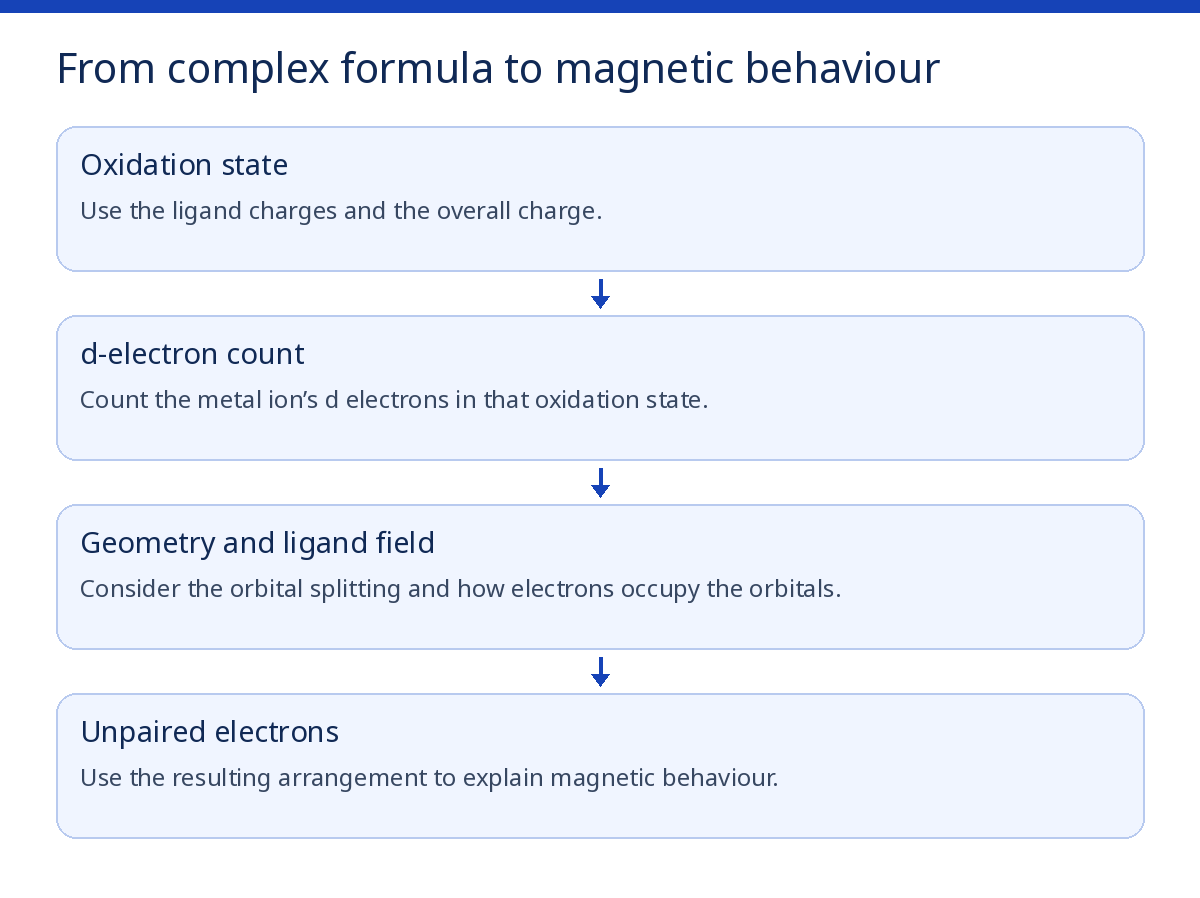
For the crystal-field questions, work from the metal’s oxidation state to its d-electron count, then consider the geometry and ligand field before deciding how electrons occupy the orbitals. This sequence matters because the number of unpaired electrons cannot be read from the metal’s name alone. For isomerism, compare the arrangements or connections of the ligands rather than just checking whether two drawings contain the same groups.
Organic chemistry: read the conditions above the arrow
The organic questions range from identifying products and explaining substitution to comparing properties and planning conversions. Several sequences change reagents between steps. Read each arrow separately: aqueous and alcoholic conditions are not interchangeable, and a reagent named in one step does not carry over automatically into the next. For substitution and elimination questions, consider the structure of the substrate as well as the reagent before choosing a pathway.
In the carbonyl identification problem, treat the positive and negative test results as constraints on the same proposed structure. A single positive test is not enough if your candidate fails another observation. Likewise, when asked to distinguish two compounds, choose a test that gives different observable results for the pair, rather than simply listing a reaction of one compound.
Quick self-check for the two case passages
Section D uses passages on ideal solutions and nucleic acids. For the solutions case, ask yourself whether you can connect interactions between unlike molecules to a deviation from the vapour pressure predicted by Raoult’s law. Keep the ideal-solution model distinct from the limiting behaviour of the solvent in a very dilute solution.
For the biomolecules case, check whether you can distinguish a comparison of DNA and RNA structure from a question about the products of hydrolysis. Also check that you can explain the distinction between a nucleoside and a nucleotide without relying on the similarity of the names. In both cases, use the passage to identify the context, then answer the particular subpart rather than summarising the passage.
Use the worked solutions to locate the first error
Attempt the paper before opening the keyed explanations. The file includes a question-number index, and the worked solutions identify the formula or concept used and explain the steps. When reviewing a response, look for the first point where your reasoning diverged: you may have chosen a rule that does not apply, used the wrong sign or unit, or reached a conclusion without explaining it.
After the timed attempt, try the unused OR branches as separate practice. That lets you review a topic you bypassed without treating both branches as part of the mock. This guide leaves aside the subpart asking for an overall molecularity for a multistep mechanism; molecularity applies to an elementary step.
Spotted an error? Report a correction. Practise this in the app: notes, formula sheets and mind maps.















































































































































Loading comments…