CBSE Class 12 Chemistry 2025 Previous Year Paper Guide
CBSEChemistry2025 Previous Year Paper
Paper code: 56/4/2 · 2025Use the full 2025 CBSE Class 12 Chemistry main examination paper (Q.P. Code 56/4/2) for a timed theory attempt, then use its worked solutions to review how you chose and applied each method.
This set is one of the year's papers. See every set from 2025, grouped by series.
Know the paper before you start
This year-wise resource pairs the English version of the 2025 CBSE Class 12 Chemistry main examination paper with worked solutions. It is a full theory paper, not a chapter worksheet: physical, inorganic and organic chemistry appear in the same sitting. That makes it useful for checking whether you can switch between interpreting data, explaining chemical behaviour and reading reaction schemes without a chapter heading telling you which approach to use.
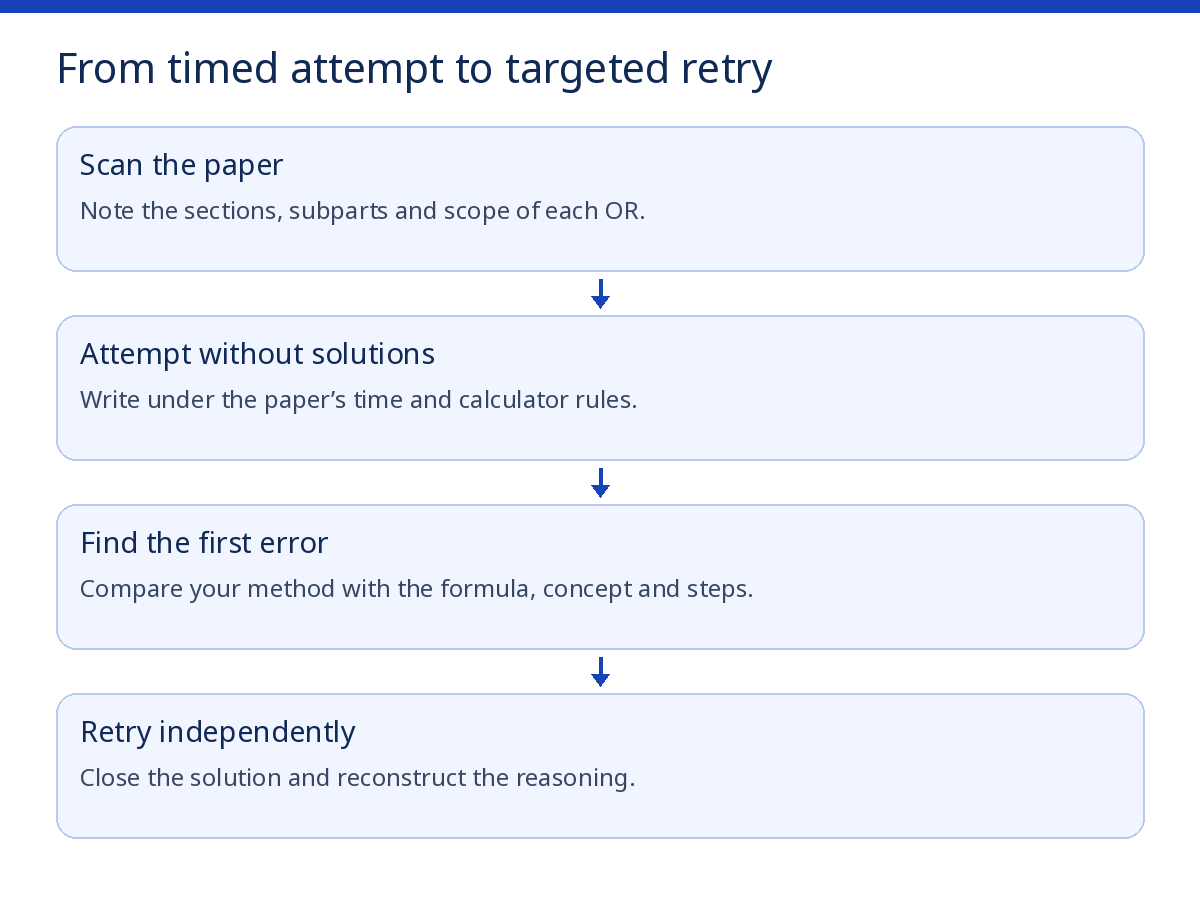
The paper allows 3 hours and carries 70 marks. Its front page sets aside a separate 15-minute reading period during which candidates do not write answers, and the general instructions prohibit calculators. To practise under those conditions, keep the solutions closed and use the reading period to scan the sections, locate internal choices and identify questions with several subparts.

Chemistry 2025 | Class 12 | Previous Year Paper | Code 56/4/2
In the StudentCurio app
Complete CBSE Class 12 Chemistry main examination paper for 2025 (Q.P. Code 56/4/2), with worked solutions. It covers questions across physical, inorganic and organic chemistry, helping students practise the board-paper format and review solution methods.
Read the five sections and their choices correctly
The 33 questions are divided by response type and marks:
- Section A, Q1–16: multiple-choice questions worth 1 mark each, including assertion–reason items at the end.
- Section B, Q17–21: very short answers worth 2 marks each.
- Section C, Q22–28: short answers worth 3 marks each.
- Section D, Q29–30: case-based questions worth 4 marks each.
- Section E, Q31–33: long answers worth 5 marks each.
All questions are compulsory, but some questions outside Section A offer internal choice. Check where the printed OR falls: in the case-based section it can apply to one subpart rather than to the entire case. For a timed attempt, answer only the required alternative. Save the unused branch for a separate revision attempt so it tests recall rather than recognition.
Physical chemistry: start with what is given
The physical chemistry questions ask you to work with a concentration–time table, a stated rate law, cell potentials and an osmotic-pressure measurement. They do not all start from the same kind of evidence. In kinetics, for example, one question provides measurements from which to infer behaviour, while an alternative provides the rate law and asks you to reason about a change in conditions. In the solutions case, the task shifts from calculating to explaining how intermolecular interactions affect vapour-pressure behaviour.
Before substituting numbers: identify whether a cell potential is a standard value or the voltage under the stated conditions. The paper includes a voltaic-cell calculation at specified ion concentrations and temperature. For kinetics calculations, keep the time unit consistent with the unit you report for the rate constant. These checks help you spot a setup error before it becomes an arithmetic error.
Inorganic chemistry: connect ligand effects to electron arrangement
The inorganic questions move between trends in the transition and inner-transition elements and the behaviour of individual coordination compounds. The paper asks about contraction trends, complex nomenclature, magnetism and isomerism. Treat these as distinct tasks: naming requires correct identification of the species in the complex, while an explanation of magnetism must account for electron pairing. A question about isomerism, in turn, may ask for drawings as well as the name of the type.
A useful connection: in an octahedral complex, compare the splitting of the d orbitals with the energy needed to pair electrons. Where both high-spin and low-spin arrangements are possible, that comparison helps explain the effect of ligand strength. When reviewing a magnetic-behaviour response, check that your explanation links the electron arrangement to magnetism instead of simply labelling the complex.
Organic chemistry and biomolecules: track the clues
Organic chemistry appears through reaction sequences, ether preparation, comparisons of amine properties, and tests used to distinguish or identify compounds. For a reaction sequence, work arrow by arrow: read the reagent and conditions before drawing the next structure. For an identification task built around chemical tests, keep positive observations separate from negative ones. A proposed structure has to fit the set of observations, not just the first test. Use the PDF drawings wherever a question depends on a displayed structure or scheme.
Biomolecules appear in more than one format. A very short answer deals with essential amino acids and amphoteric behaviour, while a case-based question focuses on components and structure of nucleic acids. In the case, mark which subparts ask you to distinguish terms and which ask about structure or function; they call for different kinds of responses.
Use the worked solutions to diagnose your first error
The file’s cover provides question-number links, and the supplied solution pages separate the formula used, concept used and explanation in steps. After your timed attempt, use those labels to find where your reasoning first diverged. If you chose the wrong relationship, revisit the conditions under which it applies. If you chose the right relationship but lost a sign or unit, redo that step. For a written explanation, check whether you gave the chemical reason or merely restated the observation.
Quick self-check: for an assertion–reason item, can you judge each statement separately before deciding whether the reason actually explains the assertion? For a multi-part response, can you point to the line of your answer that addresses each prompt? Close the solution before retrying either kind of question so you can tell whether you can reconstruct the reasoning yourself.
Spotted an error? Report a correction. Practise this in the app: notes, formula sheets and mind maps.















































































































































Loading comments…