CBSE Class 12 Chemistry 2025 Board Paper with Solutions
CBSEChemistry2025 Previous Year Paper
Paper code: 56/1/1 · 2025Practise with the full English-language CBSE Class 12 Chemistry 2025 main board paper (56/1/1), then use the worked solutions to check your reasoning. The paper carries 70 marks and has a three-hour time limit.
This set is one of the year's papers. See every set from 2025, grouped by series.
What this year-wise paper contains
This file contains one complete main examination paper, organised by year rather than by chapter. It spans physical, inorganic and organic chemistry and includes multiple-choice, short-answer, case-based and long-answer questions. That mix makes it useful for practising how to move between calculations, structural reasoning and written explanations without a chapter heading to tell you which idea to apply.
The file preserves the original English question layout, options and diagrams. Its cover indexes the questions by number, and the worked solutions cover subparts and both printed OR choices. The solutions distinguish the formula or rule used, the underlying concept and the steps of the explanation. Use those parts separately: a correct result does not necessarily mean you identified the right principle or explained it clearly.

Chemistry 2025 | Class 12 | Previous Year Paper | Code 56/1/1
In the StudentCurio app
Complete CBSE Class 12 Chemistry 2025 main examination paper with worked solutions, spanning physical, inorganic and organic chemistry. It includes multiple-choice, short-answer, case-based and long-answer questions to help students practise and review board-exam material.
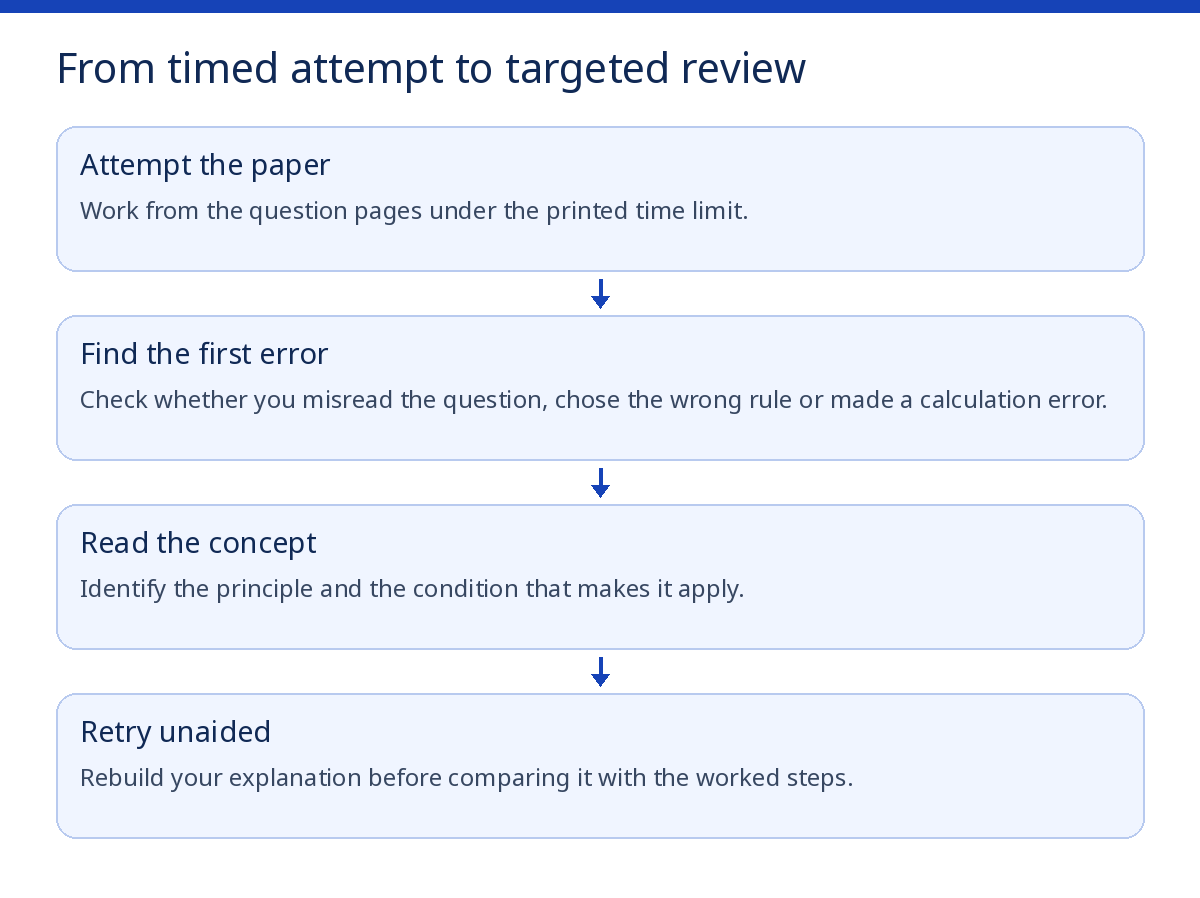
Attempt the paper before opening the solutions
For a board-style attempt, set aside the printed three hours and work from the question pages without consulting the explanations. Where an OR choice is printed, follow the paper's directions rather than treating both alternatives as compulsory. After the timed attempt, try the alternative you skipped. This lets you use both worked solutions without changing the conditions of your first attempt.
Vary what you write according to the question. For a multiple-choice item, jot down the clue that rules out a competing option. For a short or long response, make each step readable without relying on the final line to carry the argument. In a case-based item, separate the information supplied in the passage from the chemical principle you bring to it. That distinction helps you see whether an error came from reading the prompt or applying the concept.
Physical chemistry: check what each quantity describes
In the solutions questions, distinguish the amount of solute added from the number of dissolved particles that contribute to a colligative effect. The van ’t Hoff factor accounts for the difference between the observed effect and the value expected if the solute stayed as separate formula units or molecules. When reviewing, ask what assumption about the solute went into the calculation. That is more useful than memorising the direction of a change in apparent molar mass without its cause.
In electrochemistry, label the oxidation and reduction half-reactions before substituting potentials. When both tabulated values are standard reduction potentials, subtract the anode’s reduction potential from the cathode’s reduction potential. Balance the electrons in the half-reactions, but do not multiply a potential by a stoichiometric coefficient. If your calculation differs from the worked solution, check the electrode labels and signs before redoing the arithmetic.
Inorganic chemistry: read the coordination sphere first
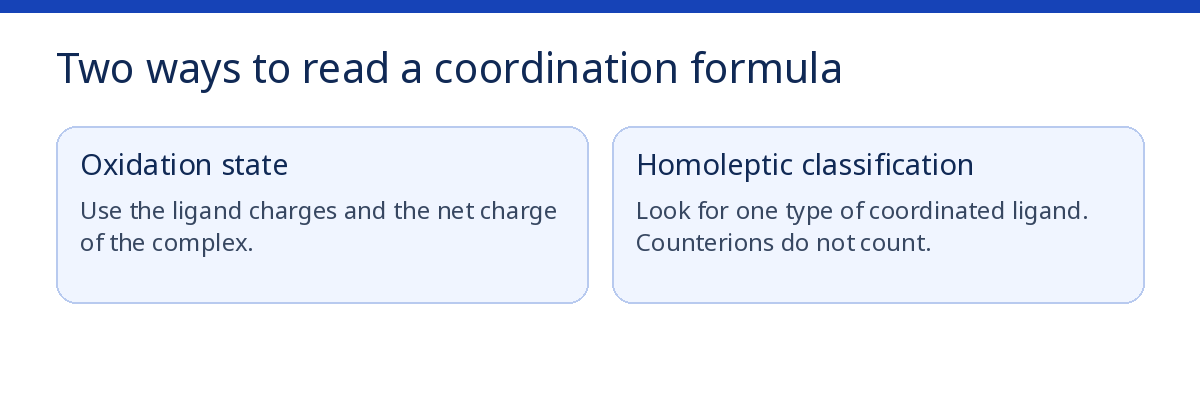
For a coordination compound, start by separating the species inside the brackets from any counterions outside. To find the metal’s oxidation state, use the charges of the coordinated ligands and the net charge of the complex. For homoleptic classification, count types of coordinated ligand, not the total number of ligands or the types of ion present in the salt. The same reading of the brackets therefore supports two different tasks: charge accounting and classification.
Magnetic-moment questions call for a different check. In the spin-only expression, the input is the number of unpaired electrons, not the total number of electrons in the d subshell. Write the configuration for the species actually named in the question before counting. In review, check that electron count separately from the numerical evaluation.
Organic chemistry: track the structure, not just the reagent
The organic questions make you switch between predicting a transformation and explaining a property. For a reaction, track the carbon skeleton and the bonds changed. In Grignard carboxylation, carbon dioxide supplies a carbon and acidic work-up gives the carboxylic acid. When comparing routes from an amide to an amine, distinguish reduction from Hofmann rearrangement by checking what happens to the original carbonyl carbon. A product name alone can conceal a mistake in this count.
For a property comparison, identify what is held constant. Comparing branching among isomers is different from comparing halogens while keeping the alkyl group fixed. For acidity, compare the stability of the conjugate bases rather than relying on the presence of an O–H bond alone. These checks turn a memorised order into an explanation that stays within the comparison the question actually makes.
Quick self-check: does the reason explain the claim?
When reviewing an assertion–reason item, make three separate judgments: whether the assertion is true, whether the reason is true, and whether that reason explains that particular assertion. A statement about a related trend is not automatically the cause of the trend under discussion. In a boiling-point explanation, for example, check whether the interaction invoked acts between molecules or within one molecule; those are not interchangeable descriptions.
Finally, choose a response you got right but could not explain, and another where your first step was wrong. For each, read only the concept line in the worked solution, then close it and reconstruct the reasoning. Compare your new response with the steps. The useful outcome is being able to name the condition or distinction you missed, not merely recognising the printed answer.
Spotted an error? Report a correction. Practise this in the app: notes, formula sheets and mind maps.















































































































































Loading comments…