2024 CBSE Class 12 Chemistry Board Paper with Solutions
CBSEChemistry2024 Previous Year Paper
Paper code: 56/1/2 · 2024Use the 2024 CBSE Class 12 Chemistry main board paper (56/1/2) for a three-hour, 70-mark theory practice session. The file pairs the full English question paper with worked solutions, so you can attempt the paper first and then review the reasoning behind your answers.
This set is one of the year's papers. See every set from 2024, grouped by series.
How the 2024 paper is organised
This year-wise resource is the 2024 main examination Set 2, not a chapter-wise question bank. Its 33 questions span five sections: Section A has 16 one-mark multiple-choice questions, including assertion–reason items; Section B has five two-mark very short answers; and Section C has seven three-mark short answers. Section D contains two four-mark case-based questions, while Section E contains three five-mark long answers.
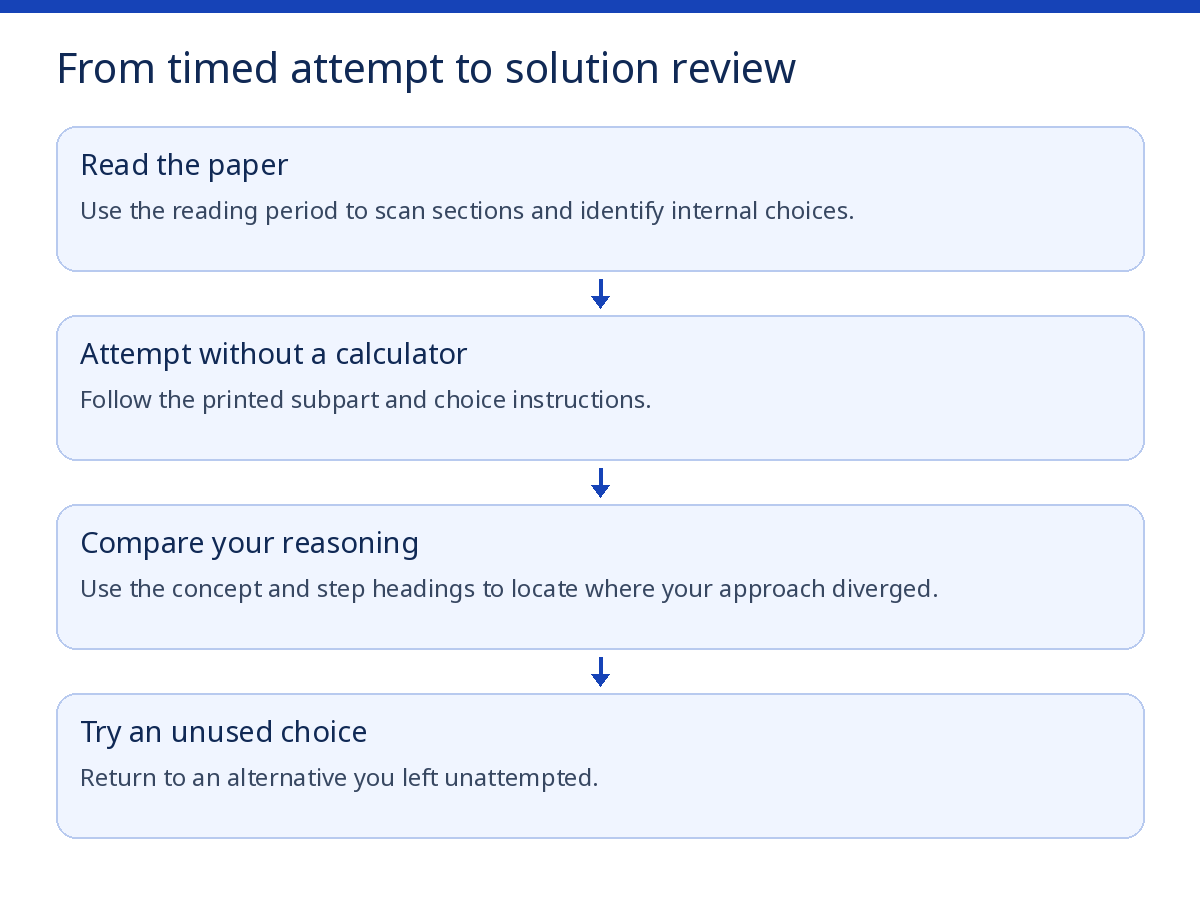
There is no overall choice. Internal choices appear in some questions outside Section A, and some prompts specify how many subparts to answer. Follow those instructions on a timed attempt rather than treating every printed alternative as compulsory. The title page specifies a separate 15-minute reading period, during which candidates do not write answers. Calculators are not allowed.

Chemistry 2024 | Class 12 | Previous Year Paper | Code 56/1/2
In the StudentCurio app
Complete 2024 CBSE Class 12 Chemistry main examination paper with worked solutions, covering questions across organic, physical and inorganic chemistry. Includes worked material on amine reactions and is useful for full-paper practice and reviewing solution methods.
What the organic questions ask you to track
The organic questions move from recognising reaction types to writing products, explaining conditions and following multistep transformations. Haloalkane questions, for example, ask you to distinguish substitution from elimination under different conditions. Treat the solvent as part of the reaction information, not as an incidental detail. Carbonyl questions ask for equations and also test whether you can carry structural information from one reaction to the next.
For a conversion chain, note which functional group changes at each stage and whether the carbon skeleton is retained. In the long-answer question on amines, the task changes from subpart to subpart: a reason needs a chemical explanation, a distinguishing test needs an observable difference, and a synthesis or conversion needs reagents and a reaction sequence. A product name alone does not serve all three purposes.
Common mix-ups in physical chemistry
The kinetics questions distinguish reaction order from molecularity. Order comes from the exponents in the rate law; molecularity counts the reacting species involved in a single elementary step. Do not read the order from the coefficients of an overall equation. In an initial-rate table, compare runs in which one reactant concentration changes while the other stays fixed. That comparison isolates the dependence on the reactant being varied.
The solutions and electrochemistry questions require a different set of distinctions. Colligative properties depend on the effective number of solute particles, so association or ionisation can change the result at a given solute concentration. In a conductivity-cell problem, measured resistance is not conductivity: the cell constant connects the two. Molar conductivity also accounts for concentration. In review, identify which quantity each line of your calculation actually represents before checking the arithmetic.
Inorganic chemistry and biomolecules require precise terms
The inorganic questions cover coordination-compound formulae, isomerism, and the properties and reactions of d- and f-block elements. When reading a coordination formula, separate ligands written inside the coordination brackets from counter-ions written outside them. That distinction matters when reasoning about ions in solution. When reviewing an explanation of an oxidation state, distinguish an electronic-configuration argument from a universal claim about stability: the medium, ligands and redox conditions can also matter.
The biomolecules questions shift between definitions, structural features and reactions. Use the exact level of description the prompt requests. A question about the linkage between residues is not asking how the whole protein folds, and a question about interactions that hold strands together is not asking for the components of an individual nucleotide.
Read the case passage, then answer the subpart
The two case-based questions use coordination compounds and galvanic cells as their contexts. In the coordination case, notice when a prompt asks for a definition and when it asks you to explain a property. Crystal field splitting concerns a difference in orbital energies; an explanation of magnetic behaviour must also account for electron occupancy and whether electrons are paired.
The electrochemistry case places primary batteries, rechargeable batteries and fuel cells alongside one another. Keep rechargeability separate from the way a fuel cell obtains reactants and converts chemical energy into electrical energy. A passage may introduce several related ideas, but each subpart still asks for a distinct piece of evidence, reasoning or chemical notation.
Quick self-check before opening the worked solutions
At the end of your timed attempt, pick one answer from each format you found difficult. For an assertion–reason item, did you judge each statement independently before deciding whether the reason explains the assertion? For a numerical response, can you identify the assumption behind your chosen relation and account for the units? For a reaction, did you use the conditions you were given, or answer from memory of a similar-looking example?
Then use the file’s question-number links to compare your attempt with the worked explanations. Their formula, concept and step headings help you locate the first point where your reasoning diverged. Save the unused internal alternatives for a second pass. Clipped reaction diagrams and garbled numerical or option notation in the text extract are not reproduced here; consult the rendered question pages for the printed details.
Spotted an error? Report a correction. Practise this in the app: notes, formula sheets and mind maps.















































































































































Loading comments…