CBSE Class 12 Chemistry 2024: Solved Main Board Paper
CBSEChemistry2024 Previous Year Paper
Paper code: 56/5/2 · 2024Practise the full English-language 2024 CBSE Class 12 Chemistry main examination paper, set 56/5/2. Use the worked solutions after your attempt to identify whether an error came from choosing the wrong concept, missing a condition or applying the right rule incorrectly.
This set is one of the year's papers. See every set from 2024, grouped by series.
What this year-wise paper contains
This file presents a complete 2024 CBSE Class 12 Chemistry main board examination paper, with a printed duration of 3 hours and a maximum of 70 marks. It is organised around one exam year and set, not around individual chapters. The question pages preserve the original English layout, options and diagrams, so you can practise reading the information in the form in which it appeared in the exam.
The file also provides worked solutions for the questions, subparts and both printed OR choices. The question-number index helps you find a particular item during review. If you want a timed attempt, go straight to the question paper and leave the explanations unopened until you finish. Follow the printed instructions on choices during the attempt; use the unattempted alternatives as extra practice afterwards.

Chemistry 2024 | Class 12 | Previous Year Paper | Code 56/5/2
In the StudentCurio app
A solved CBSE Class 12 Chemistry main examination paper for 2024, with questions spanning organic, inorganic and physical chemistry. It helps students practise board-style questions and review worked solutions.
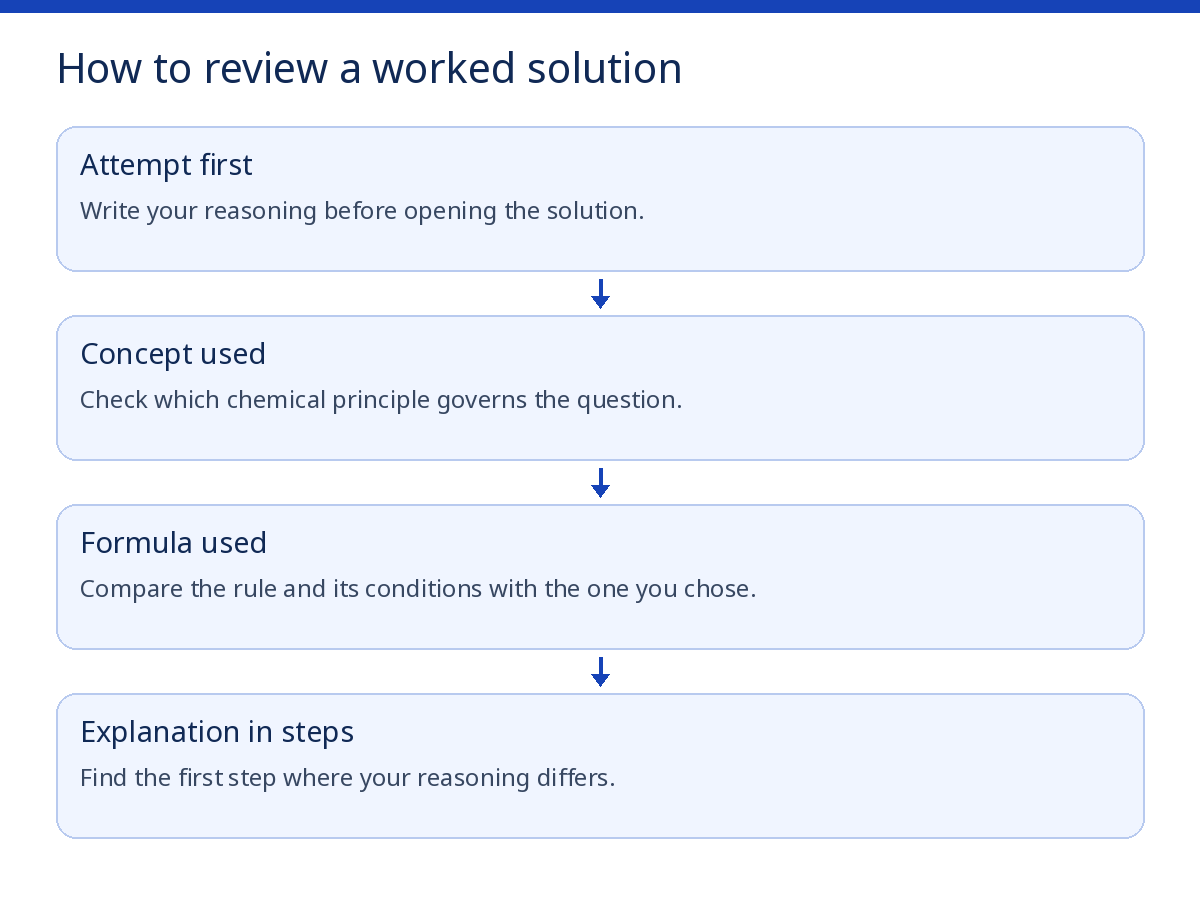
Read the worked solutions in three passes
The worked pages distinguish Formula used, Concept used and Explanation in steps. Read the concept first when you are unsure why your approach did not work. Then compare the formula or rule with the one you chose. Finally, find the first step at which your reasoning differs. That sequence helps distinguish a wrong starting idea from an error in carrying out a sound method.
For an option-based item, do not treat a matching option as proof that your reasoning was sound. Check whether you could justify the choice without seeing the alternatives. For a question with subparts, compare each response separately: knowing the relevant law in one part does not necessarily mean you have explained the process asked about in another.
Common mistake: treating conductivity and molar conductivity alike
One useful distinction in the physical chemistry material is between conductivity and molar conductivity. Conductivity describes the solution’s ability to conduct current; molar conductivity relates that quantity to the amount of electrolyte present. Using conductivity in siemens per centimetre and concentration in moles per litre, the relation is . The factor of one thousand belongs to that choice of units, not to every way of writing the relation.
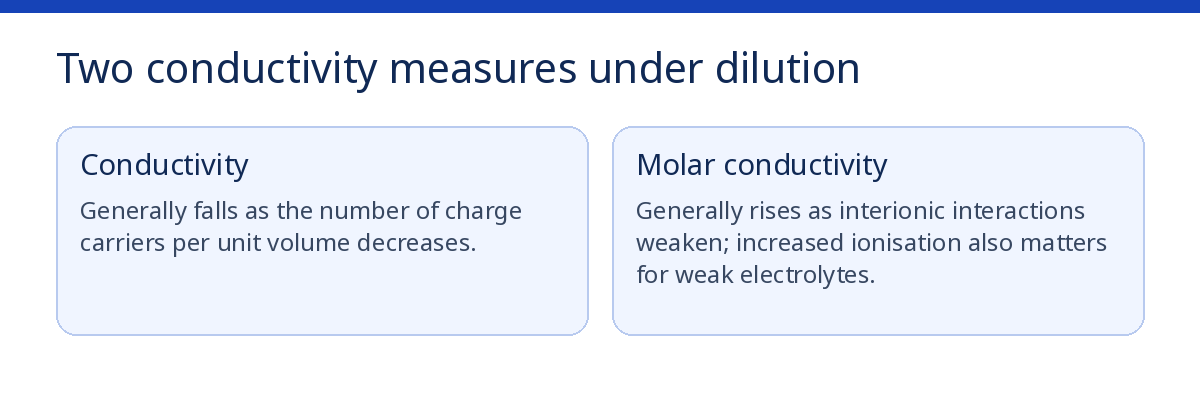
During dilution, conductivity generally falls because there are fewer charge carriers per unit volume. Molar conductivity, by contrast, generally rises as interionic interactions decrease; increased ionisation also matters for weak electrolytes. In the solutions material, a different distinction is just as important: isotonicity compares osmotic pressures at the same temperature and does not imply identical densities or volumes. In both cases, name the property being compared before deciding which rule applies.
When a kinetics rule applies
A balanced equation shows how much reactant is consumed and how much product is formed. It does not, by itself, show how the reaction rate depends on concentration. For a rate law written as , the exponents are normally determined experimentally. Stoichiometric coefficients can be used directly for the rate law of an elementary step, but not simply because an overall reaction equation is balanced.
Once a rate law is established, it also tells you what units the rate constant must have. In the zero-order case, the law reduces to , so the rate constant has the same units as the rate: concentration per unit time. When reviewing, keep these two tasks separate: establishing the order and using that order to interpret the rate constant.
Organic chemistry: check the reagent and the mechanism
The organic chemistry explanations show why a reaction name is not a substitute for reading the reagents. In diazonium substitution, for instance, the copper-powder route and the copper-halide route can involve the same kind of group replacement, but the reagent form distinguishes the named methods. When reviewing a conversion, compare what you wrote over the arrow as carefully as you compare the product.
Mechanism matters separately from product identity. In an substitution, the nucleophile attacks from the back in a concerted step; a free carbocation is not formed. If the reacting carbon is a suitable stereogenic centre, the substitution gives inversion of configuration. In a structure-based question, check whether all four substituents differ before describing a tetrahedral carbon as stereogenic. Repeated groups and distinct isotopic substituents both matter to that check.
Connect inorganic properties to their causes
The inorganic material links observable properties to structure. In an interstitial compound, small atoms occupy gaps in a metal lattice. Their presence can restrict the motion of metal layers and generally makes deformation harder. That explanation does more than name a property: it connects the position of the small atoms to the behaviour of the solid.
Lanthanoid contraction calls for a different kind of explanation. Poor shielding by electrons in the four-f subshell contributes to the contraction, which helps explain why some corresponding four-d and five-d elements are unexpectedly close in size and have similar chemistry. When reviewing a written response, check that it connects the cause to the property being asked about rather than merely naming the trend.
Review assertion–reason items without forcing a choice
Judge the assertion and the reason independently before asking whether the reason explains the assertion. In particular, when a reason contains more than one claim, check each clause before judging the statement as a whole. This matters in organic chemistry because an inductive effect and a resonance effect describe different ways in which a substituent affects electron distribution; the two effects need not point in the same direction.
The file flags a wording and option issue in Question 13. That item’s disputed conclusion and answer choice are omitted here. Keep it separate when reviewing your attempt rather than treating a forced option as evidence of a conceptual mistake.
Spotted an error? Report a correction. Practise this in the app: notes, formula sheets and mind maps.















































































































































Loading comments…