CBSE Class 12 Chemistry 2024 Paper With Worked Solutions
CBSEChemistry2024 Previous Year Paper
Paper code: 56/3/2 · 2024Practise with the complete 2024 CBSE Class 12 Chemistry main board theory paper, Set 2 (56/3/2). Use the worked solutions after your attempt to check how you chose a concept, set up a calculation or justified an answer.
This set is one of the year's papers. See every set from 2024, grouped by series.
Know the format before you start
This year-wise file pairs the English question paper with worked solutions. The paper allows three hours for writing, carries 70 marks and contains 33 questions. The title page also specifies a separate 15-minute reading period during which candidates could not write answers. Calculators were not allowed. These are the instructions for this paper, so use them if you want to recreate its conditions at home.
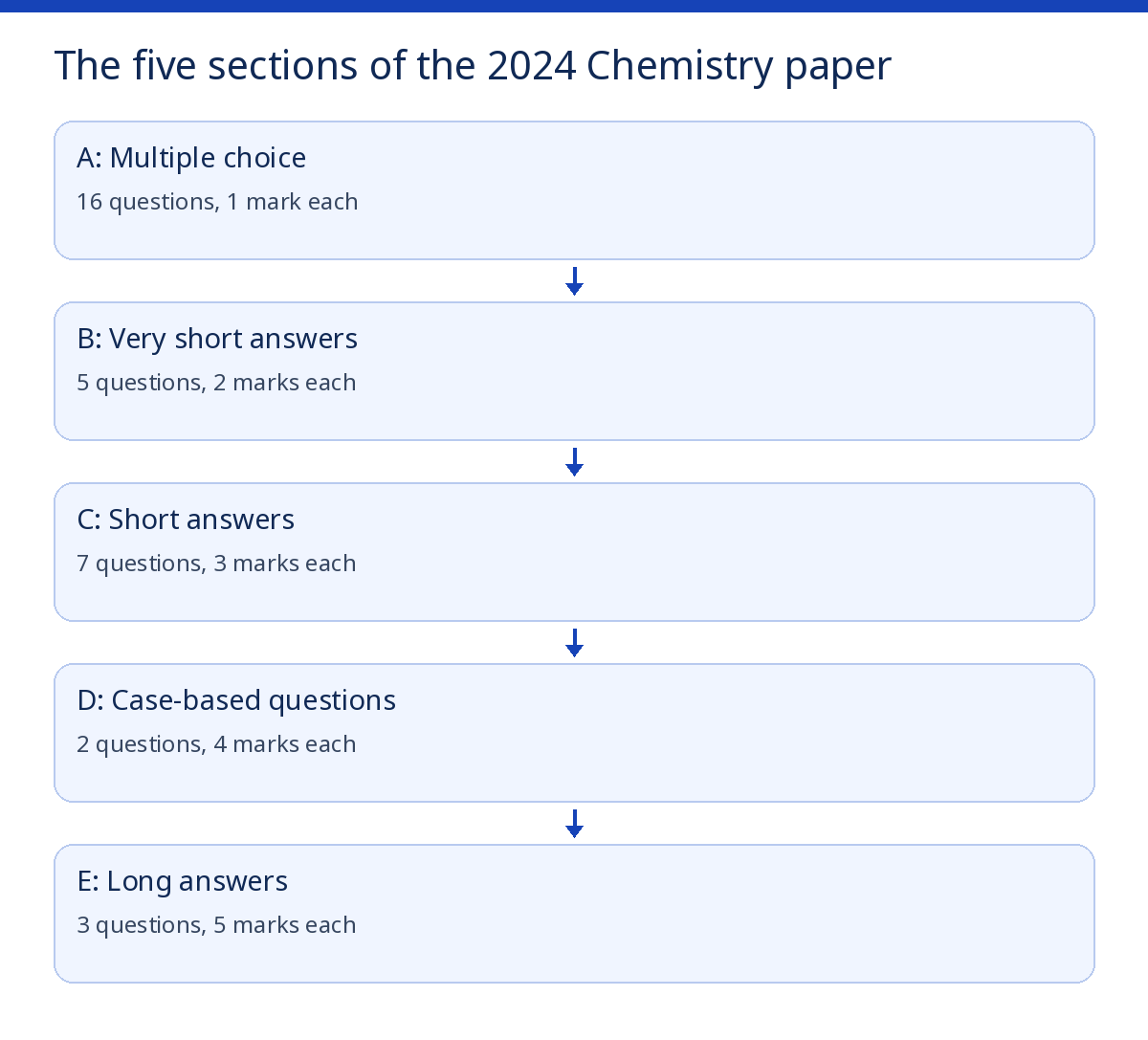
Section A contains 16 one-mark multiple-choice questions, including four assertion–reason items. Section B has five two-mark very short answers, and Section C has seven three-mark short answers. Section D contains two four-mark case-based questions, and Section E has three five-mark long answers. The format lets you compare how you handle brief decisions, written explanations and multi-part responses within one sitting.

Chemistry 2024 | Class 12 | Previous Year Paper | Code 56/3/2
In the StudentCurio app
The complete 2024 CBSE Class 12 Chemistry main examination paper, code 56/3/2, with worked solutions. It covers questions across the syllabus and helps students practise the board-paper format and review solution methods.
Common mistake: treating internal choice as optional questions
All 33 numbered questions are compulsory. There is no overall choice, although some questions outside Section A offer internal choices. Read the placement of each printed OR: where it sits between two versions of a subpart, it does not replace the rest of the question. Also distinguish an OR from an instruction to attempt a stated number of items from a list. In either format, the choice applies only where the instruction puts it.
During the reading period, notice where the alternatives begin and end without writing answers. When you start writing, label the question and subpart clearly. After the timed attempt, try the unused branch separately if you want more practice. Keep that second attempt out of your original timed record.
Physical chemistry: decide what the data represent
The paper tests solutions, chemical kinetics and electrochemistry through several kinds of tasks. The solutions questions move between the behaviour of mixtures and the use of measured properties, such as vapour pressure, to infer a solute’s molar mass. In a vapour-pressure comparison, check that the pure solvent and the solution are being compared at the same temperature and that the solute is specified as non-volatile.
In kinetics, percentage completion tells you how much reactant has been used, not how much remains. If you are applying an integrated rate law in terms of reactant concentration, make that distinction before substituting. In electrochemistry, distinguish conductivity from molar conductivity: the latter relates the former to the amount of electrolyte per unit volume, so concentration and unit consistency matter. Distinguish standard electrode potentials supplied as data from the cell potential requested at stated concentrations. In review, check these decisions before checking your arithmetic.
Inorganic chemistry: connect the observation to a model
Coordination chemistry appears in both multiple-choice and long-answer formats. The paper moves from ligand attachment and coordination number to nomenclature, geometry, crystal field splitting and magnetic character. Keep coordination number separate from oxidation state: one counts donor atoms directly attached to the metal, while the other is a formal assignment of charge. When discussing electron occupancy in an octahedral field, compare the splitting energy with the pairing energy rather than assuming that a given electron count always produces the same arrangement.
The transition-element material asks you to connect observable properties with atomic or electronic features. The case on transition and inner transition elements brings together catalysis, oxidation states and atomic size. In a written explanation, identify the feature relevant to the particular property rather than listing every property associated with the group.
Organic chemistry and biomolecules: distinguish the tasks
The organic questions ask you to predict products, justify reactivity, propose conversions and distinguish compounds by chemical tests. These tasks need different kinds of responses. For a conversion, check whether the carbon skeleton changes as well as the functional group, and show the sequence if more than one step is needed. For a chemical test, distinguish the reagent you would use from the observation that would tell the compounds apart. For a reactivity comparison, connect the structural difference to the reaction named in the question.
The biomolecules case gives you a passage on amino acids and proteins, including levels of protein structure and denaturation. Read the subpart before deciding how much of the passage to use: a definition, an example and a structural distinction are different requests. The printed alternative also draws on reducing sugars and the distinction between nucleosides and nucleotides, so reading the passage is not a substitute for revising those concepts.
Quick self-check before opening the worked solutions
For assertion–reason questions, judge each statement on its own first. If both are true, ask whether the reason actually explains the assertion. Two true statements about the same topic are not necessarily an explanation. For a calculation, ask what condition makes your chosen relation applicable. For a reaction question, ask whether the prompt wants a product, a reagent, an observation or a reason.
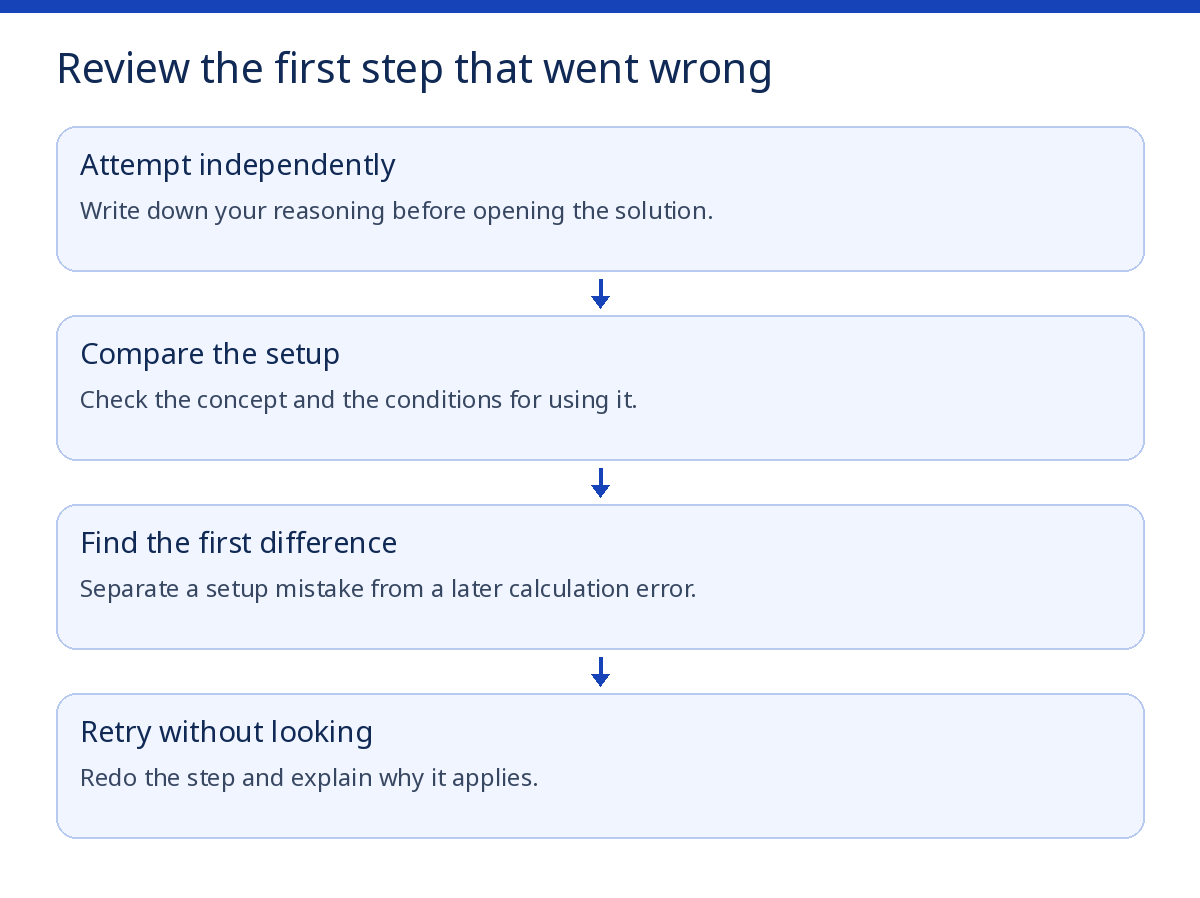
Then use the question-number navigation to compare your attempt with the worked solution. The solution layout separates the formula or relation, the concept and the explanation in steps. Find the first point where your reasoning differs: perhaps you chose the wrong model, misread a subpart or made a substitution error. Retry that step without looking. This guide leaves out individual answer options and examples whose symbols, signs or diagrams are incomplete in the supplied text; consult the question page in the file for its printed notation.
Spotted an error? Report a correction. Practise this in the app: notes, formula sheets and mind maps.















































































































































Loading comments…