CBSE Class 12 Chemistry 2024 Question Paper With Solutions
CBSEChemistry2024 Previous Year Paper
Paper code: 56/2/3 · 2024Use the complete 2024 CBSE Class 12 Chemistry main board exam paper, code 56/2/3, for a timed attempt. Then use the worked solutions to check how you chose a method, justified a comparison, or showed the steps in a calculation.
This set is one of the year's papers. See every set from 2024, grouped by series.
What this paper contains
This year-wise file contains the English version of the 2024 Chemistry theory paper for CBSE Class 12, followed by worked solutions. It is a full paper, not a chapter-wise worksheet. The question pages retain the original English layout, options and diagrams. The cover links to individual questions, and the solution pages shown in the source link back to the corresponding questions. That makes it possible to review one response without reading through the solutions in order.
The paper carries 70 marks and allows three hours of writing time. Its title page also records a separate 15-minute reading period during which candidates were not to write answers. If you recreate those conditions, use the reading period to locate internal choices and look over the case passages. Leave the solutions closed until you finish.

Chemistry 2024 | Class 12 | Previous Year Paper | Code 56/2/3
In the StudentCurio app
A complete CBSE Class 12 Chemistry main examination paper with worked solutions, covering questions across multiple syllabus chapters, including Coordination Compounds. Useful for board-exam practice and reviewing answer methods.
How the five sections work
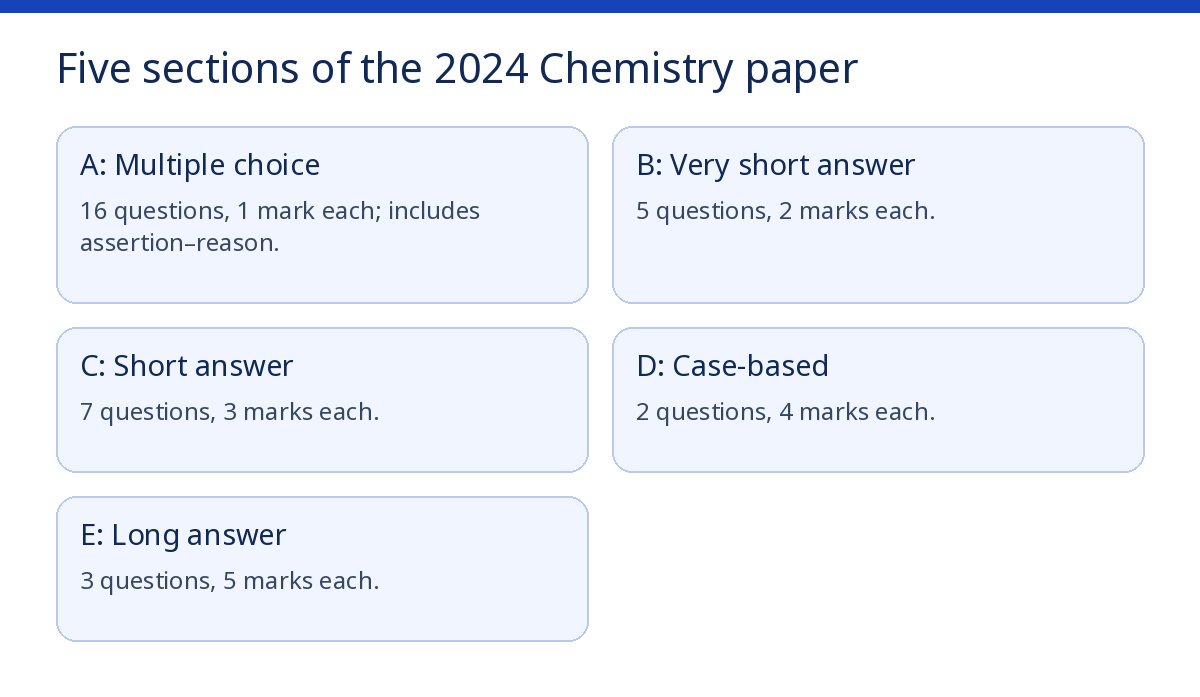
The paper has 33 questions. Section A has 16 one-mark multiple-choice questions, including an assertion–reason block. Section B has five two-mark very short answers, and Section C has seven three-mark short answers. Section D has two four-mark case-based questions, while Section E has three five-mark long-answer questions. Calculators are not allowed.
There is no overall choice: all questions are compulsory, subject to the choices printed within individual questions. Some questions outside Section A offer an internal alternative, and some ask you to select a specified number of subparts. In a timed attempt, follow the instruction at each question rather than attempting every branch. In review, the unused branch gives you a fresh prompt on which to test a method you have just revisited.
Physical chemistry: read the condition before the numbers
The physical chemistry questions cover solutions, chemical kinetics and electrochemistry. The solutions prompts include vapour-pressure lowering, isotonic solutions and an electrolyte calculation with an explicit dissociation assumption. The kinetics questions use concentration–time relationships, half-life and the effect of temperature on rate. Electrochemistry ranges from cell constant and conductivity to cell emf, electrolysis and a storage battery.
Before calculating, write down the quantity being asked for and the condition that determines your method. A half-life expression depends on the reaction order; it is not interchangeable between rate laws. Likewise, resistance, conductivity and molar conductivity are different quantities, so the unit on the last line should match the one you were asked to find. This guide omits the numerical slope in the kinetics multiple-choice item because its sign is unclear in the extracted text.
Inorganic chemistry: keep the models separate
Coordination Compounds appears in the opening multiple-choice section and again in a dedicated long-answer group. The paper asks about naming, ligand types, isomerism, geometry, magnetic behaviour and electron arrangement. Notice when a prompt specifies valence bond theory and when it specifies crystal field theory. In the former, the requested explanation can involve hybridisation and geometry. In the latter, a spin assignment depends on electron occupancy: use the stated relationship between crystal field splitting and pairing energy rather than treating geometry alone as enough.
The paper also covers transition-element properties and the lanthanoids and actinoids. Keep a periodic trend, such as contraction across a series, distinct from a comparison based on the oxidation state or electronic configuration of a particular ion. They call for different kinds of justification.
Organic chemistry and biomolecules: match the answer to the task
The organic questions move between product prediction, preparation equations, reaction sequences, chemical tests and explanations of reactivity. The paper draws on halo compounds; alcohols, phenols and ethers; carbonyl compounds and carboxylic acids; and amines. In a conversion or reaction sequence, track the functional group and carbon skeleton at each arrow instead of jumping straight from the starting compound to the final product. For a distinguishing test, practise stating both the reagent and the contrasting observations.
Biomolecules appears through short prompts on vitamins and amino acids and a case on carbohydrates. When reviewing the carbohydrate passage, keep classification by hydrolysis separate from evidence about molecular structure. A definition, a classification and a structural inference are different tasks, even when they occur in the same chapter.
Quick self-check: is the reason doing the work?
For an assertion–reason item, make three separate judgements: whether the assertion is true, whether the reason is true, and, if both are true, whether the reason explains the assertion. A statement can be chemically correct and still fail to explain the particular comparison being made. Before choosing an option, try expressing the link in a single sentence without restating the assertion.
Use a related check for the case questions on carbohydrates and transition elements. Identify which information comes from the passage or table and which concept you need to supply yourself. A useful review question is: Did I just repeat a fact from the passage, or did I use it to answer the subpart?
Review the method, not just the final answer
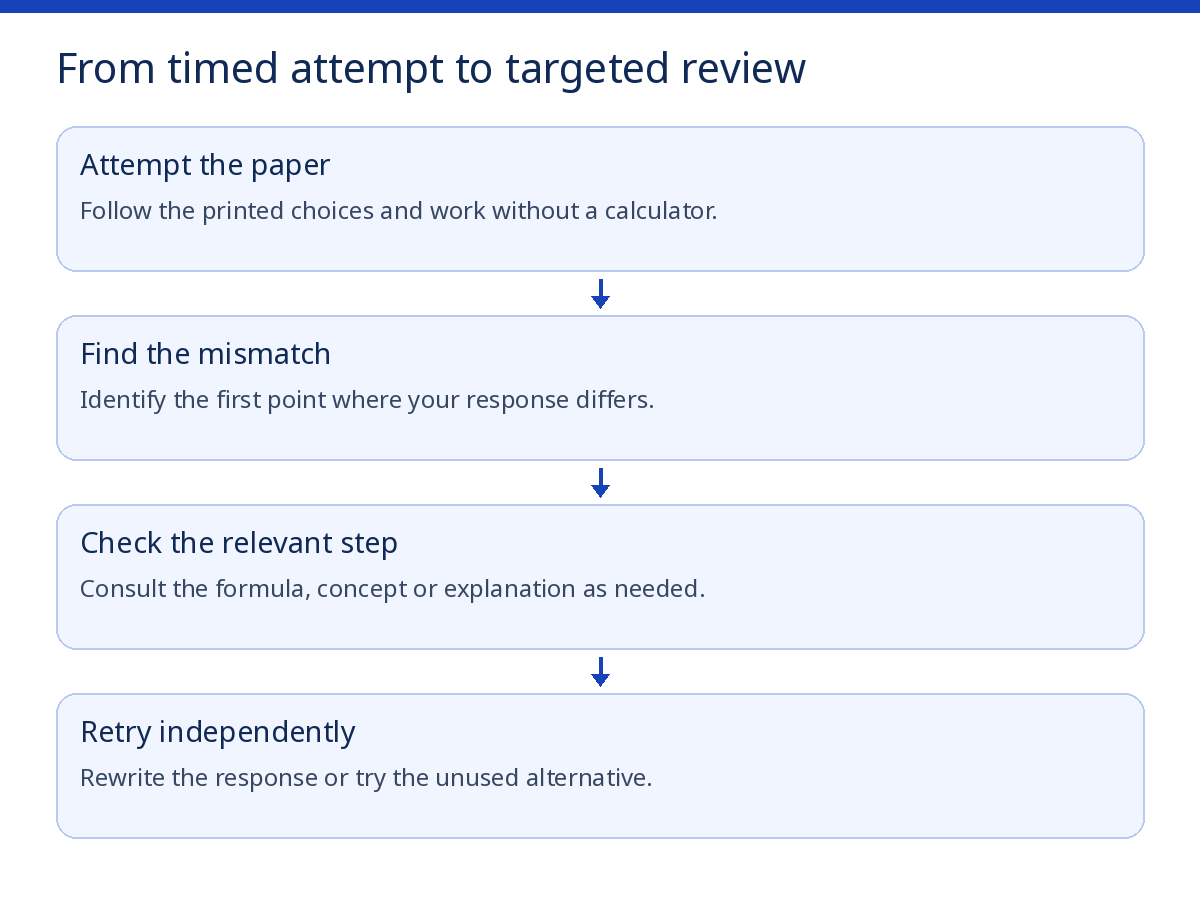
The worked solutions separate the formula used, concept used and explanation in steps. Start with the part that matches your error. If you chose the wrong equation, check the concept before reading the algebra. If your equation was appropriate but your result differed, compare the substitutions, units and arithmetic. For a structure or reasoning question, look for the first missing distinction rather than copying the final line.
Close the solution and write the corrected response in the form the question asks for: an equation, a structure, a reason or a calculation. For a question with an internal choice, try the branch you left untouched before opening its solution. That checks whether you can select and apply the method without the worked steps in front of you.
Spotted an error? Report a correction. Practise this in the app: notes, formula sheets and mind maps.















































































































































Loading comments…