CBSE Class 12 Chemistry 2024 Paper and Worked Solutions
CBSEChemistry2024 Previous Year Paper
Paper code: 56/3/1 · 2024Practise the full 2024 CBSE Class 12 Chemistry main board paper (Q.P. Code 56/3/1), then use the worked solutions to check how you chose a method, applied it and explained your reasoning.
This set is one of the year's papers. See every set from 2024, grouped by series.
What this 2024 paper contains
This year-wise resource pairs the English version of the CBSE Class 12 Chemistry theory paper with a worked-solutions section. The question paper is worth 70 marks and allows three hours for writing. Its title page also specifies a separate 15-minute reading period during which candidates may not write answers. The file preserves the question layout, options and diagrams, so use the paper pages for your attempt, especially where a structure or reaction scheme is part of the question.
Keep the question paper code with any notes you make. It identifies the exact paper you attempted, which matters when comparing a question or discussing a solution. Treat this as a record of what the 2024 paper tested, not as a prediction of the topics or mark distribution in a future exam.

Chemistry 2024 | Class 12 | Previous Year Paper | Code 56/3/1
In the StudentCurio app
Complete CBSE Class 12 Chemistry main examination paper for 2024 (Q.P. Code 56/3/1), with worked solutions covering physical, inorganic and organic chemistry. It helps students practise a full board paper and review solution methods.
Read the mark split and choice rules
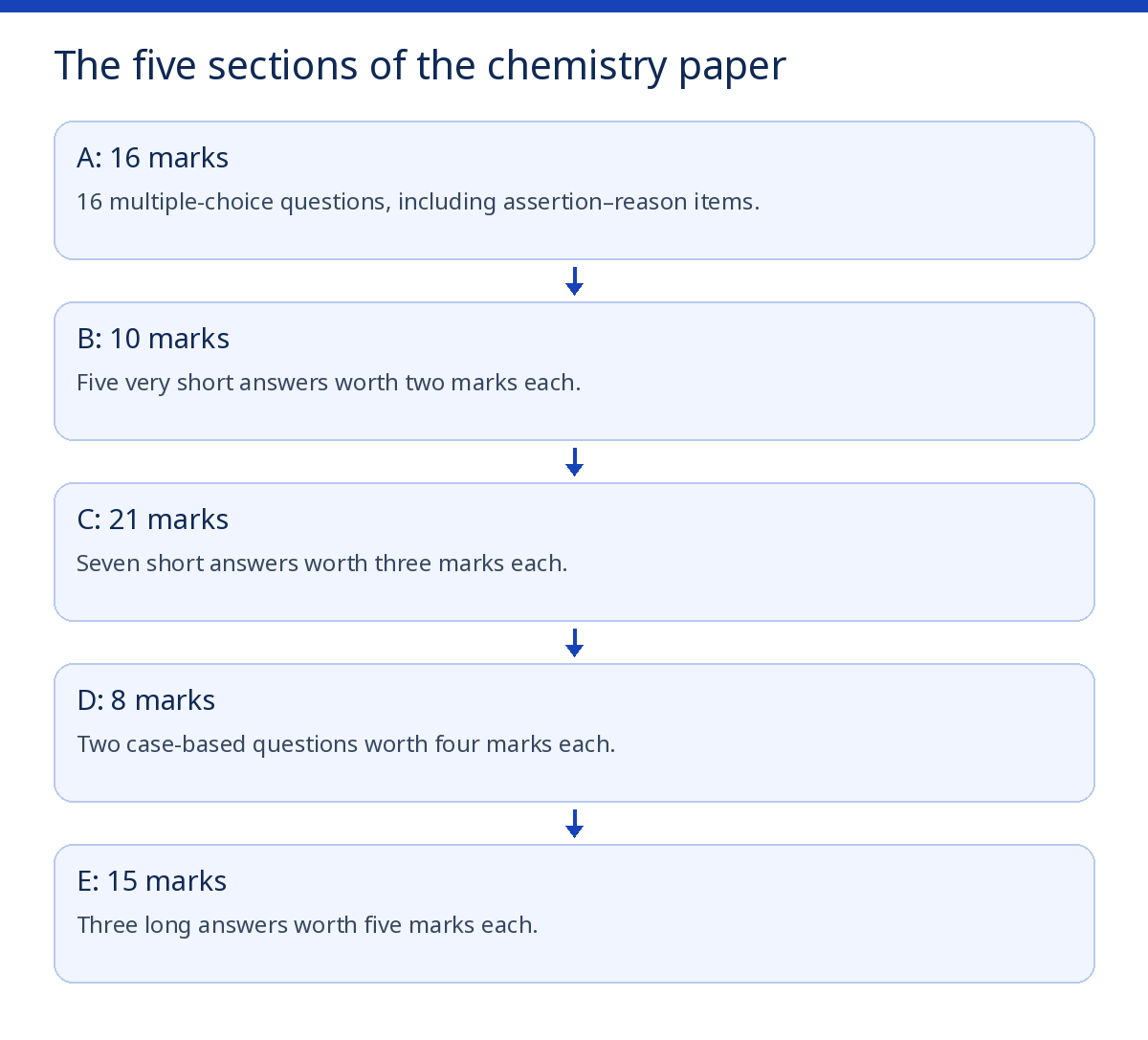
The paper has 33 numbered questions across five sections. Section A has sixteen one-mark multiple-choice questions, including four assertion–reason items. Section B has five two-mark very short answers, and Section C has seven three-mark short answers. Section D has two four-mark case-based questions, while Section E has three five-mark long answers. Calculators are not allowed.
There is no overall choice: you cannot drop an entire numbered question because another looks easier. Instead, follow the internal choices and subpart limits printed in individual questions. Use the reading period to spot those limits and decide which branches to attempt. When reviewing the paper, you can try the unused branches separately without counting them as part of your timed attempt. That lets you use more of the resource without changing the conditions of the original paper.
When the physical chemistry formula applies
The physical chemistry questions include solution properties, reaction kinetics, conductivity and electrochemical cells. The important step is to identify the situation before choosing an equation. For example, the paper’s vapour-pressure problem specifies a non-volatile solute. For an ideal solution with a non-volatile solute, the relative lowering of the solvent’s vapour pressure equals the solute mole fraction. The comparison is with the pure solvent at the same temperature; the pressure difference alone is not the relative lowering.
For an integrated first-order rate calculation, use the amount or concentration remaining, not the percentage that has reacted, in the denominator of the initial-to-final ratio. Keep the time unit consistent with the unit you report for the rate constant. In electrochemistry, distinguish standard electrode potentials from the cell potential at the stated concentrations. Before substituting into a cell equation, check the direction and balance of the reaction.
Connect inorganic explanations to the model
Inorganic chemistry appears both as short prompts and as extended reasoning. The transition-element case links electronic structure to properties such as variable oxidation states, magnetism and catalysis. It also introduces the decrease in size across the lanthanoids. When practising a trend explanation, distinguish the observed change from its cause: naming the trend is not the same as explaining how shielding affects it.
The coordination chemistry questions cover naming, ligand types, isomerism, crystal-field splitting and magnetic character. For a magnetic-character prompt, establish the metal’s oxidation state and d-electron count before deciding how the electrons occupy the orbitals. Use the geometry and model specified: the paper asks for valence bond theory in one context and octahedral crystal-field reasoning in another. A count of unpaired electrons is useful only if it follows from the model and conditions in the question.
Track what changes in organic reactions
Organic chemistry tasks ask you to predict products, explain reactivity, distinguish compounds and plan conversions. For a conversion, compare the starting material and target before naming a reagent: has the carbon framework changed, or has only the functional group changed? For a distinguishing test, practise writing the expected observation for each compound, rather than stopping at the name of the test. For a basicity comparison, note the stated medium; an explanation for amines in water must account for solvation as well as electronic effects.
The biomolecules questions require a different kind of precision. The case passage distinguishes levels of protein structure and describes how changes in temperature or pH can disrupt higher-level structure and impair function. Keep that idea separate from the peptide linkage that joins amino acid residues. The paper also includes glucose reactions, so biomolecules revision here involves both structural vocabulary and reaction recall.
Find the first step that went wrong
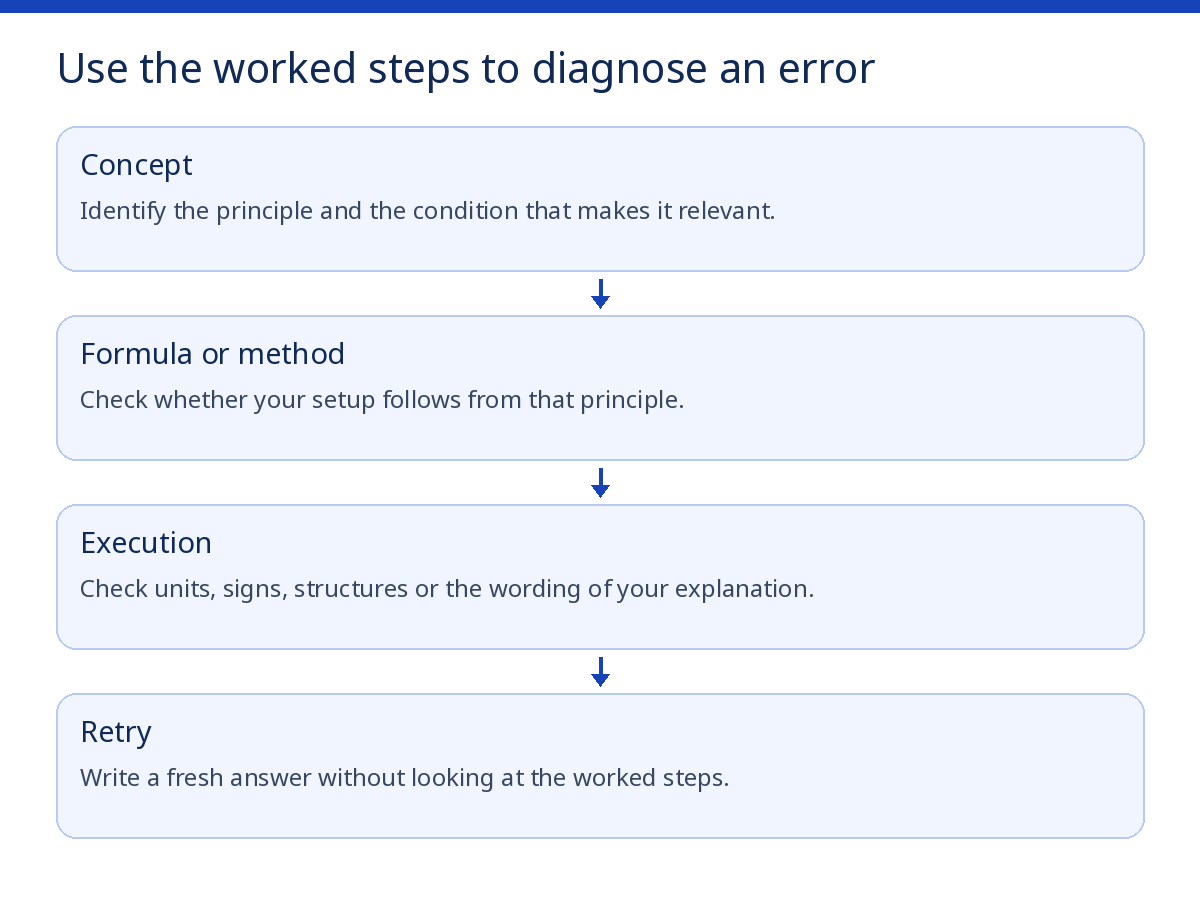
Attempt the paper before opening the linked solutions. Afterwards, use the resource’s separation of formula used, concept used and explanation in steps to locate the first point where your reasoning diverged. An incorrect result may begin with an unsuitable equation, a missed condition or a unit error. A correct multiple-choice selection is worth revisiting if you guessed it; for assertion–reason items, check each statement independently before deciding whether the reason explains the assertion.
Then retry a missed question without looking at the worked method. Check whether your new response explains the chemical choice, not merely whether it reaches the same result. Some lines in the extracted text are incomplete, so this guide leaves out the affected numerical details and answer options rather than reconstructing them. Read quantities, signs and structures directly from the paper pages.
Spotted an error? Report a correction. Practise this in the app: notes, formula sheets and mind maps.















































































































































Loading comments…