CBSE Class 12 Chemistry 2024 Board Paper with Solutions
CBSEChemistry2024 Previous Year Paper
Paper code: 56/4/3 · 2024Practise with the complete English-language 2024 CBSE Class 12 Chemistry main examination paper, set 56/4/3. Use the worked solutions to review not just what you wrote, but why a particular rule, reagent or explanation applies.
This set is one of the year's papers. See every set from 2024, grouped by series.
What this 2024 paper includes
This is a year-wise previous year paper for the CBSE Class 12 main board examination, not a chapter test. The original paper allows three hours and carries 70 marks. The file preserves the English question layout, options and diagrams, and the cover provides links by question number. The worked solutions cover subparts and both printed alternatives where the paper offers an OR choice. They separate the rule or formula used from the underlying concept and the step-by-step explanation. That structure is useful when you know how to start a question but cannot tell whether the next line should be a calculation, a statement about structure or a justification based on reaction conditions.

Chemistry 2024 | Class 12 | Previous Year Paper | Code 56/4/3
In the StudentCurio app
The complete 2024 CBSE Class 12 Chemistry main examination paper with worked solutions, covering questions across physical, inorganic and organic chemistry. Useful for board-exam practice and reviewing solution methods across multiple chapters.
Use the full paper before opening the solutions
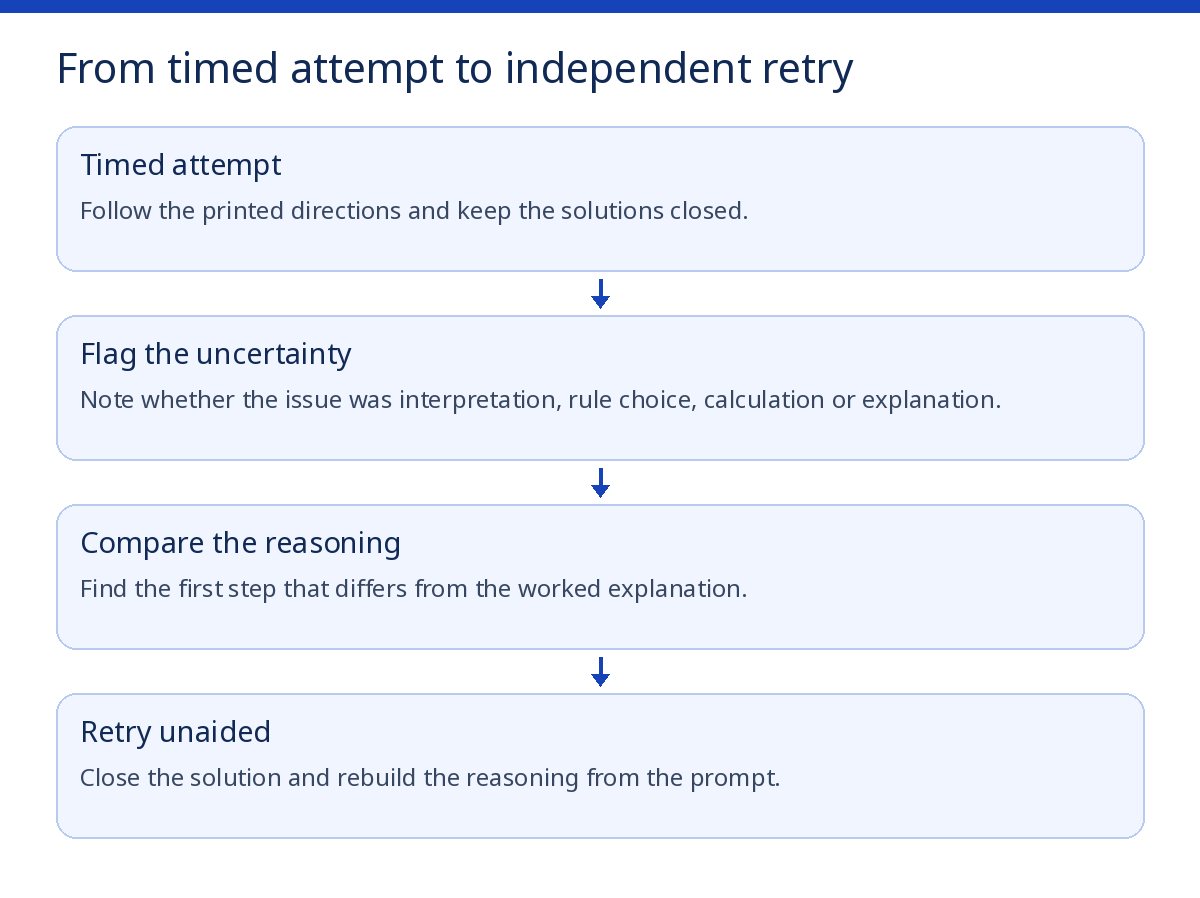
For a timed attempt, use the printed three-hour limit and follow the question paper’s directions for internal choices. Keep the worked solutions closed. When you are unsure, put a short note beside your response identifying what stopped you: interpreting the prompt, choosing a rule, carrying out a calculation or explaining a conclusion. That note is more useful on review than a blank alone, because it shows where your reasoning broke down. Afterward, you can attempt the other side of an OR choice as a separate exercise. Comparing the two attempts can show whether your original choice reflected stronger understanding or simply greater familiarity with the wording.
Physical chemistry: match the rule to the quantity
The paper includes limiting molar conductivity, electrochemical cell behaviour and chemical kinetics. These topics call for different checks. In conductivity, first distinguish the contribution of an individual ionic species from the overall quantity for an electrolyte. In a cell question, establish whether the setup describes spontaneous operation or includes an opposing external voltage before reasoning about the direction of change. In kinetics, identify the variables on a graph before interpreting its shape: a concentration–time plot and a rate–concentration plot are not interchangeable. When reviewing, look for the point at which the solution identifies the relevant quantity or model. A correct calculation cannot repair a choice made for the wrong quantity.
Inorganic chemistry: separate patterns from individual cases
The d-block material gives you a chance to distinguish a general electronic configuration from the configuration of a particular element. A general pattern describes a range of occupancies; it does not assign one occupancy to every member of the block. An oxidation-state comparison asks a different question again. The electron configuration provides context for which electrons can be involved, but writing a configuration is not the same as comparing oxidation states. As you review this part of the paper, notice whether the prompt asks for a statement about the block, a fact about an individual element or a comparison among elements. The scope of the claim determines what your explanation needs to establish.
Organic chemistry: identify what controls the transformation
The organic questions cover reagent selection, substitution, carbonyl reactions and functional-group behaviour. When comparing your work with a solution, name the structural feature or reaction condition that makes the proposed pathway applicable. A reagent-matching question asks you to connect a reagent with a particular change in the substrate, not merely recall that the reagent appears in the chapter. For substitution, distinguish the structure of the starting compound from the stability of the intermediate invoked by the mechanism. For an acidity comparison, look at the species formed after proton loss. This helps you see whether the explanation actually addresses the comparison rather than merely describing the original molecules.
Common mistakes: mixing up counts and skipping conditions
Some errors come from using the right idea with the wrong input. In a limiting molar conductivity calculation, the multipliers come from the stoichiometric numbers of ions produced per formula unit, not from the magnitudes of their charges. In biomolecules, don't infer how a sugar will behave in a reducing test from its functional-group label alone: the alkaline test medium can affect which structures are present. For an assertion–reason item, check each statement independently before deciding whether one explains the other. A reason that mentions the right chemical species can still be false, and a true statement on the same topic is not necessarily an explanation.
Review the first step you would change
Open the solution for a question you missed and find the earliest point where your reasoning differs. If you chose the wrong rule, write down the condition you overlooked. If the rule was right but your explanation was incomplete, add the missing link between the chemical fact and your conclusion. Then close the solution and try the question again without looking at its final answer. As a quick self-check, ask: If the condition in the prompt changed, which line of my reasoning would I have to reconsider? This is especially useful after a correct guess, where checking the answer alone can hide the gap that the worked explanation helps you find.
Spotted an error? Report a correction. Practise this in the app: notes, formula sheets and mind maps.















































































































































Loading comments…