CBSE Class 12 Chemistry 2024 Solved Paper (56/3/3)
CBSEChemistry2024 Previous Year Paper
Paper code: 56/3/3 · 2024Practise the full 2024 CBSE Class 12 Chemistry main examination paper, code 56/3/3, in its original English layout. Use the worked solutions after your attempt to check not just your answers, but also the reasoning, equations and units that support them.
This set is one of the year's papers. See every set from 2024, grouped by series.
Know the paper before you start
This year-wise resource pairs the 2024 Class 12 Chemistry theory paper with worked solutions. The paper carries 70 marks and allows three hours of writing time. The front page lists a separate 15-minute reading period during which candidates could read the questions but not write answers. Calculators were not permitted.
The 33 questions are organised into five sections. Section A has 16 one-mark multiple-choice questions, including assertion–reason items. Sections B and C contain five two-mark very short answers and seven three-mark short answers, respectively. Section D has two four-mark case-based questions, and Section E has three five-mark long answers. There is no overall choice, but some questions outside Section A offer an internal choice. Follow the instruction at each question: a printed OR and a direction to attempt a specified number of subparts are different kinds of choice.

Chemistry 2024 | Class 12 | Previous Year Paper | Code 56/3/3
In the StudentCurio app
Complete solved CBSE Class 12 Chemistry main examination paper 56/3/3 from 2024, covering physical, organic and inorganic chemistry, including electrochemical calculations, Faraday’s laws and fuel cells. It helps students practise the board-paper format and review exam-style answers.
Physical chemistry: identify the model before calculating
Chemical kinetics appears in both short conceptual questions and calculations. Before using a half-life or integrated rate expression, establish the reaction order. For a first-order reaction, ; the unit of the resulting time must correspond to the inverse time unit of . When a problem gives percentage completion, distinguish the fraction that has reacted from the fraction remaining: the first-order integrated rate law uses the amount remaining relative to the initial amount.
The solutions questions connect vapour pressure, freezing-point depression and deviations from Raoult’s law. A non-volatile solute matters in a vapour-pressure calculation because it does not contribute its own vapour pressure to the solution. For a question about deviations, the direction of deviation and the explanation based on interactions between molecules are separate parts of the response.
Electrochemistry calls for several distinct approaches. Conductivity and molar conductivity are different quantities, so concentration and unit conversions matter when moving between them. For a cell-emf calculation under non-standard conditions, identify the balanced cell reaction and electron transfer before writing the reaction quotient. Faraday-law questions link charge to the amount of electrons transferred, whereas a fuel-cell comparison calls for a qualitative explanation.
Organic chemistry: let the structure guide the answer
The paper tests organic chemistry through product prediction, named reactions, conversions, chemical tests and short explanations. These formats ask for different things. A product question needs the resulting structure; a conversion needs reagents and any necessary intermediate steps; a distinguishing test needs an observation that tells the two compounds apart. Giving only the name of a test does not show what difference you would observe.
The substitution questions make it useful to locate the carbon bearing the leaving group before deciding how to reason about the reaction. Do not transfer an explanation about the effect of crowding in an reaction of a haloalkane directly to nucleophilic substitution in a haloarene. When checking a multistep conversion, track the carbon skeleton as well as the functional group. A route can reach the right class of compound while still giving the wrong structure.
Inorganic chemistry: separate charge, bonding and geometry
Coordination chemistry appears in objective questions and a long-answer question with selectable subparts. The paper asks about naming, ligand behaviour, isomerism, crystal-field splitting and magnetic character. In a complex, the metal’s oxidation state, the number of donor atoms attached to it and its geometry are distinct pieces of information. Keeping them separate makes it easier to check where an explanation went wrong.
For octahedral electron filling, the comparison between crystal-field splitting and pairing energy matters because it determines whether pairing or occupation of a higher-energy orbital is favoured. When a question explicitly asks for an explanation using valence bond theory, use that framework rather than treating it as interchangeable with crystal-field notation. The paper also asks you to balance inorganic redox equations. In acidic medium, check total charge as well as atom counts.
Read the case, then answer the subpart
The two case passages bring together transition and inner transition elements and biomolecules. The first links electronic structure to properties of transition elements and introduces lanthanoid contraction. The second moves between amino acids, protein structure and denaturation, with an internal choice that also reaches carbohydrates and nucleic-acid components.
Use each passage to locate the relevant idea, then look at the verb in the subpart. A definition sets out what a term means; an explanation supplies a cause; a comparison identifies the relevant difference. A sentence copied from the passage may name the right phenomenon without doing what the question asks.
Quick self-check: can you justify the method?
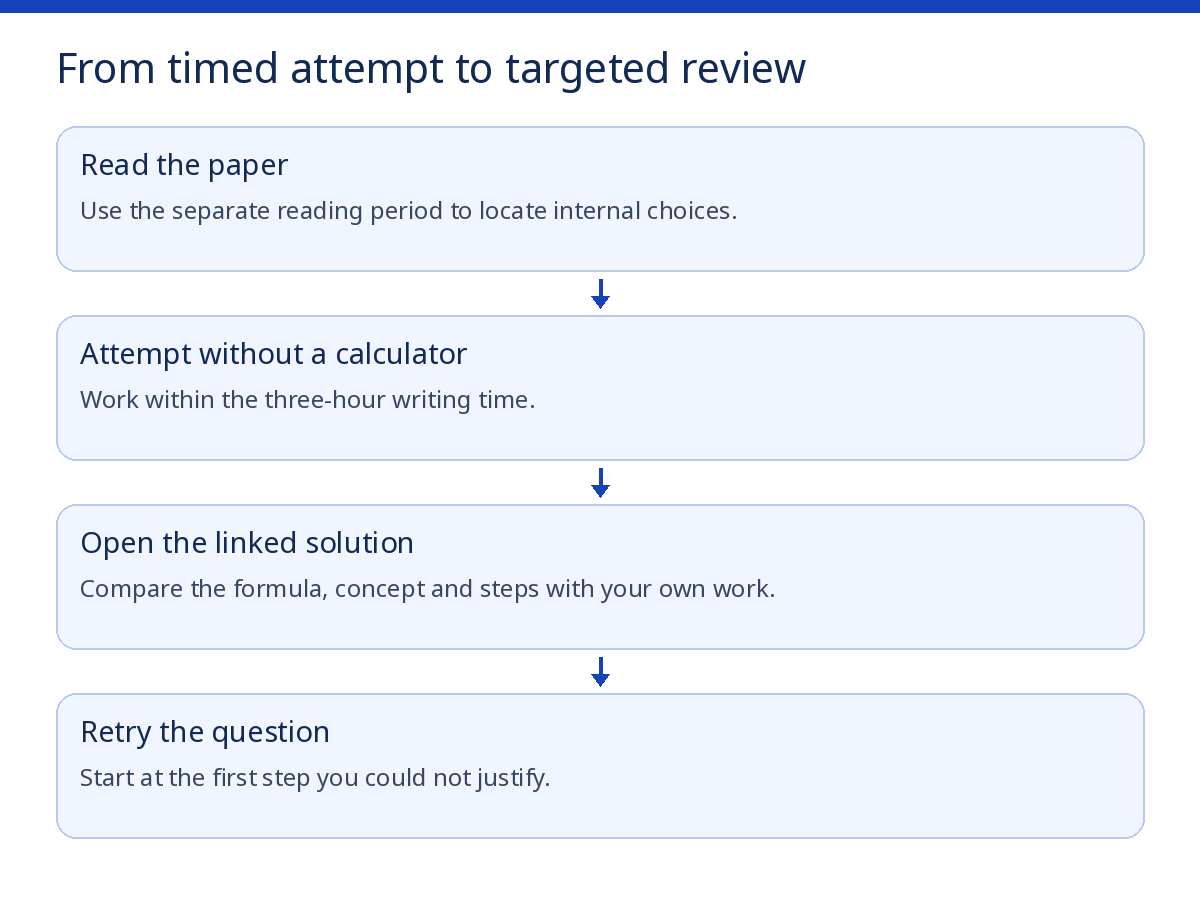
Attempt the paper before opening the worked solutions. Use the reading period to identify internal choices and note which questions require calculations, structures or explanations. Afterward, use the question-number links to compare your work with the file’s Formula Used, Concept Used and Explanation in Steps. Look for the first point at which your reasoning diverges, rather than checking only the final line.
Before retrying a missed question, ask yourself: Can I name the condition that makes my formula valid? Does my organic route preserve or deliberately change the carbon skeleton? In an assertion–reason item, have I checked each statement separately before deciding whether the reason explains the assertion? This guide does not reproduce interpretation-dependent assertion–reason answer codes or calculations from passages where the extracted notation is unclear.
Spotted an error? Report a correction. Practise this in the app: notes, formula sheets and mind maps.















































































































































Loading comments…