CBSE Class 12 Chemistry 2023 Paper: Set 56/3/2
CBSEChemistry2023 Previous Year Paper
Paper code: 56/3/2 · 2023Use the full 2023 CBSE Class 12 Chemistry main board paper, set 56/3/2, for a three-hour theory practice session. The English-language file pairs the question paper with worked solutions so you can review why a method applies, not just whether your answer matches.
This set is one of the year's papers. See every set from 2023, grouped by series.
How the 70-mark paper is organised
This year-wise resource contains one complete board paper, not a chapter-wise question bank. Its 35 questions are divided into five sections: A has 18 one-mark multiple-choice questions, including assertion–reason items; B has seven two-mark very short answers; C has five three-mark short answers; D has two four-mark case-based questions; and E has three five-mark long answers.
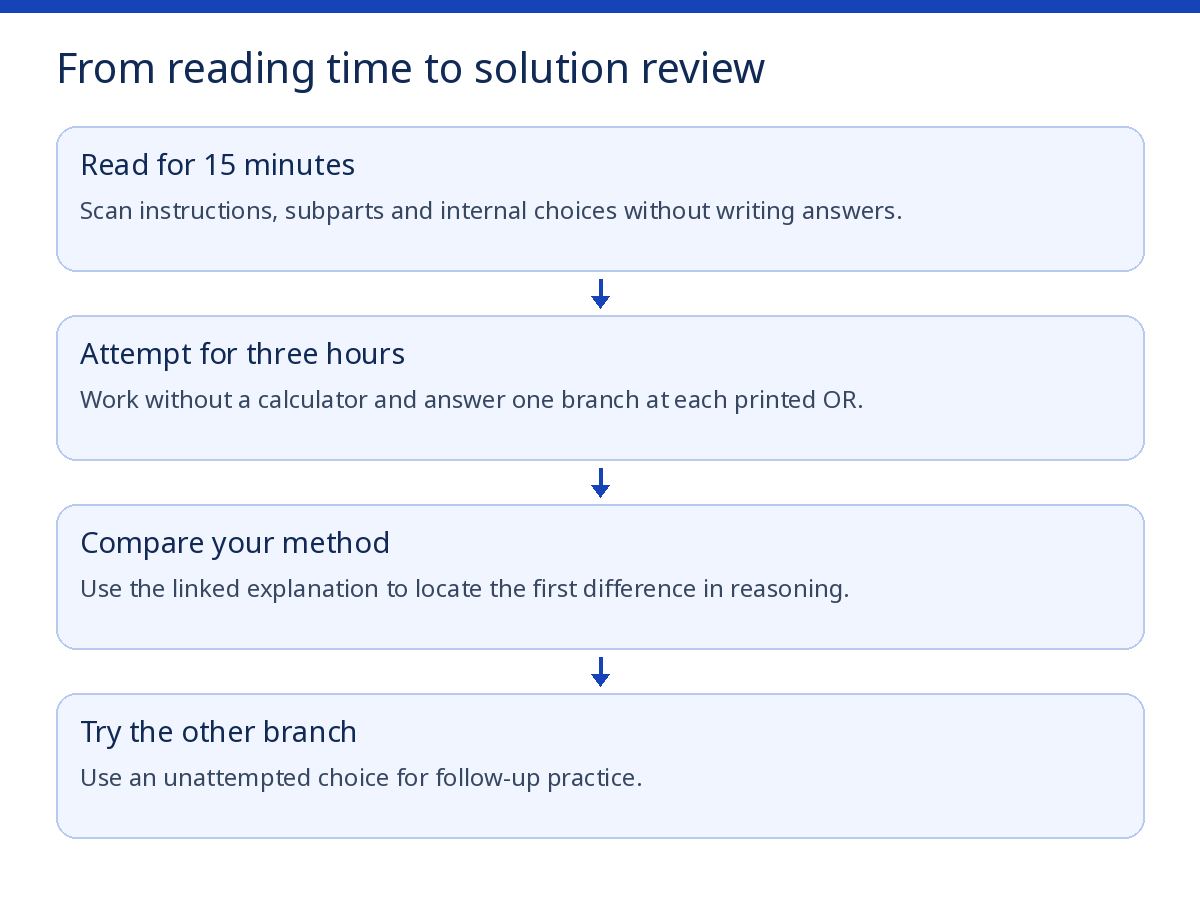
The paper has no overall choice: all question numbers are compulsory, but there are internal choices in Sections B through E. In a timed attempt, answer just one branch where an OR is printed. The solutions cover both branches, so you can use the unattempted branch later to check a skill that your first choice let you avoid.

Chemistry 2023 | Class 12 | Previous Year Paper | Code 56/3/2
In the StudentCurio app
The complete 2023 CBSE Class 12 Chemistry main examination paper (set 56/3/2) is presented with worked solutions. It covers questions across multiple syllabus chapters, helping students practise the board paper and review solution methods.
Physical chemistry: decide what the data can tell you
The physical chemistry questions draw on solutions, chemical kinetics and electrochemistry. The solutions chapter appears through prompts on osmotic pressure, deviations from ideal behaviour and freezing-point depression. Before choosing a relation, identify the property being measured. In a colligative-property calculation involving association, distinguish the amount of solute added from the effective number of dissolved particles: association reduces the particle count relative to that expected without association.
Kinetics asks you to read initial-rate data and reason about how a rate changes with temperature. These are different tasks: concentration comparisons help establish reaction order, whereas a temperature comparison can be used to estimate activation energy when the kinetic model and stated conditions support it. Electrochemistry brings in cell emf, corrosion, fuel cells and conductance, so not every prompt in that chapter calls for a cell-potential calculation.
When a shortcut applies: order and conductivity
An excess reactant can be treated as effectively constant only if its concentration changes negligibly over the interval being considered. Its contribution can then be absorbed into an observed rate constant. That simplifies the rate expression under those conditions; it does not remove the reactant from the underlying rate law. In an initial-rate table, look first for a comparison in which one concentration changes while the other stays fixed.
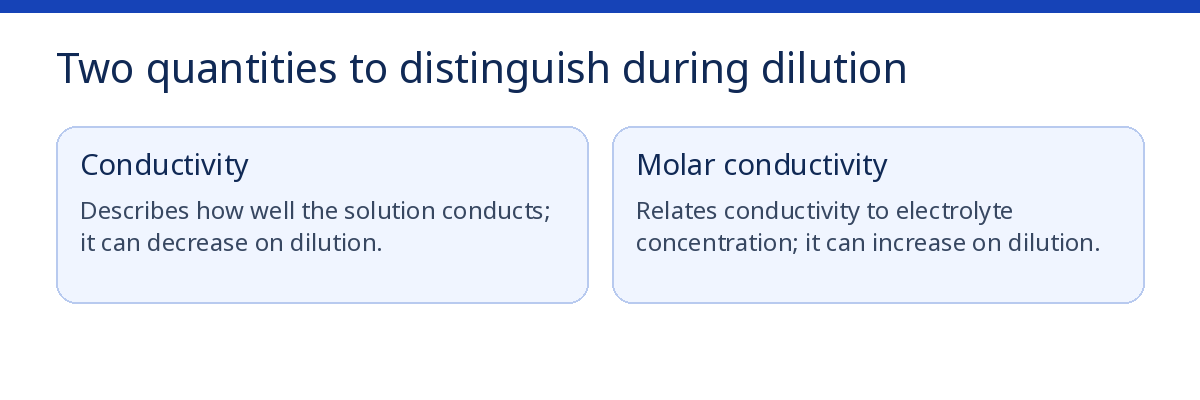
Likewise, conductivity and molar conductivity are not interchangeable. Conductivity describes how well the solution conducts, whereas molar conductivity relates that quantity to electrolyte concentration. Dilution can lower conductivity while increasing molar conductivity. When reviewing a dilution question, first check which quantity the question names before deciding what trend to explain.
Organic chemistry and biomolecules: read the task verb
The organic questions ask for different kinds of evidence: equations for named reactions, reagent choices in conversions, structures of intermediates and products, a mechanism, and explanations of reactivity. For a conversion, make sure each step leads from the structure you have to the structure needed for the next step. For a mechanism, naming the reaction or writing only the final product does not show how the transformation occurs. The paper also uses carbonyl chemistry to test whether you can connect structural features to reaction behaviour.
The biomolecules questions move between carbohydrates, proteins and nucleic-acid components. When asked to distinguish two linkages, compare what each linkage joins. When asked to distinguish a nucleoside from a nucleotide, compare their components rather than relying on the similarity of their names.
Inorganic chemistry: use the right evidence for each claim
The paper covers transition-metal oxidation states, redox equations and coordination chemistry. In a redox question, the reaction medium matters; a familiar oxidising agent does not necessarily give the same products under different conditions. When reviewing a balanced ionic equation, check charge as well as atom counts.
The coordination case links experimental evidence, nomenclature, geometry and magnetic behaviour. A precipitation observation can help distinguish ions outside the coordination sphere from ligands bound to the metal, while magnetic reasoning depends on whether electrons are unpaired. The case passage also distinguishes the roles of two models: valence bond theory is used here to discuss geometry and magnetism, while crystal field theory describes how the ligand field splits the metal’s d-orbital energies.
Quick self-check: match the reasoning to the format
For an assertion–reason item, ask three separate questions: Is the assertion true? Is the reason true? If both are true, does the reason actually explain the assertion? A statement can be relevant to the same topic without explaining the particular claim.
For a case-based question, identify what the passage supplies and what you must infer from it. The two cases use coordination compounds and haloalkanes or haloarenes, but their subparts call for different outputs, such as a name, a prediction or an equation. In a multi-part response, check each subpart against its own instruction instead of assuming that one general explanation covers the whole question.
Use the worked solutions after a closed-paper attempt
To mirror the printed conditions, allow 15 minutes for reading without writing answers, then attempt the paper in three hours without a calculator. Keep the worked solutions closed until you finish. On review, use the question-number links to compare your governing concept, formula or reaction, and intermediate steps with the explanation. Mark where your reasoning first changed course; that is more useful for revision than recording only a wrong final answer.
Use the PDF layout to read structures, symbols and answer options that are incomplete in the extracted text. This guide leaves out individual answers and does not interpret the incomplete compound-identification prompt in Question 3.
Spotted an error? Report a correction. Practise this in the app: notes, formula sheets and mind maps.















































































































































Loading comments…