CBSE Class 12 Chemistry 2023 Board Paper With Solutions
CBSEChemistry2023 Previous Year Paper
Paper code: 56/5/3 · 2023Practise with the complete 2023 CBSE Class 12 Chemistry main board paper (Set 3, code 56/5/3). Use the worked solutions after your attempt to check how you chose a method, handled the conditions and explained your reasoning.
This set is one of the year's papers. See every set from 2023, grouped by series.
What this year-wise paper contains
This file brings together the English question paper and worked solutions for one complete CBSE Class 12 Chemistry theory examination. It preserves the original question layout, options and diagrams, so you can practise reading the paper as it was presented rather than as a collection of chapter exercises. The paper is worth 70 marks, with three hours of writing time and a separate 15-minute reading period. Calculators were not allowed.
For a timed attempt, stay in the question-paper portion and use the reading period to locate internal choices, identify multi-part prompts and note where a table or passage supplies information. Then start writing when the reading time ends. Save the linked solutions for review so that you can tell which methods you selected independently.

Chemistry 2023 | Class 12 | Previous Year Paper | Code 56/5/3
In the StudentCurio app
The complete 2023 CBSE Class 12 Chemistry main examination paper (code 56/5/3) with worked solutions. It covers questions across multiple Chemistry topics and helps students practise the board-paper format and review solution methods.
How the five sections change what you write
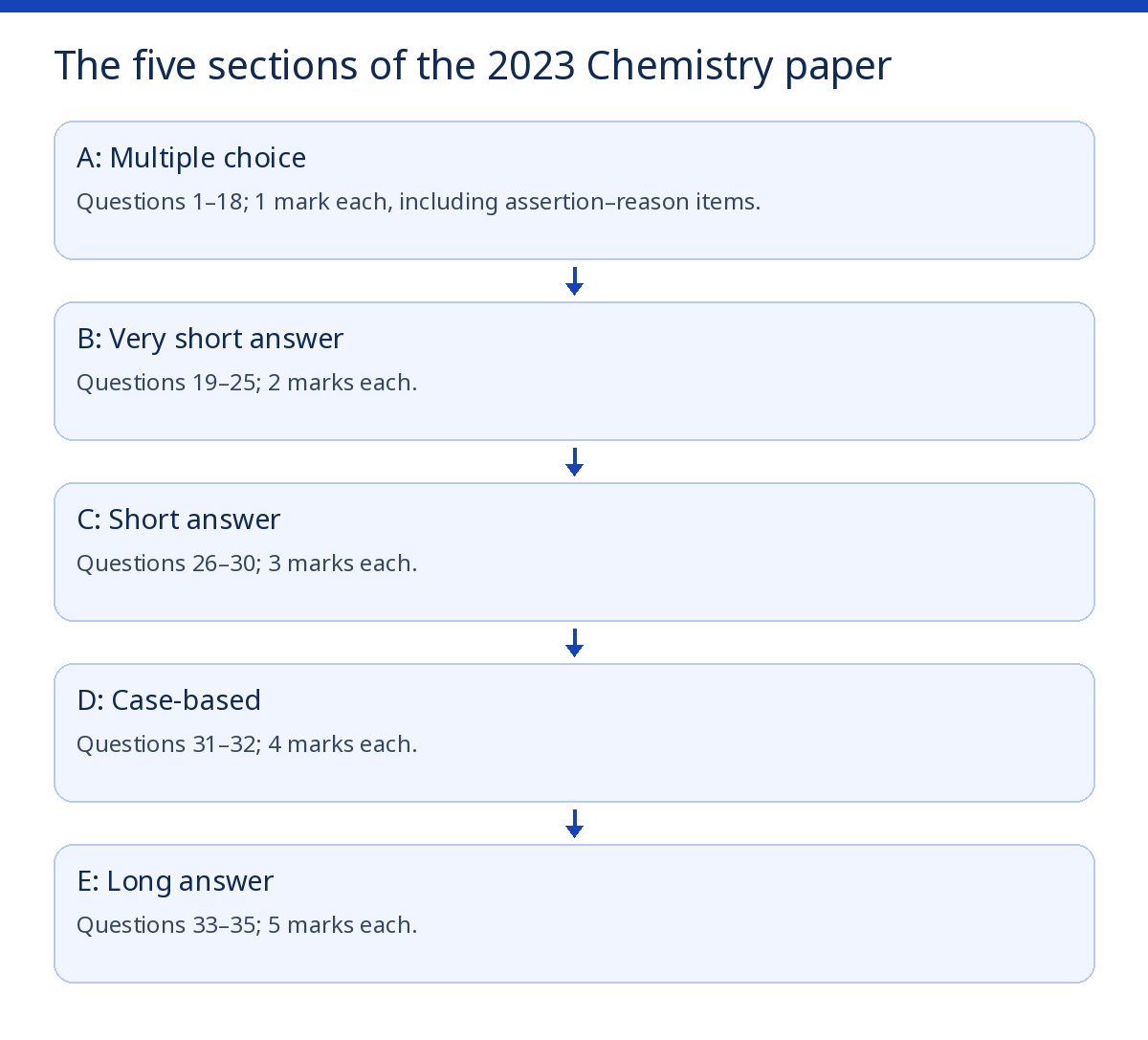
- Section A: Questions 1–18 are one-mark multiple-choice items, including assertion–reason questions.
- Section B: Questions 19–25 are two-mark very short answers.
- Section C: Questions 26–30 are three-mark short answers.
- Section D: Questions 31–32 are four-mark case-based questions.
- Section E: Questions 33–35 are five-mark long answers.
All 35 questions are compulsory in the sense that there is no overall choice. Sections B through E offer internal alternatives in specified places. In a mock attempt, follow each printed OR instead of treating it as permission to leave the whole question out. Also check the verbs in each subpart: a request to state a law, justify a trend or derive a relationship calls for different evidence, even when the prompts draw on the same chapter.
When a physical chemistry rule applies
The paper draws on chemical kinetics, electrochemistry and solutions. In an initial-rate table, compare trials at the same temperature in which one reactant concentration changes while the other is held fixed. That isolates the concentration dependence you are trying to infer. Keep this task separate from a first-order derivation: an integrated relationship for first-order kinetics is not a general rule for every rate law.
In electrochemistry, distinguish balancing a redox equation from calculating its standard cell potential. You may need to scale a half-equation to balance electrons, but that does not scale its standard electrode potential. In colligative-property calculations, check which concentration measure the formula requires: boiling-point elevation and freezing-point depression use molality. If a prompt specifies complete dissociation, use it as a condition of that calculation, not as a rule for every real solution.
Follow the structural clue in organic and inorganic chemistry
Organic questions ask for more than reaction recall. The paper includes comparisons of acidity, basicity and boiling point, as well as conversions and functional-group identification. On an identification prompt, check that your proposed structure accounts for all the clues rather than stopping at the first test it fits. When comparing basicity, retain the stated medium: a comparison in aqueous solution is not automatically a comparison under all conditions.
In coordination chemistry, distinguish the metal ion's electron count from the way those electrons occupy split orbitals. For a crystal-field configuration, start with the ion and check the stated relationship between splitting and pairing energy before placing the electrons. The paper also connects electronic structure with magnetic behaviour and includes transition-metal properties and biomolecule topics such as protein structure and amino acids.
Read each case study for the evidence it supplies
One case compares the two-step and single-step mechanisms of nucleophilic substitution in haloalkanes. Use the passage to identify which factor the subpart is asking about: substrate structure, leaving group, nucleophile or solvent. A useful explanation connects the relevant factor to the mechanism rather than using solvent polarity as a rule on its own.
The other case presents measurements for potassium chloride solutions at different concentrations. Read the headers before interpreting a trend: conductivity and molar conductivity are different quantities, with units of and , respectively, in the table. As a self-check, ask whether your explanation names the same quantity as the column you are using. A trend in one column is not evidence that the other quantity changes in the same direction.
Compare your reasoning with the worked solutions
The file includes a question-number index, and the worked solutions separate the formula, concept and explanation in steps. Start the comparison with the concept: did you recognise what the question was testing? Then locate the first step where your reasoning diverged. In an assertion–reason item, for instance, distinguish testing each statement from deciding whether the reason actually explains the assertion. In a calculation, distinguish choosing the wrong relationship from making an error after choosing the right one.
The solutions cover the printed OR branches, so you can use the alternative you did not choose as a second practice task. Attempt it before opening its explanation; this helps you check whether you can apply the relevant ideas without following a displayed method.
Printed details not used in this guide
The guide leaves out the disputed brine options (Q11), cobalt-complex colour (Q20(b)), printed reaction scheme in Q28(b)(i), and numerical rate example in Q30(a). It also omits the solvent-rate figures and broad solvent rule in Q31, the wording and dissociation calculation in Q32(a)–(b), the chemical-test prompt in Q33(b)(i), and the europium configuration in Q35(c)(iii). These omissions are limited to the flagged details; the paper still provides independently supported material on the surrounding topics for practice and review.
Spotted an error? Report a correction. Practise this in the app: notes, formula sheets and mind maps.















































































































































Loading comments…