CBSE Class 12 Chemistry 2023 Solved Paper: Set 56/2/3
CBSEChemistry2023 Previous Year Paper
Paper code: 56/2/3 · 2023Practise with the full 2023 CBSE Class 12 Chemistry main board examination paper, Set 3 (56/2/3). The English question paper and worked solutions let you attempt the five-section theory paper first, then review the reasoning behind your responses.
This set is one of the year's papers. See every set from 2023, grouped by series.
What this year-wise file contains
This resource presents one complete examination set rather than rearranging questions by chapter. The English paper retains the original question order, options and diagrams, so you can practise moving between topics as they appeared in the actual exam. The title page identifies it as a Chemistry theory paper with a writing time of three hours and a maximum of 70 marks.
The file includes a question-number index that links to worked solutions. Those solutions separate the formula used, the underlying concept and the explanation in steps. For a first attempt, stay in the question-paper portion of the file. For a targeted review, use the index to revisit a particular question without reading through the answers to questions you have yet to attempt.

Chemistry 2023 | Class 12 | Previous Year Paper | Code 56/2/3
In the StudentCurio app
Solved CBSE Class 12 Chemistry main examination paper for 2023, set 56/2/3, with questions and worked answers spanning the syllabus. Includes a worked solution on transition-element properties and related d- and f-block chemistry, helping students practise the board-paper format and review solution methods.
How the 35 questions are organised
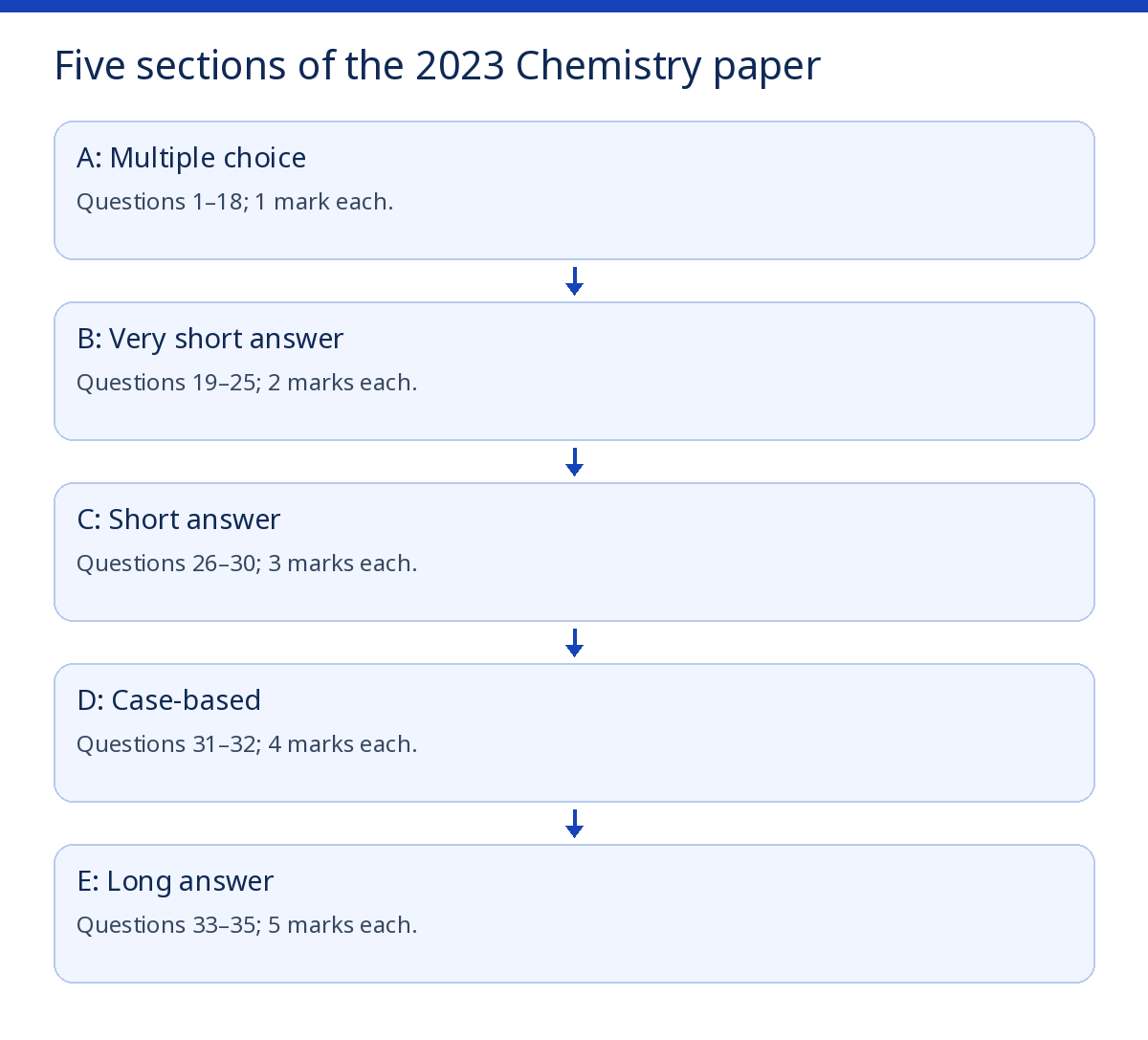
Section A has 18 one-mark multiple-choice questions, including assertion–reason items. Section B has seven two-mark very short answers, and Section C has five three-mark short answers. Section D has two four-mark case-based questions. Section E closes the paper with three five-mark long-answer questions. These formats ask you to do different things: select an option, explain a relationship, show a calculation, or organise several responses under one question number.
The instructions give no overall choice: all question numbers are compulsory, but some questions in Sections B to E offer internal choices. Read the instruction at the point where the choice is printed. In a case-based question, for instance, an OR can apply to one subpart rather than to the entire case. In a timed attempt, answer only the required branch; use the other later for extra practice.
Physical chemistry: decide which relationship applies
The paper tests solutions, chemical kinetics and electrochemistry in several forms. Solutions questions include vapour pressure and freezing-point depression. The vapour-pressure task specifies an ideal mixture, so ideality is a condition for applying Raoult’s law to the components, not an assumption to make for every liquid mixture. In a freezing-point calculation, molality uses the mass of the solvent in kilograms, not the mass of the finished solution.
The kinetics questions distinguish reaction order, pseudo-first-order behaviour and the temperature dependence of a rate constant. In electrochemistry, the paper moves between conductivity, molar conductivity and quantities related to cell potential. These are good places to check whether you can identify the quantity requested before choosing an equation. In particular, molar conductivity at a stated concentration is not the same quantity as its limiting value as concentration approaches zero.
Inorganic chemistry: keep the reasoning visible
The coordination chemistry questions cover ligand behaviour, systematic naming, isomerism, hybridisation and magnetism. When working through a complex, keep the charge of the complex ion separate from the oxidation state of the central metal. Ligand charges connect the two, but they are not interchangeable. Likewise, a geometrical isomerism question asks about the arrangement of ligands, whereas a magnetism question requires attention to electron pairing.
The d- and f-block material includes oxidation states, ion colour, alloy formation, redox behaviour and comparisons between lanthanoids and actinoids. The long-answer prompt combines several of these topics. When reviewing it, check whether each explanation addresses the particular ion, property or comparison named in that subpart, rather than merely describing a broad trend.
Organic chemistry and biomolecules in the case passages
Organic chemistry appears in questions on substitution, conversions, reaction mechanisms, functional-group tests and amines. Pay attention to the requested form of the answer: identifying a product, writing an equation and showing a mechanism are different tasks. Where a conversion sets a step limit, check that your proposed route meets it before looking at the worked method.
One case passage uses the polarity of the carbonyl group to frame questions about aldehydes, ketones and carboxylic acids. The other draws on biomolecules, with subparts involving glucose, vitamins, proteins or carbohydrates. Read each subpart alongside the passage and identify what the passage supplies and what you need to recall. A definition requires a different response from a test, a comparison or an explanation.
Before you start: rehearse the printed conditions
The original title page specifies 15 minutes of reading time during which candidates do not write answers. To mirror those conditions, use that interval to locate internal choices, notice supplied constants and check which prompts call for reasons, equations or calculations. Then keep the three hours for writing. The paper does not allow a calculator, so use the supplied numerical data and show enough intermediate work to trace your arithmetic afterwards.
Quick self-check: find the first step you would change
After the attempt, compare your work with the formula, concept and steps in the solution rather than checking only the final line. Was your first difficulty choosing a principle, applying it under the stated conditions, or carrying out the calculation? For an assertion–reason item, ask separately whether each statement is true and whether the reason actually explains the assertion. Then redo the item without the solution open.
This guide omits the garbled Hindi extraction, the unusual notation in Q3 and the worked answer line in Q14. It also leaves out the Q4 worked slope, the Q8 option formulas and Q12’s rate wording. No numerical results from Q34 or completed reactions from Q35 are reproduced.
Spotted an error? Report a correction. Practise this in the app: notes, formula sheets and mind maps.















































































































































Loading comments…