CBSE Class 12 Chemistry 2023 Paper and Worked Solutions
CBSEChemistry2023 Previous Year Paper
Paper code: 56/1/3 · 2023Practise the full English version of the 2023 CBSE Class 12 Chemistry main board paper, set 56/1/3. This guide explains the five-section format and shows how to use the worked solutions to check your choice of formula, interpretation and reasoning.
This set is one of the year's papers. See every set from 2023, grouped by series.
How the 70-mark paper is organised
This year-wise resource is a complete Chemistry theory paper, not a chapter-wise question bank. The paper allows three hours for writing and specifies a separate 15-minute reading period during which no answers are written. Calculators are not allowed.
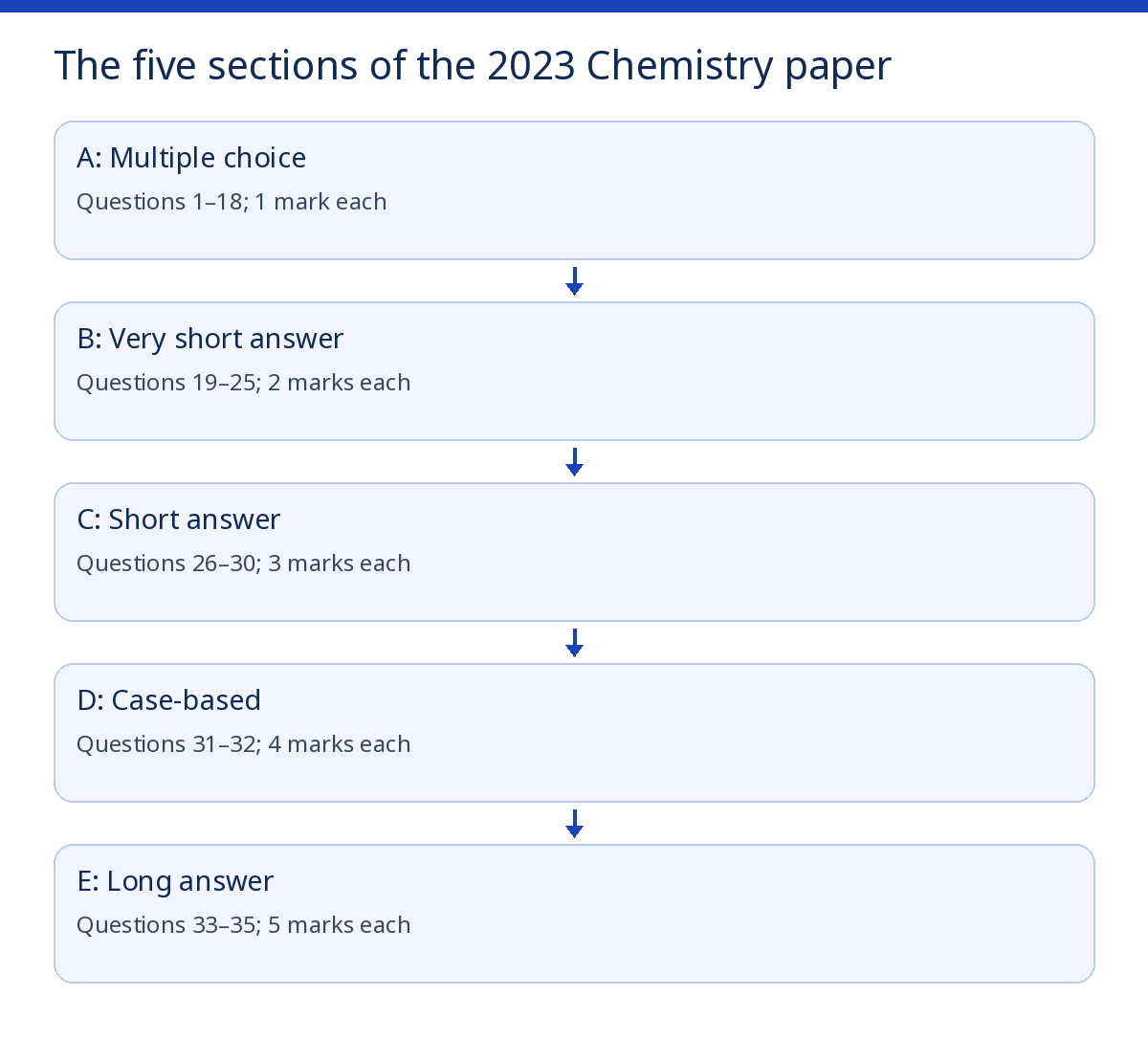
- Section A: Questions 1–18 are one-mark MCQs, including assertion–reason items.
- Section B: Questions 19–25 are two-mark very short answers.
- Section C: Questions 26–30 are three-mark short answers.
- Section D: Questions 31–32 are four-mark case-based questions.
- Section E: Questions 33–35 are five-mark long answers.
All 35 numbered questions are compulsory, but there are internal choices in Sections B through E. During the reading period, identify where an alternative is offered and which subparts belong to it. An internal choice lets you choose between the printed alternatives; it does not let you skip the entire question.

Chemistry 2023 | Class 12 | Previous Year Paper | Code 56/1/3
In the StudentCurio app
The complete 2023 CBSE Class 12 Chemistry main examination paper, set 56/1/3, with worked solutions. It covers questions across the syllabus, including electrochemistry, chemical kinetics, coordination compounds, biomolecules and organic chemistry.
Electrochemistry and solutions: distinguish the quantities
The paper tests cell notation, electrode potentials, conductivity and the relationship between cell potential and Gibbs energy change. A useful first step is to identify oxidation and reduction before doing any arithmetic. When using , take from the balanced cell reaction and use the potential for that reaction as written. If you reverse the reaction, both the cell potential and the Gibbs energy change reverse sign.
Common mix-up: resistance is not conductivity. For a uniform column of solution, conductivity is , where is resistance, is column length and is cross-sectional area. If the dimensions are in centimetres, use square centimetres for area to obtain conductivity in . The vapour-pressure question in Section C calls for a different distinction: in Raoult’s law for an ideal solution, a component’s partial vapour pressure uses its mole fraction, not its mass fraction.
Chemical kinetics: when the rate law applies
The kinetics case asks you to distinguish an average rate over an interval from an instantaneous rate at a particular time. It also tests how to interpret a rate law and how the units of the rate constant depend on reaction order. To check the units, start with concentration per unit time for the rate and account for the concentration factors in the rate law.
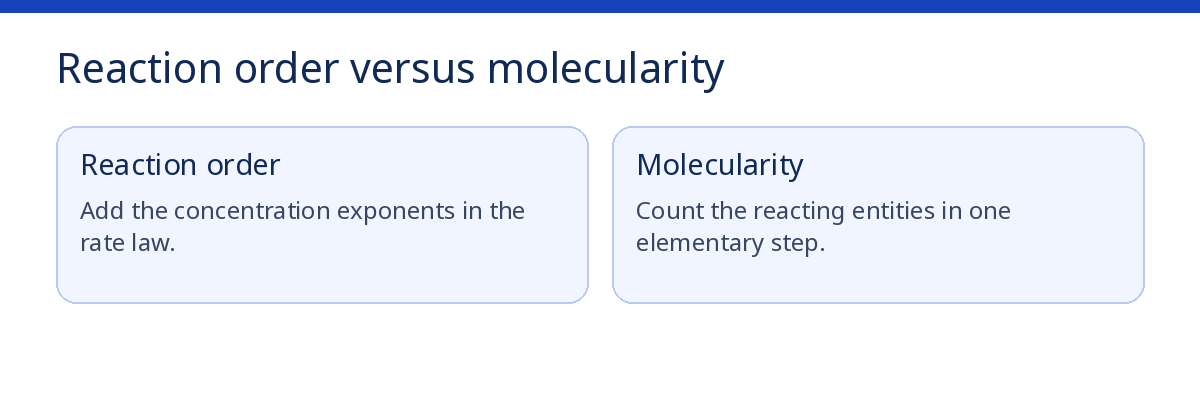
Good to remember: order and molecularity answer different questions. Overall order is the sum of the concentration exponents in the rate law. Molecularity counts the reacting entities in a single elementary step, so it cannot be assigned to a multistep reaction merely by counting molecules in its overall equation. In a pseudo-first-order treatment, a reactant in large excess changes so little in concentration that its contribution can be absorbed into an observed rate constant.
Coordination compounds and periodic trends
The coordination case links Werner’s primary and secondary valencies with formula writing, naming and the behaviour of complexes. When reading a formula, begin with the brackets: the species inside belong to the coordination sphere, while counter-ions outside balance the charge. Keep oxidation state separate from coordination number. The former follows from charge accounting; the latter counts donor atoms bound to the metal, so counting ligand molecules alone can be misleading when a ligand binds through more than one donor atom.
The paper also tests lanthanoid contraction and oxidation states in the d- and f-block. In a written explanation, distinguish a trend from its cause. For example, in a contraction argument, explain how shielding affects the nuclear attraction experienced by electrons rather than simply restating that size decreases.
Organic chemistry: let conditions guide the reaction
Organic questions move from predicting products to writing conversions, explaining properties and distinguishing compounds by chemical tests. In a product question, read the reagent and medium together before deciding what change is being tested. In a conversion, work backwards from the target: compare its carbon skeleton and functional group with those of the starting compound, then identify what each step needs to change.
The long-answer section also uses observations as evidence about structure. When practising a chemical-test question, keep the reagent, observable result and structural inference separate. Naming a test is not the same as explaining how its outcome distinguishes the compounds under consideration.
Biomolecules: connect structure to behaviour
The biomolecules questions cover carbohydrate structure and reducing behaviour, amino-acid amphoterism and protein structure. For carbohydrates, distinguish the role of a glycosidic bond in linking sugar units from the question of whether an anomeric centre remains available for ring opening. For amino acids, connect amphoterism to the ability to act as an acid or a base. In protein questions, distinguish the linkage that joins amino-acid residues from the secondary structures adopted by the chain; these describe different aspects of the same molecule.
Use the worked solutions after a first attempt
Use the question-number links after attempting the paper. The worked solutions separate the formula, concept and steps, so look for the first point where your reasoning diverged. If a numerical result is wrong, check the setup, sign and units before redoing the arithmetic. For assertion–reason items, judge each statement independently before deciding whether the reason explains the assertion. Try the unused internal alternatives in a separate review pass.
This guide omits the keys to the starch-wording, photochemical-order, molecularity and aniline-acetylation items, where the solutions flag wording or interpretive assumptions. It also leaves out isolated fragments where the supplied transcription does not clearly preserve the notation or full prompt.
Spotted an error? Report a correction. Practise this in the app: notes, formula sheets and mind maps.















































































































































Loading comments…