CBSE Class 12 Chemistry 2023 Paper With Worked Solutions
CBSEChemistry2023 Previous Year Paper
Paper code: 56/2/1 · 2023Practise the full 2023 CBSE Class 12 Chemistry main examination paper (Set 1, code 56/2/1) under its original time limit. Use the worked solutions to check how you chose a formula, explained a trend or set out a reaction, not just whether your final answer matched.
This set is one of the year's papers. See every set from 2023, grouped by series.
How the 70-mark paper is organised
This English-version resource is organised by exam year rather than by chapter. It presents the complete Chemistry theory paper for this set, with the original options and diagrams, followed by worked solutions. The paper allows three hours for writing, with a separate 15-minute reading period. Calculators are not allowed.
Section A has 18 one-mark multiple-choice questions, including assertion–reason items. Section B has seven two-mark very short answers, and Section C has five three-mark short answers. Section D has two four-mark case-based questions, while Section E has three five-mark long answers. All 35 numbered questions are compulsory, but Sections B through E each provide internal choice in two questions. Read the scope of each choice before deciding: a printed OR may apply to a subpart rather than to the entire numbered question.

Chemistry 2023 | Class 12 | Previous Year Paper | Code 56/2/1
In the StudentCurio app
The complete 2023 CBSE Class 12 Chemistry main examination paper (set 56/2/1) includes questions and worked solutions across physical, inorganic and organic chemistry. It helps students practise board-exam questions and review solution methods.
Physical chemistry: choose the model before calculating
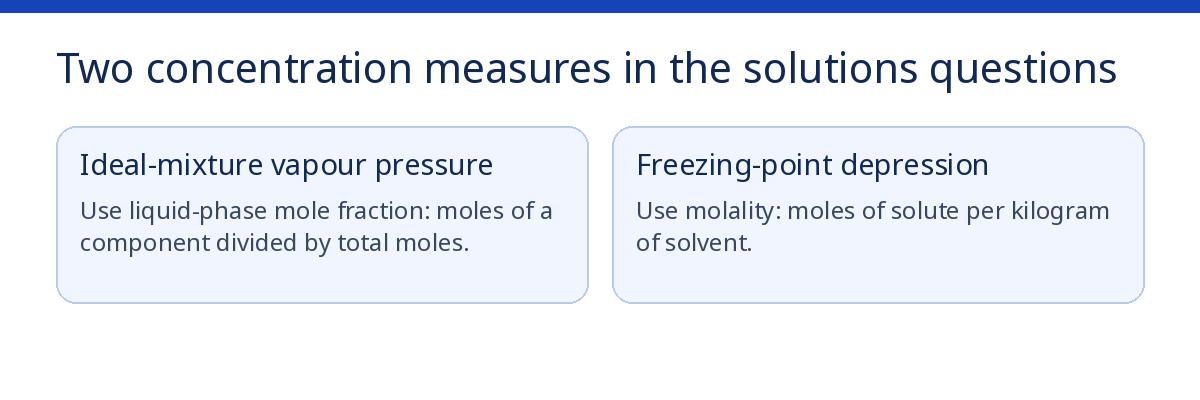
The solutions questions use two different models: one asks for the vapour pressure of an ideal liquid mixture, while another uses freezing-point depression to investigate solute dissociation. For an ideal mixture, the vapour-pressure calculation uses liquid-phase mole fractions. Freezing-point depression instead uses molality, which is based on the mass of the solvent. Identify which concentration measure the model requires before substituting values.
The kinetics questions distinguish a rate law from an integrated rate law. A concentration change affects the reaction rate according to the stated order; an integrated law relates concentration to elapsed time. The paper also asks about activation energy using the times taken for a first-order reaction to reach the same fraction of completion at two temperatures. In reviewing your attempt, check whether you connected those times to rate constants before comparing the temperatures.
Quick self-check: conductivity or molar conductivity?
Electrochemistry appears in questions on dilution, conductance measurements, cells and the link between standard cell potential and thermodynamic quantities. In the dilution questions, first check which quantity is named. Conductivity describes conduction in the solution, whereas molar conductivity relates conductivity to the amount of dissolved electrolyte per unit volume. They are not interchangeable and need not change in the same direction on dilution.
Before opening a numerical solution, ask yourself: Can I explain why concentration enters the conversion, and have I used units consistent with my expression? For a cell calculation, check that the electron count in your setup comes from the balanced overall reaction rather than from a single half-reaction taken in isolation.
Inorganic chemistry: separate charge, structure and behaviour
The coordination chemistry questions move from naming complexes and determining oxidation states to drawing geometrical isomers and describing magnetic behaviour. When reading a formula, distinguish the ligands inside the coordination sphere from any counterions outside it. The charge of the complex is not automatically the metal’s oxidation state: ligand charges also enter that calculation.
The transition-metal and f-block questions ask for explanations of properties such as ion colour, alloy formation and variation in oxidation state. In electronic-configuration explanations, pay attention to whether the question names a neutral atom or a specific ion. A configuration for the wrong species can derail the reasoning even when the element is correctly identified. For an isomer question, use the drawing to show how the ligands are arranged, rather than relying on an isomer label alone.
Organic chemistry: read the conditions as part of the question
The organic questions include substitution and elimination, reactions of alcohols and phenols, carbonyl reactions, and the preparation and properties of amines. The required response varies: an equation records the transformation, a mechanism shows the individual steps, and a conversion must reach the target within any step limit given. A correct product alone does not meet all three demands.
One useful distinction is that a compound’s carbonyl group does not by itself make it eligible for self-aldol condensation: it must have an enolisable alpha hydrogen. Likewise, when comparing amine basicity, retain the stated medium. An aqueous comparison must account for solvation, so a trend based only on electron donation is not enough. In both cases, check the condition before applying the rule.
Case-based questions: match the detail to the task
One case passage focuses on aldehydes, ketones and carboxylic acids; the other brings together carbohydrates, vitamins and proteins. The subparts ask for different kinds of responses, including an explanation, a chemical test or a definition. Use the passage to identify the relevant concept, then check what the subpart asks you to supply. A test needs a distinguishing observation, while a definition should state what makes the term distinct. For assertion–reason items elsewhere in the paper, make a different two-stage check: decide whether each statement is true, then decide whether the reason actually explains the assertion.
Use the worked solutions after your first attempt
For a timed attempt, use the reading period to locate internal choices and note questions that require diagrams, mechanisms or calculations. Leave the numbered solution links unopened until you finish. Then compare your work with the resource’s formula used, concept used and explanation in steps blocks. Find the first point where your approach went off track: a wrong model calls for a different review from a correct setup followed by a unit or sign error. Reattempt that part without the explanation in view.
This guide leaves out Question 12 and its worked answer because the printed wording does not clearly distinguish the product’s concentration-change rate from the stoichiometrically normalised reaction rate.
Spotted an error? Report a correction. Practise this in the app: notes, formula sheets and mind maps.















































































































































Loading comments…