CBSE Class 12 Chemistry 2023 Board Paper with Solutions
CBSEChemistry2023 Previous Year Paper
Paper code: 56/4/2 · 2023Practise the full 2023 CBSE Class 12 Chemistry main examination, paper code 56/4/2, under timed conditions. Then use the worked solutions to check whether you chose the right principle and gave the kind of answer each question asked for.
This set is one of the year's papers. See every set from 2023, grouped by series.
Know the format of paper 56/4/2
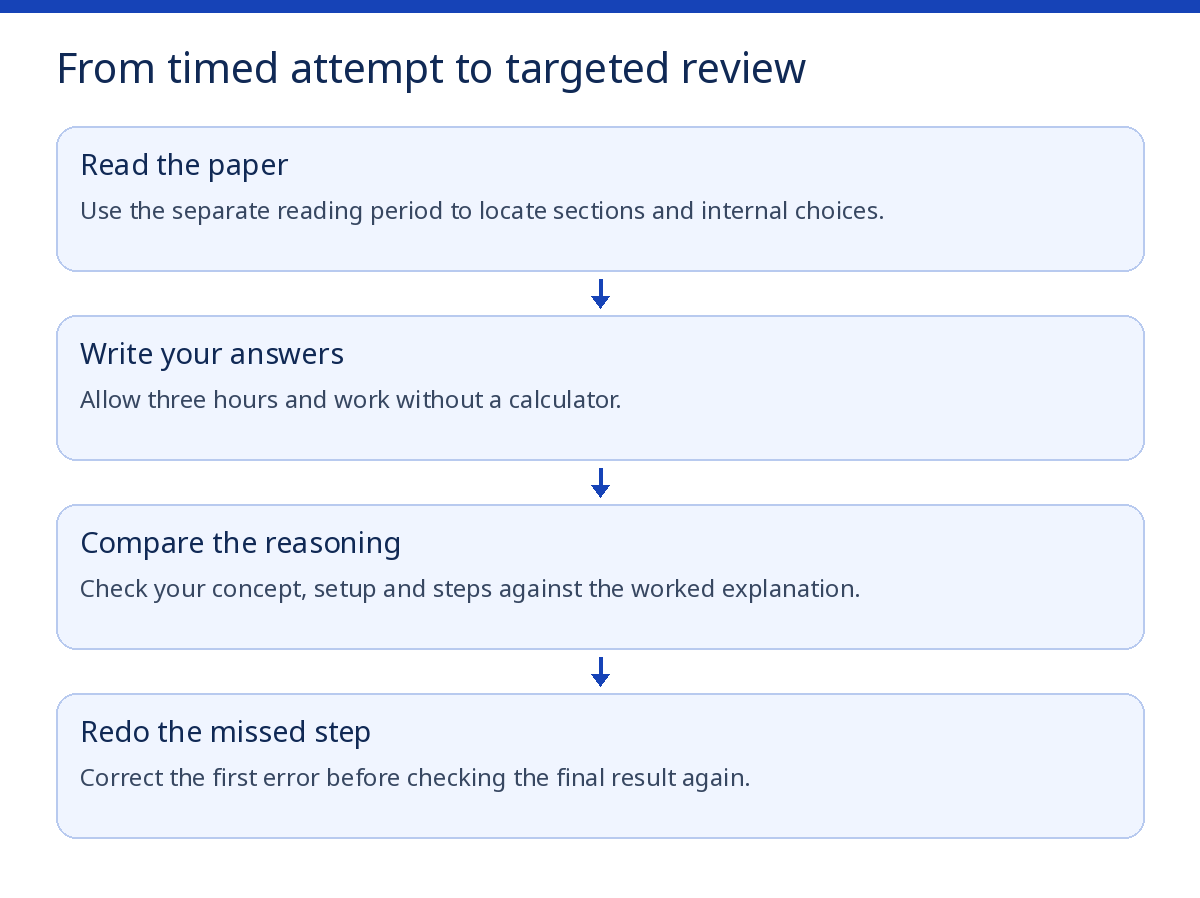
This year-wise resource contains the English version of the 2023 Main Board Exams Chemistry theory paper. It carries 70 marks and allows three hours for writing. The original instructions also specify a separate 15-minute reading period during which candidates do not write answers. Calculators are not allowed. Use those conditions if you want your attempt to reflect how this particular paper was administered.
The paper has 35 questions across five sections. Section A contains 18 one-mark multiple-choice questions, including four assertion–reason items. Sections B and C contain seven two-mark very short answers and five three-mark short answers, respectively. Section D has two four-mark case-based questions, and Section E has three five-mark long answers. There is no overall choice: use only the alternatives or selections specified within individual questions. In a mock attempt, answer the required branch; try the unused branch later as extra practice.

Chemistry 2023 | Class 12 | Previous Year Paper | Code 56/4/2
In the StudentCurio app
Complete 2023 CBSE Class 12 Chemistry main examination paper, code 56/4/2, with worked solutions across the paper’s questions. It covers topics from multiple Chemistry chapters and helps students practise the full board-paper format and review solutions.
Physical chemistry: identify what the data represent
The physical chemistry questions draw on solutions, chemical kinetics and electrochemistry. The solutions questions connect vapour-pressure behaviour and azeotropes with a separate application of colligative properties: using osmotic pressure to investigate association. The key distinction for the latter is between the amount of solute added and the number of dissolved particles after association. Before choosing an expression, identify which of those the question gives you and which one the measurement reflects.
Kinetics appears through rate laws, half-life, activation energy and a gas-phase decomposition. In the decomposition problem, the table gives total pressure, not the partial pressure of the reactant. Use the reaction stoichiometry at the stated constant volume to interpret the pressure data before applying the first-order rate law. In electrochemistry, distinguish a cell emf from a half-cell potential, and conductivity from molar conductivity. Those distinctions determine which data, units and expressions belong in your setup.
Inorganic chemistry: separate charge, shape and magnetism
The coordination questions move between naming, oxidation state, isomerism, geometry and magnetic behaviour. When checking an oxidation-state calculation, start with the charge of the coordination entity itself and account for the ligand charges. In a salt formula, counterions can help establish the charge on the complex, but they are not ligands in that entity. This distinction also helps when reading a formula before naming it.
Do not infer magnetic behaviour from geometry alone. The paper presents two complexes with the same stated geometry but different magnetic behaviour, so a justification must address electron pairing rather than simply name the shape. The transition-element questions ask for a different kind of explanation: connecting properties to electronic structure or oxidation-state behaviour, and accounting for the specified medium when writing a redox equation.
Organic chemistry and biomolecules: follow the prompt
The organic questions ask you to predict products, propose conversions, identify structures and justify reactivity. Watch the difference between a request for equations only and a request to explain why a product forms. For a conversion, check the allowed number of steps before settling on a route. For a product prediction, read the substrate and reagent together: recognising a familiar reagent is not enough if the molecule has more than one functional group that could draw your attention.
The amines case includes basicity in aqueous solution, where electron-releasing effects, steric effects and solvation can all matter. An explanation based on just one factor may therefore miss the role of the stated solvent. The biomolecules case shifts from reading a passage to distinguishing types of linkages and levels of protein structure. Keep those tasks separate: identifying a bond is not the same as explaining how a larger structure is stabilised.
Quick self-check: does your answer match the task?
For an assertion–reason item, judge each statement independently before deciding whether the reason explains the assertion. Two true statements do not necessarily form a valid explanation. For a case-based question, identify the specific part of the passage that bears on each subpart rather than treating the passage as one long answer.
Before opening a worked solution, ask: Did I name the governing concept? Did I use it under the conditions given? Did I answer in the form requested? A graph-based explanation, for instance, needs to use the behaviour of the plotted relationship; naming the two quantities on the axes is not enough.
Review the reasoning, not just the final option
The file provides question-number navigation and worked solutions that distinguish the formula used, the underlying concept and the steps of the explanation. After your attempt, compare your work with the relevant solution and find the first point where the reasoning differs. A wrong formula, a correct formula applied to the wrong quantity and a missing unit in the final line call for different corrections.
Two items are omitted from answer guidance here. Question 9 has ambiguous wording about the amounts of the electrode products, and Question 14’s printed solution option does not match its own charge-balance explanation. Use other questions to practise those concepts rather than treating either option label as definitive. When a structure, charge or reaction arrow is unclear in extracted text, refer to the original question layout in the file before attempting the item.
Spotted an error? Report a correction. Practise this in the app: notes, formula sheets and mind maps.















































































































































Loading comments…