CBSE Class 12 Chemistry 2023 Paper with Worked Solutions
CBSEChemistry2023 Previous Year Paper
Paper code: 56/1/1 · 2023Practise the 2023 CBSE Class 12 Chemistry main examination with the full year-wise paper, set 56/1/1. Use the worked explanations to review not just your answers, but also why a law, reaction condition or structural argument applies.
This set is one of the year's papers. See every set from 2023, grouped by series.
Read the 2023 paper as a full board exam
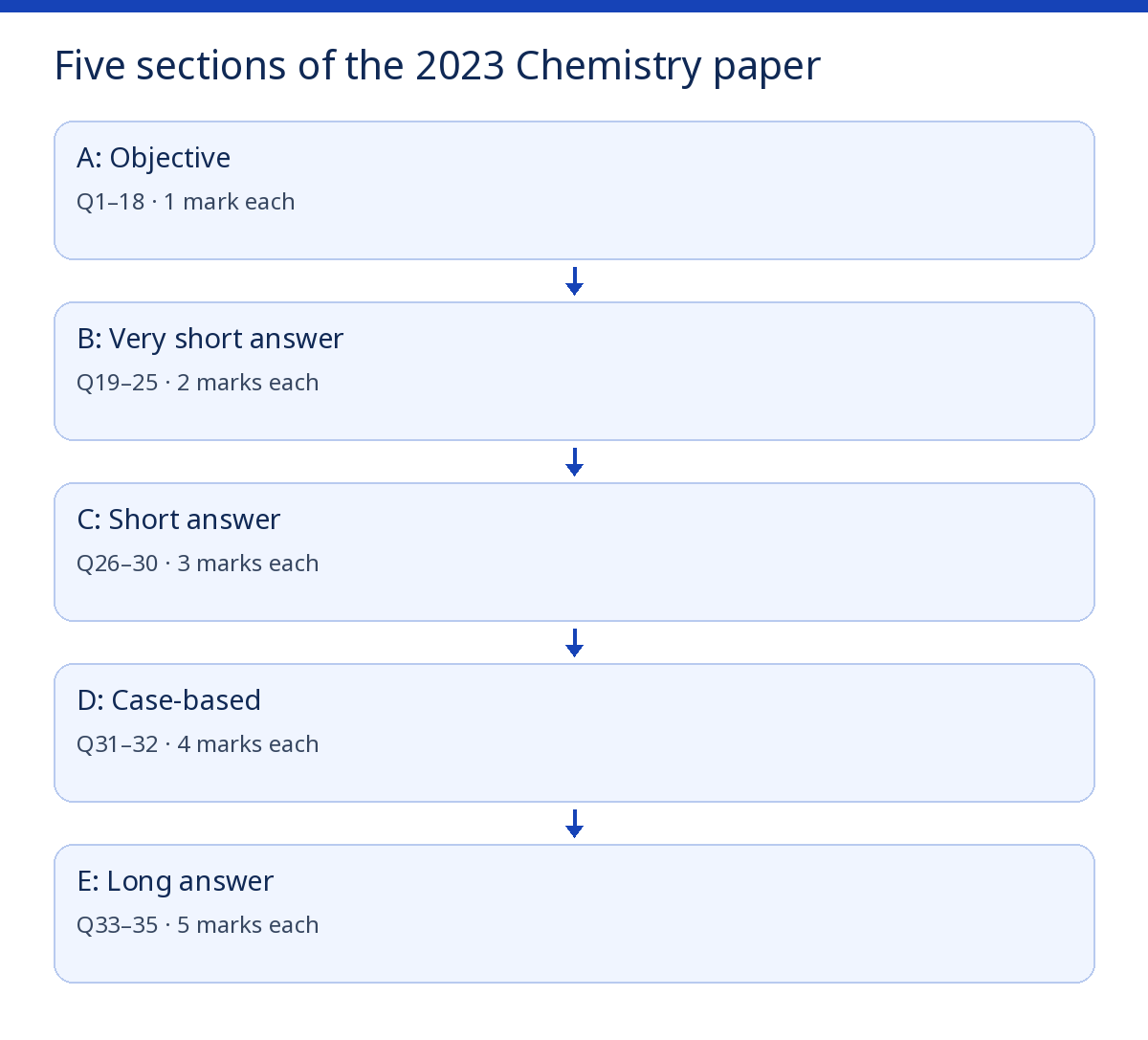
This English-version paper is for CBSE Class 12 Chemistry theory, with three hours of writing time and a maximum of 70 marks. It has 35 numbered questions across five sections. Section A has 18 one-mark questions, including assertion–reason items. Sections B and C contain two-mark very short answers and three-mark short answers, respectively. Section D has two four-mark case-based questions, and Section E has three five-mark long answers.
The paper has no overall choice: the printed alternatives apply only where indicated. The instructions list internal choices in two questions each in Sections B, C, D and E. For a timed attempt, follow the printed 15-minute reading period before writing and work without a calculator. Leave the other printed alternatives for untimed practice after you have marked your attempt.

Chemistry 2023 | Class 12 | Previous Year Paper | Code 56/1/1
In the StudentCurio app
The 2023 CBSE Class 12 main Chemistry paper with worked solutions, covering questions from across the syllabus. It helps students practise board-exam questions and review their solutions.
Physical chemistry: match the law to the quantity
The paper moves from solution properties and vapour pressure to conductivity, cell potential, electrolysis and reaction rates. The useful distinction is not simply which chapter a question comes from, but what quantity the question asks for. In a conductivity calculation, measured resistance describes a particular column of solution. Conductivity accounts for the column’s geometry; molar conductivity is a different quantity that also involves the solution concentration. Check which one you are reporting before assigning a unit.
Likewise, distinguish the cell potential under the stated conditions from the standard cell potential. The Nernst equation links the two through the reaction quotient, which must be written for the reaction in the direction shown. When reviewing an electrochemistry calculation, check the reaction direction and the number of electrons transferred before looking for an arithmetic error.
Common mix-up: reaction order and molecularity
The kinetics case brings together average rate, instantaneous rate, factors affecting rate, and the interpretation of a rate law. Average rate refers to a finite time interval; instantaneous rate refers to a particular moment. When comparing rates expressed using different species, keep track of whether you are measuring reactant disappearance or product formation.
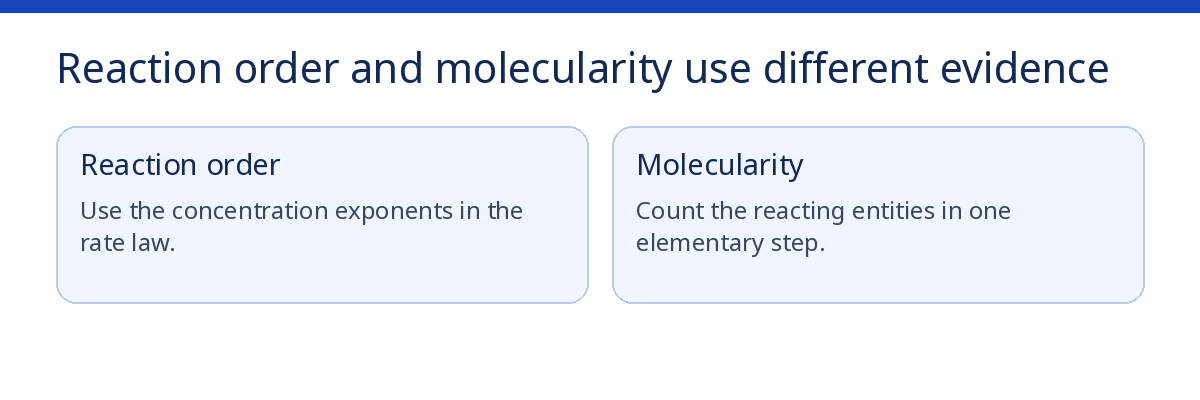
Reaction order comes from the concentration exponents in the rate law, not from the coefficients in an overall balanced equation. Molecularity counts the reacting entities in one elementary step and is not assigned to a multistep reaction as a whole. This distinction is useful when reading the paper’s kinetics items: a model-dependent or explicitly conditional explanation is not a general rule for every reaction with the same overall stoichiometry.
Inorganic chemistry: read the coordination sphere first
The paper tests coordination chemistry through isomerism, naming, formula writing and magnetic behaviour. The coordination case also uses Werner’s distinction between primary and secondary valencies. Start by identifying which species are written inside the brackets and which are counter-ions outside them. That distinction matters because moving an ion between the inner sphere and the outside can change which ions the compound produces in solution.
Do not treat oxidation state and coordination number as interchangeable. The first is found by accounting for charge; the second counts the donor atoms directly bonded to the metal. A ligand that binds through more than one donor atom therefore contributes more than one site. Elsewhere, the paper asks for reasons behind transition-metal behaviour, so practise explaining a stated property rather than merely naming it.
Organic chemistry and biomolecules: track what changes
Organic questions ask you to predict products, plan conversions, explain property trends and distinguish compounds using chemical tests. For a conversion, compare the starting and target structures before choosing a reagent. Note the functional group and whether the carbon skeleton must change. For a reaction sequence, write the intermediate at each arrow so you can check that the next reagent acts on the compound you actually drew. Keep the printed conditions with the reagent: the solvent or medium can help determine which reaction occurs.
Biomolecules call for a different kind of tracking. The paper asks about carbohydrate hydrolysis, polysaccharide structure and proteins. Separate what the units are, how they are joined and how the completed chain is arranged. Naming a linkage and describing a chain’s shape are answers to different structural questions.
Quick self-check before opening a worked solution
The file is arranged by question number, so you can compare individual responses without reading the whole solution set in sequence. The worked pages distinguish the formula used, the concept used and the explanation in steps. After an independent attempt, use those elements to locate the first point of disagreement. A correct formula with the wrong inputs calls for a different correction from a correct numerical result reached with an unsupported assumption.
Ask yourself: In a calculation, what condition made my chosen relation applicable? In a conversion, did I account for every change in the structure? In an assertion–reason item, did I judge each statement separately before deciding whether the reason explains the assertion? Once you identify the issue, rewrite the affected step before rereading the final answer.
Where the wording needs care
The guide leaves out the option letters and disputed interpretations for the light-dependent reaction-order item, the starch item that prints “amylase” where the notes discuss amylose, and the assertion–reason items whose explanations depend on readings about aniline acetylation or an elementary step. These omissions do not affect practice with the independently supported topics elsewhere in the paper.
Some equations and data are also incomplete or garbled in the extracted text, so those passages are not reproduced here. For a numerical or reaction-sequence attempt, read the printed symbols, signs, units and conditions directly from the question page before comparing your reasoning with the worked explanation.
Spotted an error? Report a correction. Practise this in the app: notes, formula sheets and mind maps.















































































































































Loading comments…