CBSE Class 12 Chemistry 2022 Previous Year Paper
CBSEChemistry2022 Previous Year Paper
Paper code: 56/1/2 · 2022Use this full CBSE Class 12 Chemistry main board paper to practise the 2022 Term II format. The worked solutions separate formulas, concepts and calculation steps, making it easier to see where your reasoning needs revision.
This set is one of the year's papers. See every set from 2022, grouped by series.
What this 2022 paper contains
This year-wise resource contains the English version of the 2022 CBSE Class 12 Chemistry main examination paper, code 56/1/2. The paper is in the Term II format, with a time limit of two hours and a maximum of 35 marks. Use those limits to recreate this particular sitting, not as a guide to the format of another year's examination.
The file preserves the original question layout, including the printed alternatives and diagrams. It includes worked solutions for every question and subpart, including both sides of the printed OR choices. That gives the file two uses: attempt it as a complete paper under its printed instructions, then revisit the unattempted alternatives as separate revision questions. Keeping the solutions closed on the first pass lets you test whether you can select a method without a prompt.

Chemistry 2022 | Class 12 | Previous Year Paper | Code 56/1/2
In the StudentCurio app
The 2022 CBSE Class 12 Chemistry main examination paper with worked solutions, covering questions across chemical kinetics, electrochemistry, amines, coordination compounds, aldehydes and ketones, and other chapters. Useful for practising board-style questions and reviewing solution methods.
Chemical kinetics: choose the rate law before calculating
The kinetics questions connect reaction order to three tasks: predicting how a rate changes, finding the units of the rate constant and relating reaction time to the fraction remaining. In a rate comparison at fixed temperature, use the concentration factor for each reactant raised to its own order in the given rate law. A change in concentration does not by itself mean that the rate constant has changed.
When checking units, work backwards from the units of rate and divide by the units contributed by the concentration terms. This is more reliable than treating the units of the rate constant as fixed across all orders. For a time calculation, identify the reaction order before using an integrated rate equation. In particular, the first-order half-life relation applies to a first-order reaction. If the question gives a percentage completed, translate it into the fraction remaining before placing concentrations in the logarithmic expression.
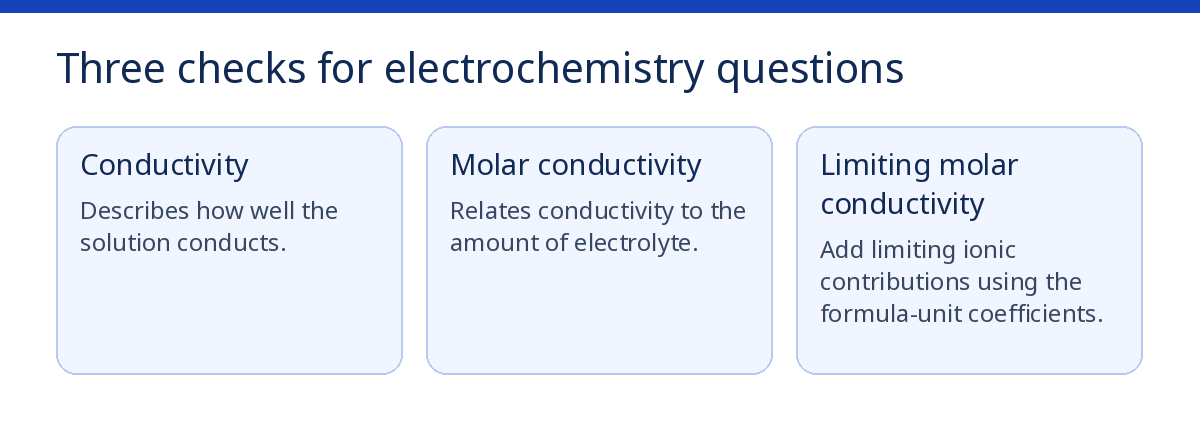
Common mix-ups in electrochemistry
- Conductivity and molar conductivity are different quantities. Conductivity characterises the solution's ability to conduct; molar conductivity accounts for the amount of electrolyte present. Check which quantity is named before reasoning about dilution. The file flags the word “conduction” in one question as imprecise; the specific concentration comparison is omitted here because its interpretation depends on the intended quantity.
- The electron count comes from the balanced cell reaction. In , use the number of electrons transferred in the reaction as written. Keep the minus sign and convert the energy units consistently before calculating a potential in volts.
- Limiting ionic contributions carry stoichiometric coefficients. When calculating limiting molar conductivity from ionic values, count how many of each ion one formula unit supplies rather than adding one contribution for each type of ion.
Coordination compounds, metals and surface chemistry
For coordination compounds, keep oxidation state, coordination number and complex charge separate. Coordination number counts donor atoms directly attached to the metal, so a ligand that attaches through two donor atoms is not counted as a single donor. An ion outside the coordination sphere can balance charge without adding to the coordination number. For a magnetic-property explanation, check the metal ion's electron count and the splitting pattern before deciding how many electrons remain unpaired. In an octahedral complex, the high-spin arrangement is favoured when splitting is smaller than the pairing energy and both spin arrangements are possible.
The paper also revisits d- and f-block properties and surface chemistry. In a metal-ion explanation, check whether the reasoning needs electron configuration, stabilisation in water, or both. In the surface chemistry questions, distinguish adsorption at a surface from the aggregation of particles in a colloid. The two topics call for different explanations even when both are tested through short definitions or comparisons.
Organic chemistry: separate trends, tests and conversions
The amines questions include aqueous basicity, water solubility and named reactions. Don't use a solubility trend as a substitute for a basicity argument: aqueous basicity concerns proton acceptance and depends on factors including electron donation and solvation. The direction of a comparison also matters: a larger corresponds to a smaller . In a conversion, track the carbon skeleton as well as the functional group so that you notice when a reaction shortens the chain.
The carbonyl questions use observations from chemical tests alongside reaction and structure clues. A test may narrow the list of possible structures without identifying a compound on its own. When comparing nucleophilic addition, consider both carbonyl electrophilicity and how easily a nucleophile can approach the carbonyl carbon. When reviewing products, keep the reagent and reaction conditions beside each arrow; products from one kind of cleavage are not automatically the products of another.
Quick self-check after marking your attempt
Use the solution's Formula used, Concept used and Explanation in steps labels to locate the first point where your reasoning differed. Ask whether you selected the wrong relationship, applied a valid rule outside its conditions, or made a bookkeeping error with a unit, sign or coefficient. A matching final result is not enough if your reasoning used the wrong quantity or skipped a necessary condition.
Then close the solution and return to the step you missed. Can you explain why the equation applies, which part of the structure controls the reaction, or what an observation lets you rule out? Once you can justify that step independently, try the unused OR alternative where one is printed. Treat it as a fresh task rather than assuming it uses the same method as the first choice.
Spotted an error? Report a correction. Practise this in the app: notes, formula sheets and mind maps.















































































































































Loading comments…