CBSE Class 12 Chemistry 2022 Term II Paper With Solutions
CBSEChemistry2022 Previous Year Paper
Paper code: 56/4/3 · 2022Practise with the full English-language CBSE Class 12 Chemistry main board paper for 2022 Term II, set 56/4/3. Use the worked solutions to review how you explain a chemical trend, interpret a figure or set up a calculation.
This set is one of the year's papers. See every set from 2022, grouped by series.
Know the 2022 Term II paper format
This year-wise resource contains the full Chemistry theory paper and a separate set of worked solutions. The paper allows two hours for writing and carries 35 marks. Its title page also specifies a separate 15-minute reading period, during which candidates could not write answers. The instructions prohibit calculators and log tables. These details describe this particular board paper, not necessarily the format of a later examination.
Section A has three very short-answer questions worth two marks each. Section B has eight short-answer questions worth three marks each, and Section C has one five-mark case-based question. All 12 question numbers are compulsory, but some offer a choice. On a timed attempt, distinguish an OR between alternatives from an any two instruction within a question: neither means you can skip the entire question.

Chemistry 2022 | Class 12 | Previous Year Paper | Code 56/4/3
In the StudentCurio app
Complete CBSE Class 12 Chemistry main examination paper for 2022, Term II, set 56/4/3, with worked solutions. It covers questions across physical, organic and inorganic chemistry and helps students practise board-exam questions and review solution methods.
Organic chemistry: Match the explanation to the task
The organic questions move between explaining reactivity, selecting a chemical test, writing equations and comparing properties. For a reason question, identify a structural feature and connect it to the requested behaviour. For a test, distinguish the reagent from the observation that identifies a positive result. When a question asks for an equation rather than a reaction name, write the reactants and products and include the relevant conditions.
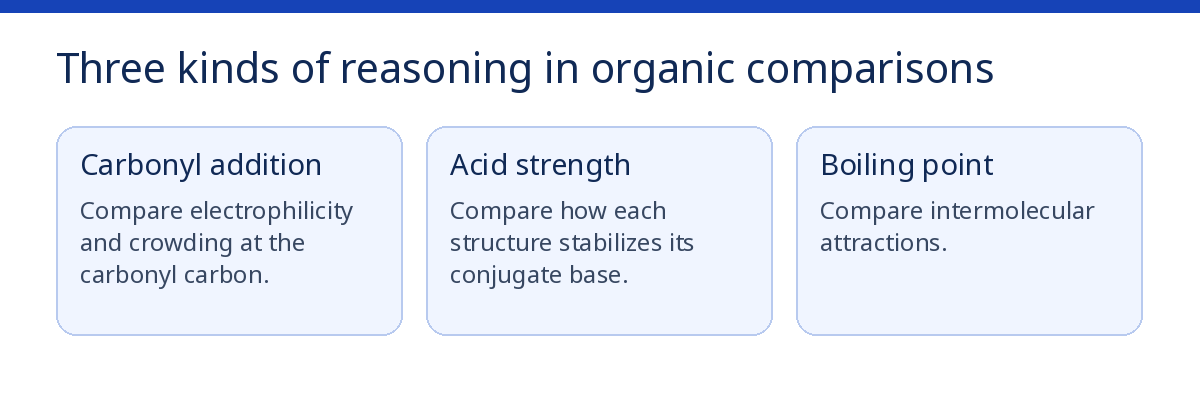
The comparison questions are useful because they ask about different properties: reactivity towards HCN, acid strength and boiling point. They do not all follow from the same structural argument. Carbonyl electrophilicity and crowding matter for nucleophilic addition; stabilization of the conjugate base matters for acidity; and intermolecular attractions matter for boiling point. Before arranging any compounds, name the property being compared and decide which of those ideas is relevant.
Inorganic chemistry: Count electrons before drawing conclusions
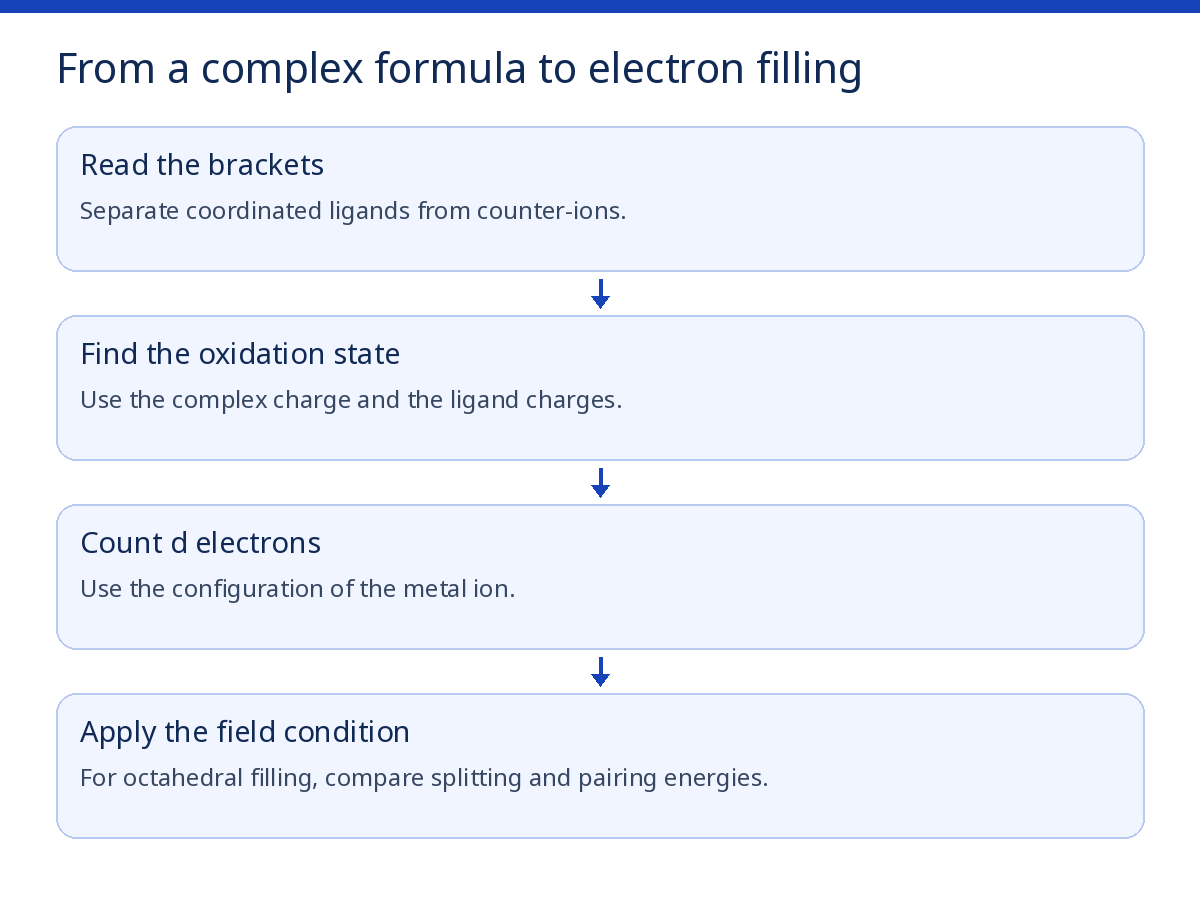
The coordination-compound alternatives cover crystal-field filling, inner- and outer-orbital descriptions, ions produced in solution, spin-only magnetic moment, ligand denticity and naming. Start by separating ligands inside the coordination brackets from counter-ions outside. The charges help you find the metal's oxidation state and then its d-electron count. That count by itself does not establish the spin state: for octahedral filling, compare the splitting energy with the pairing energy when the question supplies that condition.
The transition-element questions also use electronic configurations, but for different purposes: colour, resistance to oxidation and classification as a transition element. Other subparts concern alloys and enthalpy of atomisation. When reviewing explanations, check whether the reasoning is about an isolated atom, an ion or bonding in a metallic solid. A fact about the electronic configuration of an ion does not by itself explain a property of the metal lattice.
Read the figures before recalling the rule
The surface chemistry questions ask you to interpret a colloid preparation and an adsorption graph. In the colloid question, track which reagent is in excess in the preparation shown. Preferential adsorption of an excess lattice ion determines the charge of the particles; the chemical formula of silver iodide alone does not tell you the sign of the sol.
For gas adsorption, use the graph in the PDF rather than relying on the text alone. The Freundlich isotherm is an empirical relation at fixed temperature over the pressure range where it fits. The straight-line interpretation here depends on both quantities being plotted on logarithmic axes. Before interpreting the slope or intercept, check which variable is horizontal and which is vertical.
Two calculation checks: Cell direction and fraction remaining
The electrochemistry question asks for the Nernst equation and a cell emf at 298 K. Identify the oxidation and reduction half-reactions first. When both tabulated values are reduction potentials, subtract the anode value from the cathode value. Write the reaction quotient for the balanced cell reaction in that same direction and leave pure solids out because their activity is one. The temperature-specific form of the equation should match the stated temperature.
The kinetics case separates the definition of rate, the role of temperature, reaction order and first-order calculations. Find overall order from the sum of the exponents in the stated rate law, rather than assuming that it comes from the balanced equation. In a first-order time calculation, the logarithmic ratio uses the amount remaining, not the amount consumed. Check that the time unit is consistent with the unit used for the rate constant.
Use the worked solutions in a second pass
Complete the paper before opening the worked solutions. Then use the question-number links and compare your response with the file's Formula used, Concept used and Explanation in steps labels. Look for the first point where your reasoning diverges: a missed condition, a wrong choice of principle or a calculation error. Retry that part without the solution open. Save the unattempted OR alternatives for a separate practice round; the file includes worked solutions for those too.
This guide leaves out the numerical workings for the Nernst and first-order items, where the extracted text can obscure signs and exponents. It also does not adopt the kinetics passage's broad wording about first-order dependence or the transition-metal prompt's absolute wording about oxides and fluorides.
Spotted an error? Report a correction. Practise this in the app: notes, formula sheets and mind maps.















































































































































Loading comments…