CBSE Class 12 Chemistry 2022 Term II Previous Year Paper
CBSEChemistry2022 Previous Year Paper
Paper code: 56/5/2 · 2022Practise with the full English-language CBSE Class 12 Chemistry 2022 main examination paper and its worked solutions. Use this year-wise resource to revisit the Term II format and check the reasoning behind your answers.
This set is one of the year's papers. See every set from 2022, grouped by series.
What the 2022 paper contains
This file contains paper 56/5/2 from the 2022 CBSE Class 12 Chemistry main examination. The printed duration is 2 hours and the maximum is 35 marks. These details describe the 2022 Term II paper, not the format of a later board examination. The file preserves the English question layout, options and diagrams, then provides worked solutions for every question and subpart, including both sides of printed OR choices.
For a timed attempt, stay in the question-paper portion and follow the printed instructions on choices. For revision, use the question links to move between the paper and the worked explanations. The two approaches serve different purposes: one tests how you manage the full paper, while the other lets you examine a concept or an alternative question in detail.

Chemistry 2022 | Class 12 | Previous Year Paper | Code 56/5/2
In the StudentCurio app
Complete CBSE Class 12 Chemistry main examination paper with worked solutions. It includes questions across organic chemistry, chemical kinetics, colloids, coordination compounds, d- and f-block elements, and electrochemistry.
Organic chemistry: follow the functional group
The organic questions cover carbonyl reactivity, carboxylic acid strength, named reductions, conversions and amine chemistry. For a conversion, read the starting structure and the reagent together. Clemmensen reduction removes the carbonyl oxygen of an aldehyde or ketone, replacing it with hydrogen, whereas the Stephen reaction starts from a nitrile and gives an aldehyde after hydrolysis. Calling both reactions reductions is correct, but it does not tell you what product to expect.
For a comparison, identify what the question asks you to explain. In nucleophilic addition to a carbonyl, both crowding around the reacting carbon and electron donation from alkyl groups matter. In an acidity comparison, examine the stability of the conjugate base instead. The amine questions make another useful distinction: basicity concerns the availability of the nitrogen lone pair, while an explanation based on intermolecular hydrogen bonding must account for whether the molecule has an N–H bond that can act as a donor.
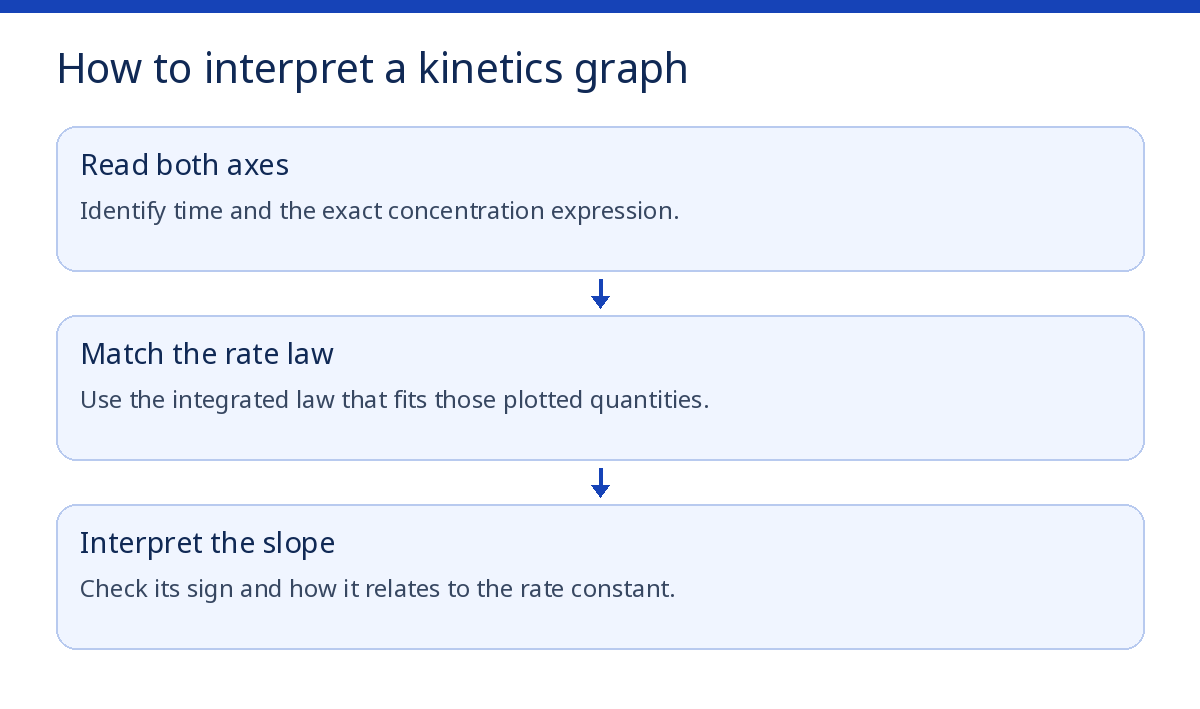
Kinetics self-check: read the axes before the slope
The kinetics material moves between rate laws, rate-constant units, concentration changes and graphs. Start by distinguishing the rate law, which relates the rate to concentration, from the integrated rate law, which relates concentration to elapsed time. To check a proposed reaction order from units, divide the units of rate by the units of the concentration terms raised to their stated powers. This checks the overall order rather than the identity of a reactant.
For a graph, write down exactly what each axis represents before interpreting the slope. A concentration, a logarithm and a logarithm of a concentration ratio are different quantities. Reversing a ratio inside a logarithm reverses its sign, and changing the logarithm base changes the numerical slope. Before consulting the solution, ask yourself whether you could explain both the sign of the slope and how it relates to the rate constant.
Colloids and adsorption: explain what changes
The surface chemistry material brings together coagulation, electrophoresis and adsorption. Coagulation concerns particles aggregating after the factors that keep them dispersed are overcome. Electrophoresis concerns the directed movement of charged colloidal particles in an electric field. Keep aggregation and movement separate when writing a definition or explaining an observation.
When applying the Hardy–Schulze rule, first identify the ion with charge opposite to that of the sol. It is the valency of this counterion that matters for the comparison, not the largest ionic charge you see in the electrolyte formula. For adsorption, compare the interaction first: physisorption involves van der Waals forces, while chemisorption involves chemical bonding. Treat differences in layer formation and specificity as typical behaviour rather than unconditional rules.
Inorganic chemistry: count electrons at the metal centre
The coordination questions cover naming, ligand identity and crystal-field splitting. For a complex written with counterions, distinguish the ligands inside the coordination brackets from the ions outside. Use charge balance to find the metal’s oxidation state before assigning its d-electron count. In an octahedral field, the d orbitals split into two energy sets; how the electrons occupy those sets depends on the splitting energy relative to the pairing energy. This guide omits the orbital-occupancy notation garbled in the extracted text.
That distinction between the atom and its ion also matters in the d-block questions. An argument about colour from d–d absorption depends on the d-electron configuration of the metal ion in the complex, not simply the neutral atom’s configuration. For periodic trends, trace lanthanoid contraction to poor shielding by 4f electrons before using it to explain similarities between corresponding 4d and 5d elements.
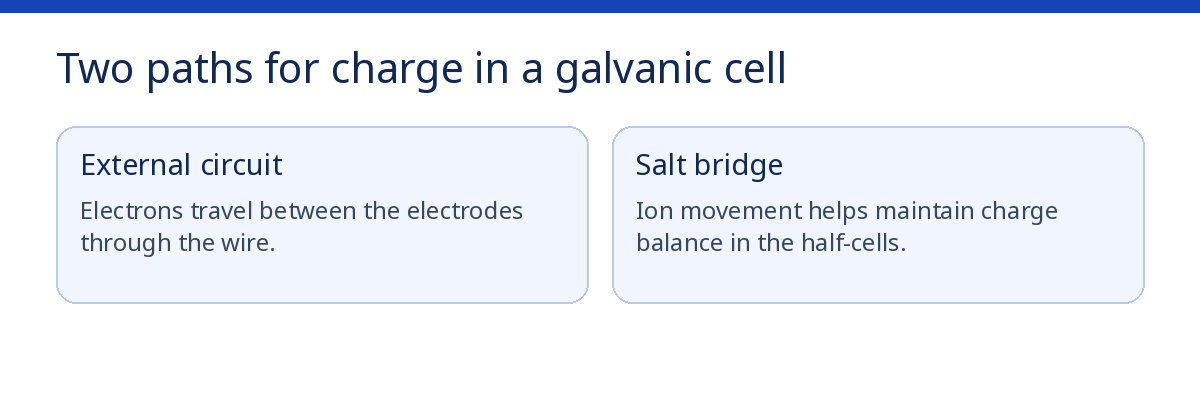
Electrochemistry: track two paths for charge
The electrochemistry material connects cell operation, equilibrium and conductivity. In a galvanic cell, electrons move through the external circuit, while ions moving through the salt bridge help maintain charge balance in the two half-cells. Keeping these paths separate helps explain why a wire connection alone cannot sustain current after the salt bridge is removed. At equilibrium, zero cell emf means there is no net cell reaction; it does not mean the participating ions have disappeared or reached equal concentrations.
Also distinguish conductivity from molar conductivity before explaining dilution. Conductivity describes how well the solution conducts, while molar conductivity relates that property to the amount of electrolyte per unit volume. On dilution, the two can change in opposite directions. In a calculation, check the concentration and conductivity units before using a conversion factor.
Review the reasoning, not just the final answer
The worked solutions separate the formula, the concept and the explanation. Use that structure to locate the first point where your reasoning went wrong. If your arithmetic was correct but your rate law did not match the graph, revisit the axes rather than repeating the calculation. If you named a plausible organic product without accounting for a reagent or reaction step, trace the functional-group change again.
After reviewing your timed attempt, try the unused OR choices separately. They give you another way to practise the material without changing the conditions of your original attempt. For each corrected response, check whether you can now supply the missing reason without looking at the worked solution.
Spotted an error? Report a correction. Practise this in the app: notes, formula sheets and mind maps.















































































































































Loading comments…