CBSE Class 12 Chemistry 2022 Term II Previous Year Paper
CBSEChemistry2022 Previous Year Paper
Paper code: 56/5/3 · 2022Use this full CBSE Class 12 Chemistry main examination paper to practise the 2022 Term II format. The worked solutions let you compare not just your final answers, but also the chemical reasoning behind them.
This set is one of the year's papers. See every set from 2022, grouped by series.
What is in the 2022 paper?
This year-wise resource contains the full English-language CBSE Class 12 Chemistry main examination paper from 2022, with paper code 56/5/3. In this Term II format, the paper carried 35 marks and allowed 2 hours. Use those figures to recreate this sitting, not to infer the duration or marks of a different CBSE paper.
The file preserves the original question layout, options and diagrams. Its worked solutions cover every question and subpart, including both branches where an OR choice is printed. The cover links to individual questions, so you can attempt the paper straight through and later return to a particular item without reading the surrounding explanations.

Chemistry 2022 | Class 12 | Previous Year Paper | Code 56/5/3
In the StudentCurio app
A CBSE Class 12 Chemistry main examination paper from 2022 in Term II format, with worked solutions. It covers questions from multiple chapters, including organic chemistry, transition elements, chemical kinetics, coordination compounds and electrochemistry.
Organic chemistry: separate the reaction from the explanation
The organic chemistry material moves between named reactions, multi-step conversions, acidity, basicity and boiling-point comparisons. For a conversion, track the functional group and carbon skeleton separately. A reagent may change the functional group without changing the skeleton, while a rearrangement may change the carbon count. In a multi-step route, check the intermediate before deciding what the next reagent can do.
For a comparison, first identify the property being explained. An acidity argument can turn on stabilization of the conjugate base; an amine basicity argument turns on how available the nitrogen lone pair is, with solvation also relevant in aqueous comparisons. A boiling-point argument instead concerns intermolecular attractions. In comparisons among amines of comparable molar mass, check whether the molecules have an N–H bond that lets them donate an intermolecular hydrogen bond.
When a kinetics rule applies
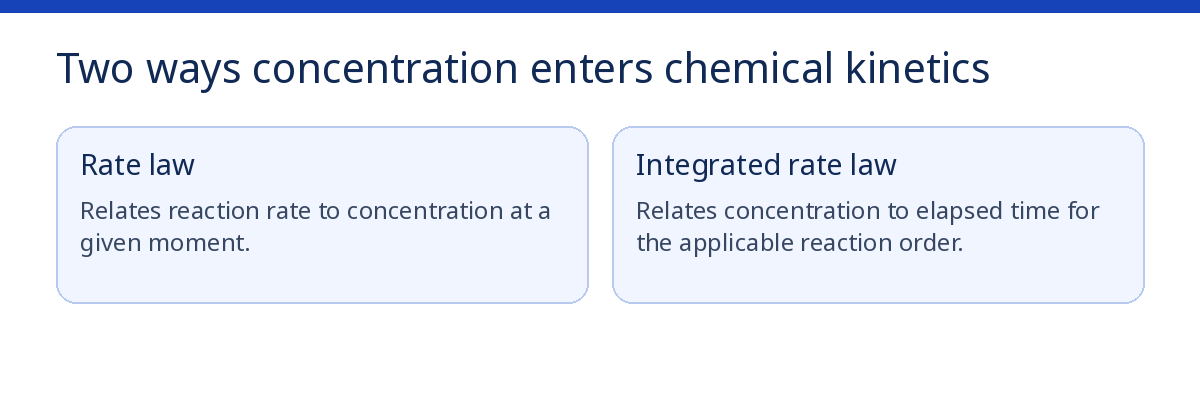
The kinetics material tests two different uses of concentration. A rate law relates the reaction rate to concentration at a given moment. An integrated rate law relates concentration to elapsed time. Before choosing an equation, ask whether the prompt gives a change in concentration and asks about rate, or gives time data and asks how much reactant remains.
Units and graph labels provide separate checks. The units of the rate constant depend on the overall order because the rate law must have the dimensions of concentration per unit time. For a graph, read the vertical axis before interpreting the slope: reversing the numerator and denominator of a logarithmic concentration ratio reverses the sign. Use a half-life relation only after establishing the reaction order to which it belongs.
Coordination compounds and the d- and f-block
In coordination chemistry, keep charge bookkeeping separate from orbital filling. Ligand charges and the overall complex charge determine the metal's oxidation state. For an octahedral complex, the resulting d-electron count is only part of the spin argument: whether electrons pair depends on how the octahedral splitting compares with the pairing energy. Also distinguish an ambidentate ligand's two possible donor atoms from simultaneous attachment through both; the term refers to alternative sites of attachment.
The d- and f-block material asks for explanations at different scales. Accessible oxidation states can help explain how a transition-metal catalyst forms intermediates. Lanthanoid contraction, by contrast, is a trend in size associated with poor shielding by 4f electrons. Relating a trend to its cause is more useful than memorising a list of consequences in isolation.
Surface chemistry: distinguish the ion, particle and surface
The surface chemistry material includes colloid behaviour and adsorption. In coagulation, colloidal particles aggregate; the Hardy–Schulze rule concerns the valency of the ion with charge opposite to that of the colloidal particles. Electrophoresis describes a different event: charged particles move through a medium under an electric field. Keeping the particle and the counterion distinct helps you explain which species moves or acts in each case.
For adsorption comparisons, start with the interaction at the surface. Physisorption involves van der Waals forces, whereas chemisorption involves chemical bond formation. That distinction gives you a basis for explaining differences in specificity and possible layer formation, rather than treating each difference as an unrelated fact.
Common mix-ups in electrochemistry
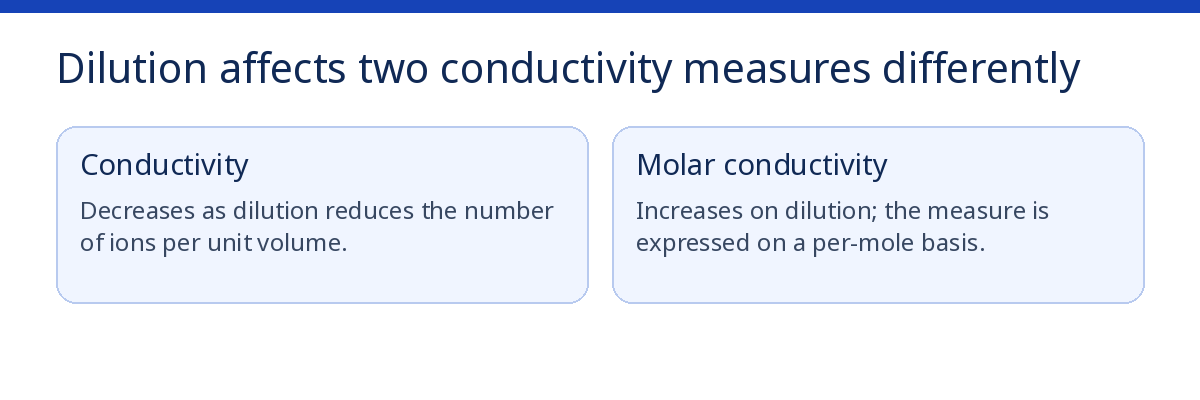
Conductivity and molar conductivity measure different things. Dilution reduces the number of ions per unit volume, so conductivity decreases even though molar conductivity increases. Before using the relation between them, check which quantity is being asked for and whether the concentration units are consistent with the form of the equation.
In a galvanic cell, the salt bridge provides a path for ionic charge compensation, not for electrons. Without that compensation, charge buildup prevents sustained current. A separate point is what zero cell emf means at equilibrium: there is no net progress of the cell reaction, but the ion concentrations need not be equal or zero. Distinguish a statement about the driving force from a statement about the composition.
Use the worked solutions to find your first reasoning gap
For a timed attempt, work from the question pages and follow the printed choices. Save the unused OR branches for a second pass. When reviewing, use the solution labels—formula used, concept used and explanation in steps—to identify where your reasoning first departed from the explanation. That is more useful than checking only whether your final result matches.
If you chose the right equation but mishandled a unit, make the unit check explicit next time. If you had the correct reaction name but could not justify an intermediate, revisit what each reagent changes. Then try the unused branch without looking at its solution: it gives you another chance to make those decisions independently.
Spotted an error? Report a correction. Practise this in the app: notes, formula sheets and mind maps.















































































































































Loading comments…