CBSE Class 12 Chemistry 2022 Term II Paper with Solutions
CBSEChemistry2022 Previous Year Paper
Paper code: 56/3/1 · 2022Practise the full 2022 CBSE Class 12 Chemistry main examination paper (56/3/1) in its original Term II format. Use the worked solutions to check not just your final answers, but also the reaction conditions, formula choices and reasoning behind them.
This set is one of the year's papers. See every set from 2022, grouped by series.
What this year-wise paper contains
This is the English version of the 2022 CBSE Class 12 Chemistry main examination, with an original duration of 2 hours and a maximum of 35 marks. Those details describe the 2022 Term II paper, not the format of a current board exam. The file preserves the original question layout, options and diagrams. Its cover links to the questions, and the worked solutions cover each subpart and both printed OR choices.
The paper brings together organic reactions, electrochemistry, chemical kinetics, transition elements, coordination compounds and surface chemistry. Because it is organised by year rather than chapter, it lets you practise recognising which concept a question calls for without a chapter heading to cue you.

Chemistry 2022 | Class 12 | Previous Year Paper | Code 56/3/1
In the StudentCurio app
Complete 2022 CBSE Class 12 Chemistry main examination paper (Q.P. code 56/3/1) with worked solutions. It covers questions across topics including organic chemistry, electrochemistry, chemical kinetics, transition elements and coordination compounds, helping students practise and review board-exam questions.
Organic chemistry: let the conditions guide you
The organic questions draw on aldehydes, ketones, carboxylic acids and amines. Some ask you to follow a sequence of reactions; others ask you to compare acidity, boiling point or reactivity, or to distinguish functional groups using a chemical test. For a reaction sequence, mark the functional group first, then read the reagent and any separate heating or work-up step. In an aldol reaction, for instance, addition and subsequent dehydration are distinct steps. Do not assume the conditions for the second merely because the first occurs.
For comparisons, match the explanation to the property: conjugate-base stability helps explain acidity, whereas intermolecular association helps explain boiling point. The guide omits a blanket caption in the solutions about retaining carbon skeletons, because whether carbon is lost depends on the transformation.
When the electrochemistry formulas apply
The electrochemistry material tests both explanations and calculations. When comparing how molar conductivity changes on dilution, distinguish a weak electrolyte, whose degree of dissociation increases, from a strong electrolyte, whose ions are already largely dissociated. In the latter case, reduced interactions between ions help explain the rise in molar conductivity. For the cell-reversal question, pay attention to both the direction and magnitude of the applied voltage: it must oppose and exceed the cell emf to drive the reverse reaction.
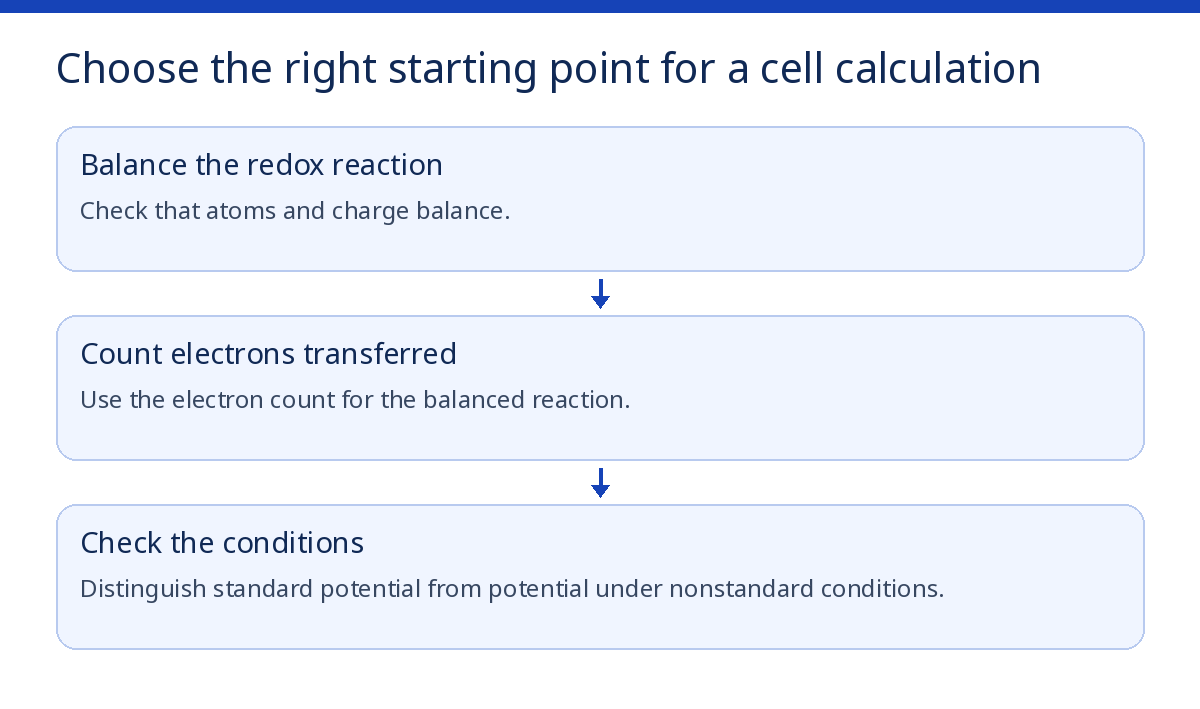
In a calculation, balance the redox reaction before deciding the electron-transfer number, . The relation uses the standard cell potential. If the conditions are nonstandard, use the reaction quotient in the Nernst equation to find the cell potential; the familiar base-ten coefficient of applies at .
From d-electron counts to coordination compounds
In the transition-element questions, electron configuration is a starting point, not an explanation by itself. Use it to connect an incomplete d subshell with transition-element classification, or to explain whether a d–d transition is possible. For an oxidation-state comparison, identify the species being compared and consider the relative stability of their configurations. Alloy formation calls for a different argument: atoms of similar size can substitute for one another in a metallic lattice.
For coordination compounds, start by distinguishing ligands inside the brackets from counterions outside. The charges of the coordinated ligands and the net charge of the complex determine the metal's oxidation state. When reasoning about unpaired electrons, also consider ligand strength; when counting ions on dissociation, keep the complex ion intact rather than counting its ligands as separate ions.
Common mix-ups in surface chemistry
The surface chemistry alternatives cover adsorption, types of colloids and colloidal stability. Adsorption means accumulation at a surface; absorption involves uptake into the bulk. For colloids, affinity for the dispersion medium distinguishes lyophilic from lyophobic systems. That is a different classification from asking whether each colloidal particle is an aggregate of smaller units or an individual large molecule.
Keep the language of colloidal charge and stability precise. Preferential adsorption of ions can give a colloidal particle a charge. Zeta potential, however, is the electric potential at the slipping plane relative to the bulk liquid, not simply the charge on the particle. Coagulation is the aggregation that follows destabilisation of the dispersed particles.
Quick self-check: order or molecularity?
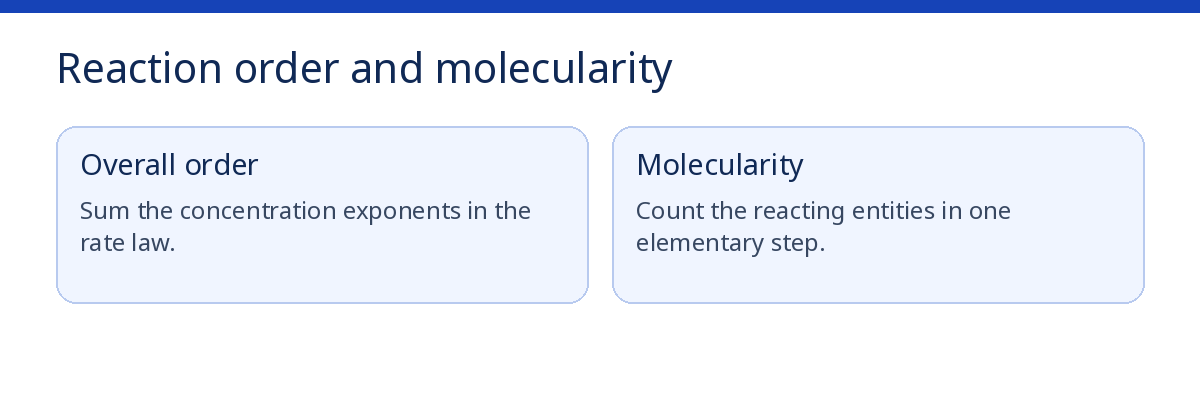
Before working through the kinetics calculations, ask yourself where the information about order comes from. Overall order comes from adding the concentration exponents in the rate law, not from reading the coefficients of an overall balanced equation. Molecularity describes an elementary step, so it is not assigned to an entire multistep reaction. The paper also connects temperature and the rate constant through the Arrhenius equation: for positive activation energy, increasing temperature increases the rate constant.
Before using , check that the process follows first-order kinetics. In an elapsed-time calculation, use the amount remaining, not the amount consumed, when the equation calls for the quantity left. Check that the time unit matches the inverse time unit of the rate constant.
How to review your attempt with the worked solutions
For a timed attempt, follow the printed instructions and leave the solutions closed. Make your OR choices as you go. Afterwards, use the unattempted alternatives as separate practice: the file includes worked solutions for them even though you would not write both in a timed attempt.
When reviewing, look for the first point where your reasoning diverged from the explanation. For a calculation, that might be the balanced reaction or the choice of formula rather than the arithmetic. For an organic reaction, check whether you missed a stated condition; for a comparison, check whether your reason actually explains the property asked about. Then retry that part without the solution. This makes the review a test of whether you can reconstruct the reasoning, not just recognise the final answer.
Spotted an error? Report a correction. Practise this in the app: notes, formula sheets and mind maps.















































































































































Loading comments…