CBSE Class 12 Chemistry 2022 Solved Board Paper (56/3/2)
CBSEChemistry2022 Previous Year Paper
Paper code: 56/3/2 · 2022Practise the full 2022 CBSE Class 12 Chemistry main examination paper in its original Term II format. Use the step-by-step solutions to check not only your final answers but also the chemical reasoning, formula choices and conditions behind them.
This set is one of the year's papers. See every set from 2022, grouped by series.
What this 2022 Term II paper contains
This year-wise resource is the English version of paper 56/3/2, with a time limit of 2 hours and a maximum of 35 marks. Those details describe this particular 2022 Term II paper, not the format of a current CBSE Chemistry exam. The file preserves the original question layout, options and diagrams and includes worked solutions for the questions, subparts and printed alternatives.
The paper brings organic, inorganic and physical chemistry together. Its solutions label the concept, the formula or relationship used, and the explanation in steps. That structure is useful when your work goes wrong before the calculation: you can tell whether you chose the wrong principle or chose the right one and applied it incorrectly.

Chemistry 2022 | Class 12 | Previous Year Paper | Code 56/3/2
In the StudentCurio app
A solved CBSE Class 12 Chemistry main examination paper covering topics including amines, coordination compounds, electrochemistry, chemical kinetics, transition elements, organic chemistry and colloids. Useful for practising board-exam questions and reviewing worked solutions across chapters.
Organic chemistry: identify what controls the reaction
The organic questions ask you to reason from structures, reagents and conditions. In nucleophilic addition to a carbonyl group, consider both how readily the nucleophile can approach the carbonyl carbon and how electrophilic that carbon is. Steric crowding and electron donation both matter in the comparisons covered here. For carboxylic acid strength, ask a different question: how stable is the conjugate base after the acid loses a proton? Electron withdrawal can stabilise the carboxylate and increase acidity. Do not substitute either explanation for the intermolecular hydrogen bonding used in boiling-point comparisons.
The amine questions show why identifying the reacting species matters. Aniline in a strongly acidic mixture is not necessarily reacting as the neutral molecule you first drew: protonation changes the nitrogen group’s effect on the ring. In reaction sequences, use the printed reagent and conditions to identify the transformation before naming a product. Where an amide undergoes a Hofmann rearrangement, check the carbon count rather than assuming the skeleton is unchanged.
Inorganic chemistry: account for charge before using electron count
The coordination questions distinguish tasks that can look similar on the page: assigning a metal oxidation state, naming ligands, explaining magnetic behaviour and counting ions on dissociation. Start by separating the species inside the coordination brackets from the counterions outside. For a magnetic explanation, determine the metal’s electron count and consider ligand strength before deciding whether electrons pair. For dissociation, treat the bracketed complex as a unit rather than counting its coordinated ligands as separate ions.
The transition-element questions also use electron configuration, but for different purposes. To explain colour through a d–d transition, check whether the configuration permits that type of excitation; a ion cannot show colour by that mechanism. For lanthanoid contraction, the reasoning instead connects poor shielding by electrons with increasing effective nuclear attraction and decreasing radii across the series.
When the electrochemistry formulas apply
Conductivity is not the same as conductance. For a cell with electrode separation and cross-sectional area , conductivity equals conductance multiplied by . The distinction matters on dilution: the number of charge carriers per unit volume falls, so conductivity decreases even though ionic mobility can improve and a weak electrolyte can dissociate to a greater extent.
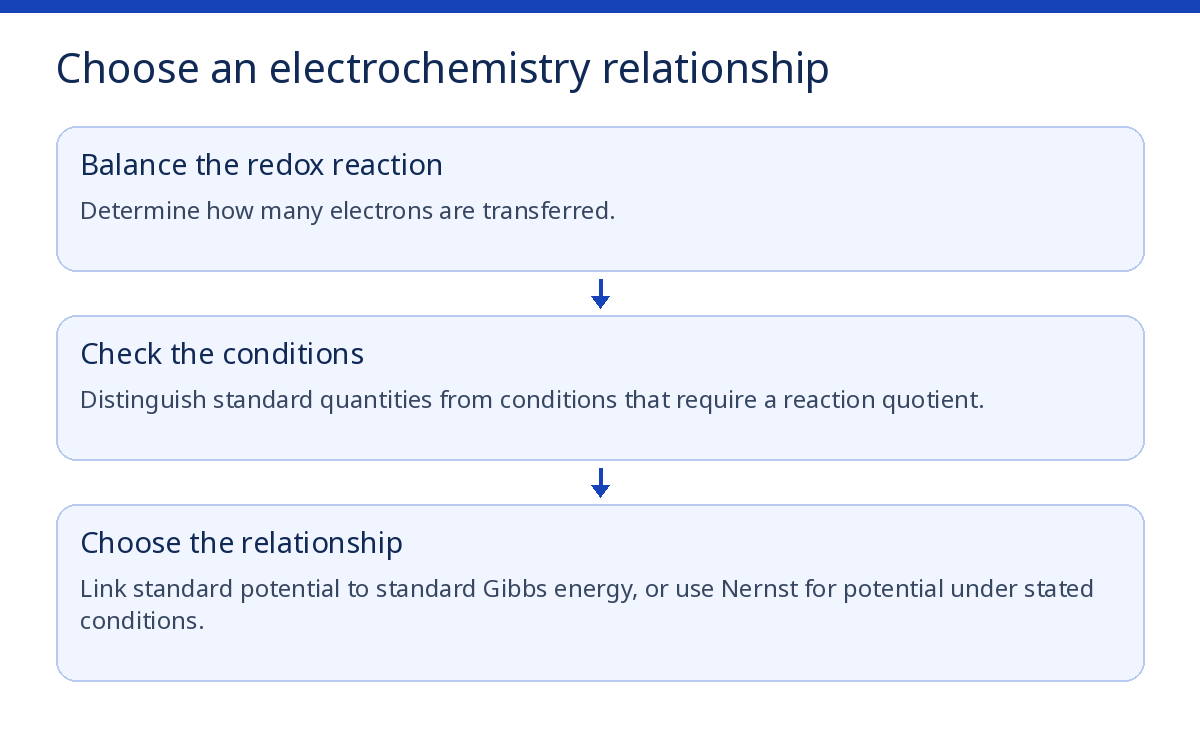
In cell calculations, start with the balanced redox reaction so that the electron-transfer number matches the reaction as written. Use for standard quantities. If the given conditions are nonstandard, the Nernst equation uses the reaction quotient to relate the actual cell potential to the standard potential. The numerical coefficient in the base-ten logarithm form applies at approximately ; it is not a temperature-independent constant.
Kinetics: choose the rule that matches the rate law
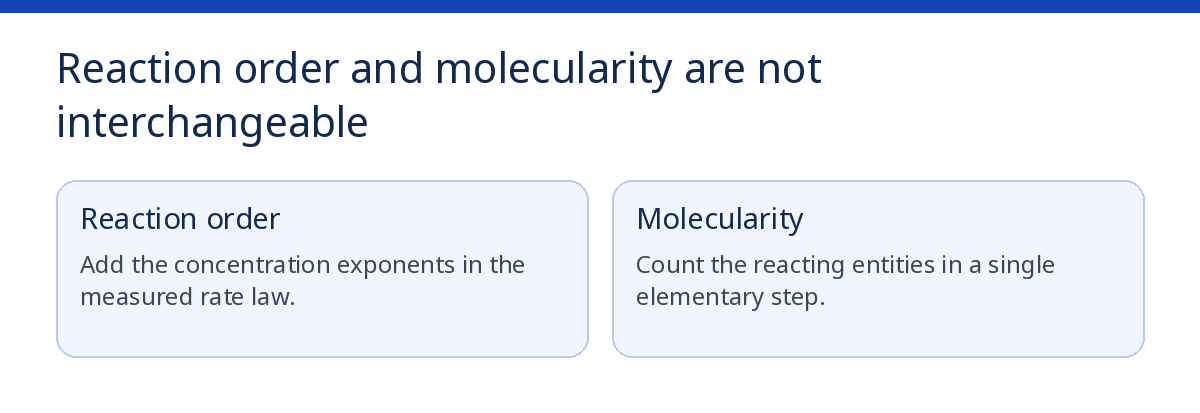
Reaction order comes from the exponents in the experimentally determined rate law, not from the coefficients of the overall balanced equation. Molecularity describes an elementary step; it is not assigned to an overall multistep reaction. When reviewing a definition or justification, make clear which of those two levels you are describing.
The integrated rate equation and half-life relation used for first-order processes apply only once first-order behaviour is established. In a decay calculation, distinguish the amount remaining from the amount lost, and keep the time unit consistent with the unit of the rate constant. The Arrhenius question asks about a different relationship: for positive activation energy, increasing temperature increases the rate constant.
Colloids: distinguish surface behaviour from bulk behaviour
In the colloid questions, adsorption means accumulation at a surface, whereas absorption involves entry into the bulk. Keep classification criteria separate, too: lyophilic and lyophobic describe affinity for the dispersion medium, while multimolecular and macromolecular describe what constitutes the dispersed particles. In the alternative on colloidal stability, zeta potential refers to electrical potential at the slipping plane relative to the bulk liquid; coagulation is aggregation after destabilisation. A useful check is to ask whether your answer describes where something happens, what the particles consist of, or how the dispersion behaves.
Review your attempt before opening the worked steps
For a timed attempt, use the original two-hour limit and follow the printed choices. Afterwards, review the unattempted alternatives separately: they offer practice in the same paper without changing the conditions of your timed attempt. When checking a response, locate the first point at which your reasoning diverged from the worked explanation. Was it a missed condition, an incorrect reading of a structure, or a slip after a sound setup? Then retry from that point without looking at the remaining steps.
For reaction review, this guide omits the solution page’s blanket note about retained carbon skeletons because it does not apply to the decarboxylation discussed on that page.
Spotted an error? Report a correction. Practise this in the app: notes, formula sheets and mind maps.















































































































































Loading comments…