CBSE Class 12 Chemistry 2022 Term II Solved Paper
CBSEChemistry2022 Previous Year Paper
Paper code: 56/3/3 · 2022Use the full CBSE Class 12 Chemistry 2022 Term II main board paper to practise under its original time limit. Then use the worked solutions to check whether your reasoning matches the reaction conditions, definitions and assumptions in each question.
This set is one of the year's papers. See every set from 2022, grouped by series.
How to attempt the 2022 Term II paper
This English-language, year-wise previous paper is from the 2022 CBSE Class 12 Chemistry main examination, paper code 56/3/3. It carries 35 marks and allows two hours. The file preserves the original English question layout, options and diagrams. Treat the time and marks as features of this historical Term II paper, not as a guide to the format of another year's exam.
Try the question pages before opening the solutions. Follow the printed OR choices in a timed attempt; afterwards, use the worked solutions for both alternatives to see what the branch you skipped tests. The question-number links take you to explanations that separate the formula or reaction from the concept and the steps. When your response differs, compare those parts in order to find the first point where your reasoning diverged.

Chemistry 2022 | Class 12 | Previous Year Paper | Code 56/3/3
In the StudentCurio app
Complete solved CBSE Class 12 Chemistry main examination paper for 2022 (Term II), with worked answers across topics including amines, carbonyl compounds, colloids, transition elements, coordination compounds, electrochemistry and chemical kinetics. It helps students practise board questions and review solution methods.
Organic chemistry: read the reagent and medium together
The organic questions cover amine preparation and reactivity, transformations of aldehydes and ketones, and comparisons involving carboxylic acids. Start by identifying the functional group, then read the reagent alongside any stated medium, heating or work-up. For amines, check whether the nitrogen is in its neutral or protonated form before reasoning about aromatic substitution. Strongly acidic conditions can change the form present and therefore change the directing behaviour.
For carbonyl compounds, distinguish aldol addition, which forms a hydroxy carbonyl compound, from aldol condensation, which includes dehydration. This guide omits a definitive product assignment for the crossed-aldol item: the worked solution discusses both stages because the printed conditions do not explicitly include heat. In comparison questions, match the explanation to the property: conjugate-base stabilization explains an acidity trend, while intermolecular association helps explain a boiling-point trend.
Transition metals and complexes: start with electron count
The paper distinguishes a transition element from an element that simply belongs to the d-block. The classification depends on whether the atom or a common ion has an incomplete d subshell. The paper also connects variable oxidation states to the similar energies of the outer s and penultimate d orbitals. Read differences between successive oxidation states as trends rather than fixed intervals that every element must follow.
For coordination compounds, use the ligand charges and the overall complex charge to find the metal's oxidation state before assigning its d-electron count. When reasoning about magnetism, that count is a starting point: you still need to consider whether electrons are paired. For structure and naming, pay attention to how each ligand binds. Denticity counts donor atoms from one ligand, not the ligands themselves; a bidentate ligand uses two donor atoms and can form a chelate ring.
Colloids: three distinctions worth keeping separate
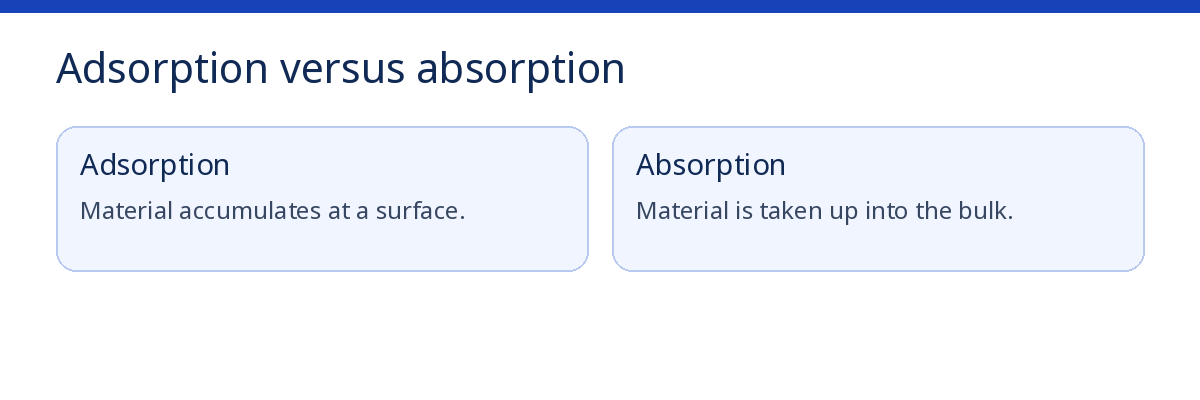
The colloid questions use several pairs of terms, but each pair answers a different question. Adsorption versus absorption concerns where material goes: it accumulates at a surface or is taken up into the bulk. Lyophilic versus lyophobic concerns affinity for the dispersion medium. Multimolecular versus macromolecular concerns what makes up a colloidal particle: an aggregate of smaller units or an individual large molecule of colloidal size.
The worked explanations also distinguish particle charge from zeta potential. Preferential adsorption of ions can charge the dispersed particles, but zeta potential refers specifically to the electrical potential at the slipping plane relative to the bulk liquid, not at the particle surface. Coagulation is a separate idea: it describes particles aggregating when the dispersion is destabilized.
Electrochemistry: when each equation applies
For the conductivity calculation, gives molar conductivity in when conductivity is expressed in and concentration in . The factor of 1000 belongs to that unit convention. For a weak electrolyte, the paper uses the ratio of molar conductivity at the stated concentration to its limiting value to estimate the degree of dissociation. Check which value is the limiting one before forming the ratio.
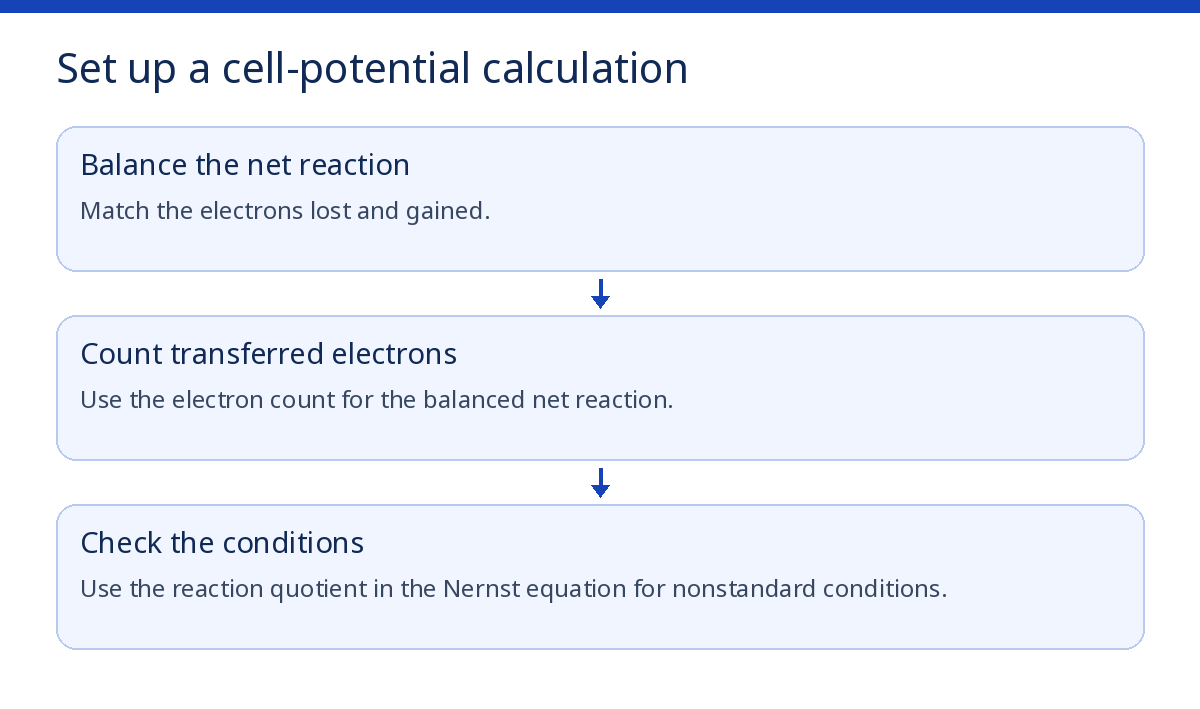
For the cell calculations, balance the net redox reaction before choosing , the number of electrons transferred. Use for the standard Gibbs energy change; the minus sign links a positive standard cell potential to a negative standard Gibbs energy change. For nonstandard conditions, the Nernst equation adjusts the standard potential using the reaction quotient. Its base-ten form with the coefficient applies at 298 K.
Kinetics self-check: what actually requires first order?
The kinetics questions separate order, found from the exponents in the experimentally determined rate law, from molecularity, which applies only to an elementary step. A multistep reaction can have an overall order but not an overall molecularity. Temperature dependence is a different issue: the Arrhenius conclusion that the rate constant increases with temperature assumes a positive activation energy, not a particular reaction order.
Before consulting the worked method, ask what justifies using . The expression requires first-order behaviour. For an integrated first-order calculation, ask whether the stated quantity is the amount remaining or the amount already reacted or decayed. The logarithmic ratio uses the initial amount divided by the amount remaining, expressed in matching units. Finally, check that the time you report matches the inverse-time unit of the rate constant before making any conversion.
Spotted an error? Report a correction. Practise this in the app: notes, formula sheets and mind maps.















































































































































Loading comments…