CBSE Class 12 Chemistry 2022: Solved Term II Board Paper
CBSEChemistry2022 Previous Year Paper
Paper code: 56/2/2 · 2022Practise the full 2022 CBSE Class 12 Chemistry main examination paper, set 56/2/2, in its original Term II format. Then use the worked solutions to check how you chose a method, applied it and explained your reasoning.
This set is one of the year's papers. See every set from 2022, grouped by series.
What this 2022 paper contains
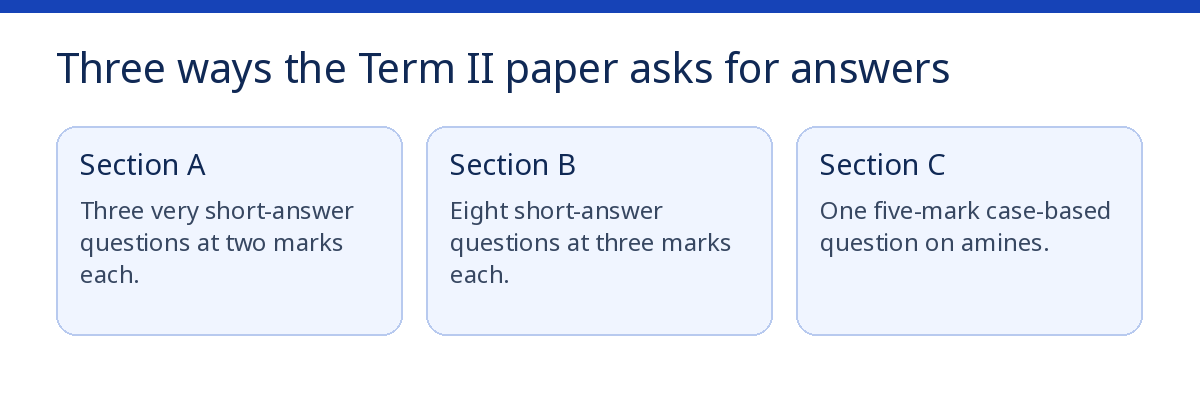
This year-wise resource pairs the English question paper with worked solutions for every question, subpart and printed internal choice. The paper is for 35 marks, with two hours of writing time and a separate 15-minute reading period. Section A has three 2-mark very short-answer questions, Section B has eight 3-mark short-answer questions, and Section C has one 5-mark case-based question. These timings and sections describe the 2022 Term II paper, not a template for later CBSE exams.
For a timed attempt, use the reading period to spot internal choices and prompts that ask for only a specified number of responses. All 12 numbered questions are compulsory, but that does not mean answering both branches of an OR. The paper does not allow calculators or log tables; use the logarithm values supplied in the relevant questions.

Chemistry 2022 | Class 12 | Previous Year Paper | Code 56/2/2
In the StudentCurio app
A solved CBSE Class 12 Chemistry main examination paper from 2022, covering topics including electrochemistry, chemical kinetics, coordination compounds, transition elements, aldehydes and ketones, and amines. It helps students practise previous-paper questions and review worked answers.
Electrochemistry: quantities and conditions
The electrochemistry questions ask for two different kinds of reasoning. The molar conductivity question asks you to define a quantity and explain its concentration dependence. Distinguish conductivity, a property of the solution, from molar conductivity, which accounts for how much electrolyte is present per unit volume. The factor of 1000 in the file's conversion applies when conductivity is in siemens per centimetre and concentration in moles per litre, giving molar conductivity in siemens square centimetres per mole. It is not part of the definition when units are already consistent.
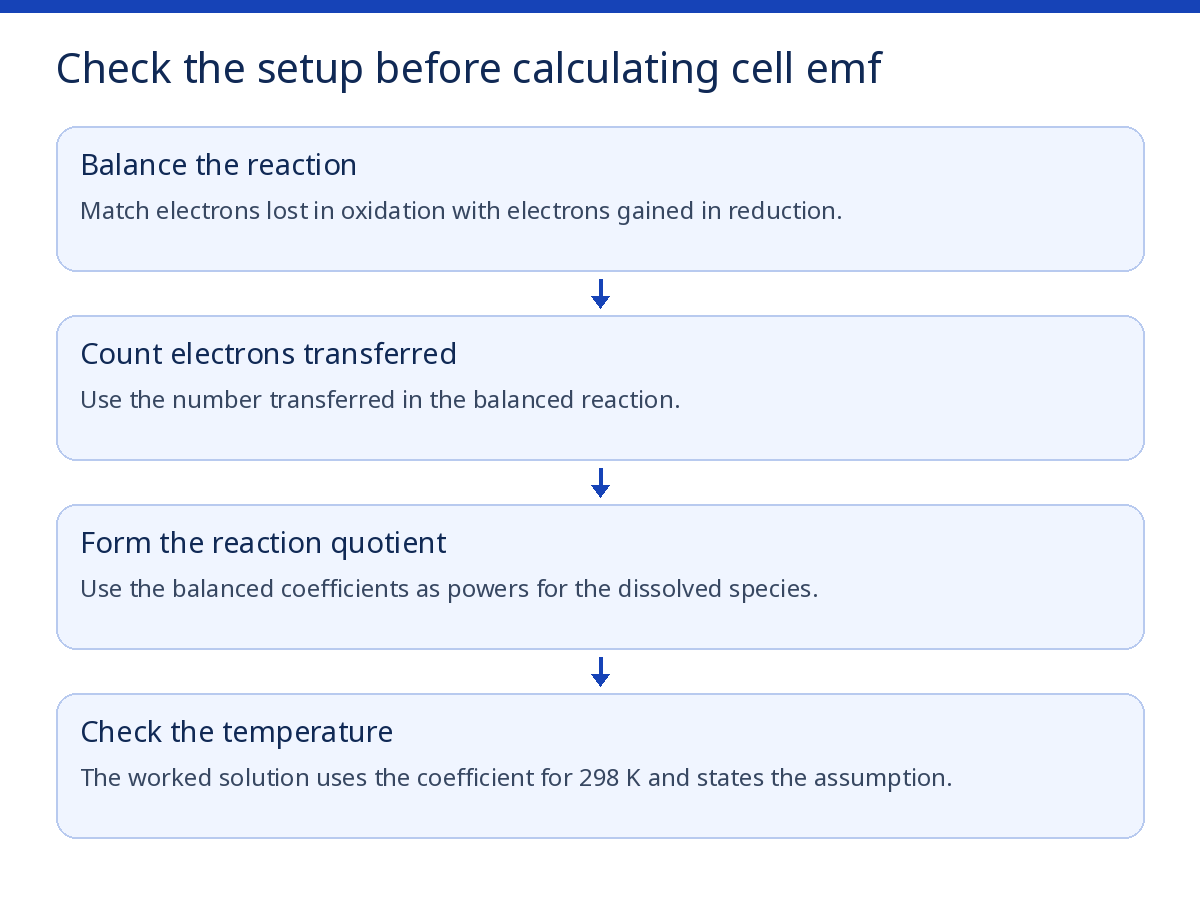
The cell question instead requires you to distinguish standard cell potential from the potential at the stated concentrations. Balance the redox reaction before deciding how many electrons are transferred and which powers belong in the reaction quotient. The worked solution uses the numerical Nernst coefficient for 298 K and identifies that temperature as an assumption, not a value printed in the question.
Common mix-ups: reaction rate and half-life
The kinetics questions distinguish a species' rate of formation or disappearance from the rate of the reaction. A reactant's concentration change is negative over an interval in which it is consumed, even though its rate of disappearance is reported as positive. The reaction rate also accounts for stoichiometric coefficients. When reviewing your attempt, check what rate your line of working represents before checking the arithmetic, and make sure the time unit matches the interval you used.
The half-life question calls for a different decision: identify the stated reaction order before choosing a time relation. For first-order kinetics with a fixed rate constant, successive half-lives are equal. If a question states the percentage decomposed, the integrated rate law uses the concentration remaining, not the amount lost. Both checks help you catch a setup error before evaluating any logarithms.
From transition elements to coordination compounds
The transition-elements questions ask you to connect observed properties to explanations, including electronic configurations, catalytic behaviour and atomic radii. The standard electrode potential comparison adds another distinction: the values reflect several energy changes, including atomisation, ionisation and hydration. A trend in just one of those terms is not enough to explain the full comparison.
For coordination compounds, separate the metal's oxidation state and electron count from the effect of the ligands on pairing. That distinction matters when a prompt asks for both hybridisation and magnetic character: the latter should agree with the presence or absence of unpaired electrons. Nomenclature and ligand definitions demand a different kind of precision. An ambidentate ligand offers alternative donor atoms and normally binds through one at a time; a bidentate ligand uses two donor atoms simultaneously.
Surface chemistry and organic reaction choices
The surface chemistry question offers a comparison of lyophilic and lyophobic sols on one branch and shorter explanations about colloids and adsorption on the other. If you attempt the comparison, pair each feature across the two types, such as affinity for the dispersion medium or resistance to coagulation. For adsorption, distinguish a change in the equilibrium amount adsorbed from a claim about how fast equilibrium is reached.
The organic questions move between product prediction, named reactions, acidity comparisons and tests that distinguish compounds. Match your answer to the task: an equation needs the relevant reagents and conditions, while a distinguishing test needs an observable result. When revisiting named reactions, look for the structural condition that makes the reaction possible. In an aldol reaction, for example, the carbonyl compound acting as the enolate donor must have an alpha hydrogen.
Reading the amines case as chemistry
The final case-based question uses a passage on amines to set up tasks on aromatic reactivity, basicity, identification tests and multistep conversions. Read each prompt for its requested output before returning to the passage. An order of basicity, an experimental distinction and a sequence of structures are different answers, even if they draw on some of the same ideas.
For basicity, keep the direction of the scale straight: a lower corresponds to a stronger base under comparable conditions. For conversions, track the functional group after each reagent rather than jumping straight from the starting compound to the target. This makes it easier to see where a later step depends on the structure produced by an earlier one.
After the attempt: find the first missed step
Use the solution pages in order: compare the concept first, then the formula or reaction, and finally the worked steps. In a numerical question, locate the first line where your setup diverges. In an explanation question, check whether you gave the chemical reason or merely restated the observation. Reattempt an unused OR branch later as a separate exercise rather than adding it to your timed attempt.
The extracted text of one surface-chemistry subpart is incomplete, so its exact wording is omitted here. Use the question page in the file for that wording.
Spotted an error? Report a correction. Practise this in the app: notes, formula sheets and mind maps.















































































































































Loading comments…